Molecular Biology Institute, University of California Los Angeles, Los Angeles, California, USA.
Department of Microbiology, Immunology, and Molecular Genetics, University of California, Los Angeles, California, USA.
J Virol. 2018 Aug 29;92(18). doi: 10.1128/JVI.00805-18. Print 2018 Sep 15.
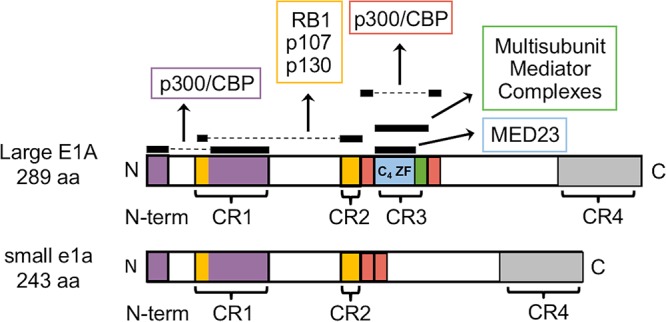
How histone acetylation promotes transcription is not clearly understood. Here, we confirm an interaction between p300 and the adenovirus 2 large E1A activation domain (AD) and map the interacting regions in E1A by observing colocalization at an integrated array of fusions of LacI-mCherry to E1A fragments with YFP-p300. Viruses with mutations in E1A subdomains were constructed and analyzed for kinetics of early viral RNA expression and association of acetylated H3K9, K18, K27, TBP, and RNA polymerase II (Pol II) across the viral genome. The results indicate that this E1A interaction with p300 is required for H3K18 and H3K27 acetylation at the E2early, E3, and E4 promoters and is required for TBP and Pol II association with the E2early promoter. In contrast, H3K18/27 acetylation was not required for TBP and Pol II association with the E3 and E4 promoters but was required for E4 transcription at a step subsequent to Pol II preinitiation complex assembly. Despite a wealth of data associating promoter and enhancer region histone N-terminal tail lysine acetylation with transcriptional activity, there are relatively few examples of studies that establish causation between these histone posttranslational modifications and transcription. While hypoacetylation of histone H3 lysines 18 and 27 is associated with repression, the step(s) in the overall process of transcription that is blocked at a hypoacetylated promoter is not clearly established in most instances. Studies presented here confirm that the adenovirus 2 large E1A protein activation domain interacts with p300, as reported previously (P. Pelka, J. N. G. Ablack, J. Torchia, A. S. Turnell, R. J. A. Grand, J. S. Mymryk, Nucleic Acids Res 1095-1106, 2009, https://doi.org/10.1093/nar/gkn1057), and that the resulting acetylation of H3K18/27 affects varied steps in transcription at different viral promoters.
组蛋白乙酰化如何促进转录尚不清楚。在这里,我们通过观察 LacI-mCherry 与 E1A 片段的融合与 YFP-p300 的共定位,证实了 p300 与腺病毒 2 大 E1A 激活域(AD)之间的相互作用,并绘制了 E1A 中的相互作用区域。构建了具有 E1A 亚结构域突变的病毒,并分析了早期病毒 RNA 表达的动力学以及乙酰化 H3K9、K18、K27、TBP 和 RNA 聚合酶 II(Pol II)在整个病毒基因组上的结合情况。结果表明,E1A 与 p300 的这种相互作用对于 E2 早期、E3 和 E4 启动子处的 H3K18 和 H3K27 乙酰化以及 TBP 和 Pol II 与 E2 早期启动子的结合是必需的。相比之下,H3K18/27 乙酰化对于 TBP 和 Pol II 与 E3 和 E4 启动子的结合不是必需的,但对于 Pol II 起始前复合物组装后 E4 转录是必需的。尽管有大量数据将启动子和增强子区域组蛋白 N 端尾巴赖氨酸乙酰化与转录活性相关联,但在大多数情况下,与这些组蛋白翻译后修饰和转录之间建立因果关系的研究相对较少。尽管组蛋白 H3 赖氨酸 18 和 27 的低乙酰化与抑制相关,但在大多数情况下,在低乙酰化启动子处受阻的转录总体过程中的步骤尚不清楚。本文提供的研究证实,腺病毒 2 大 E1A 蛋白激活域与 p300 相互作用,如之前报道的(P. Pelka、J. N. G. Ablack、J. Torchia、A. S. Turnell、R. J. A. Grand、J. S. Mymryk,Nucleic Acids Res 1095-1106,2009,https://doi.org/10.1093/nar/gkn1057),并且由此产生的 H3K18/27 乙酰化影响不同病毒启动子处转录的不同步骤。