Biomedical Research Institute, National Institute of Advanced Industrial Science and Technology, 1-8-31, Midorioka, Ikeda, Osaka, 563-8577, Japan.
Animal Breeding and Reproduction Research Division, National Agriculture and Food Research Organization, Institute of Livestock and Grassland Science, 2 Ikenodai, Tsukuba, Ibaraki, 305-0901, Japan.
Sci Rep. 2018 Jul 5;8(1):10203. doi: 10.1038/s41598-018-28438-2.
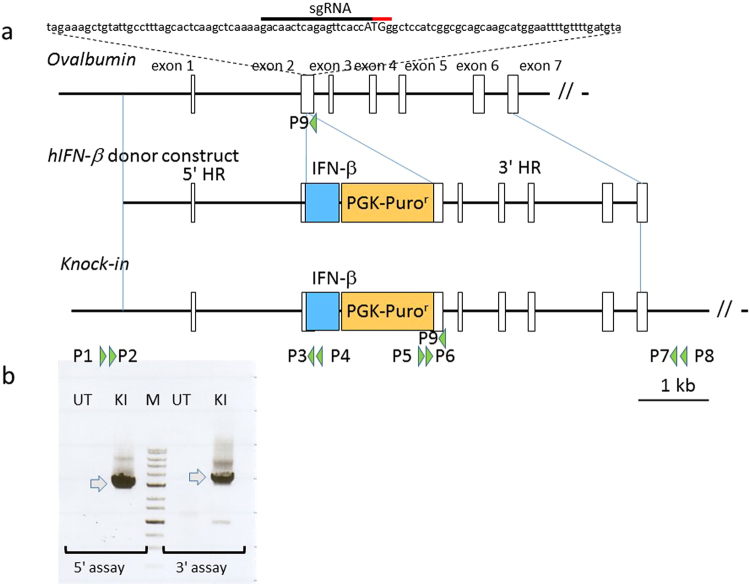
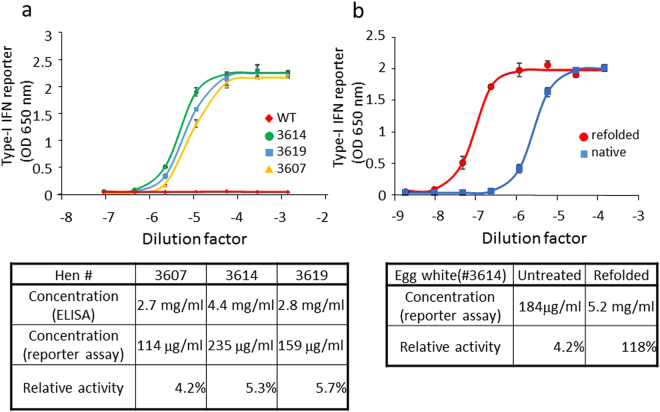
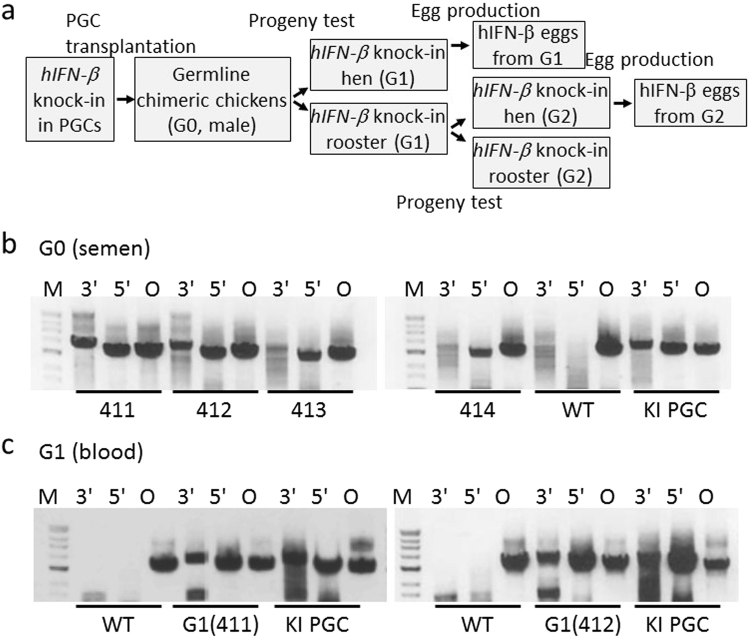
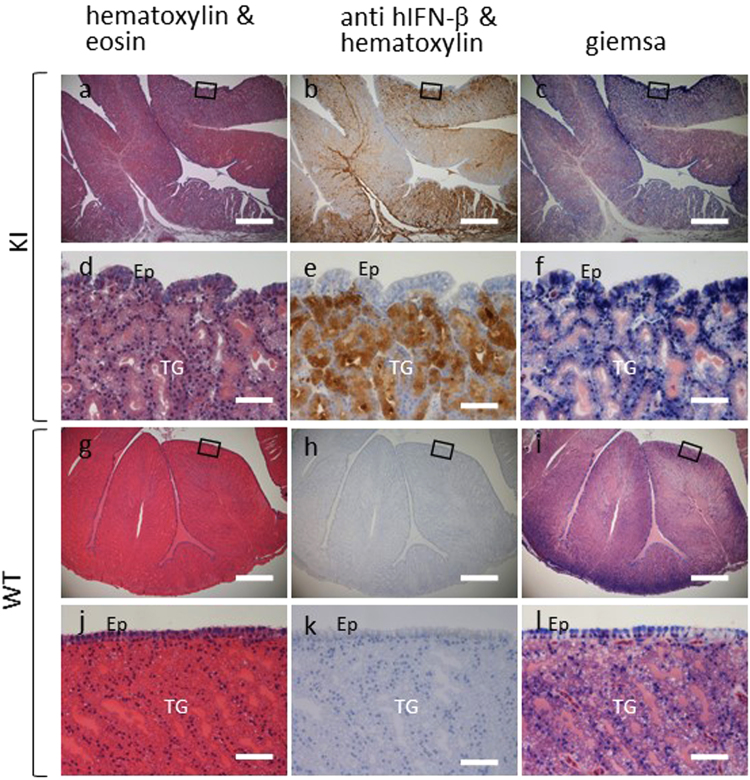
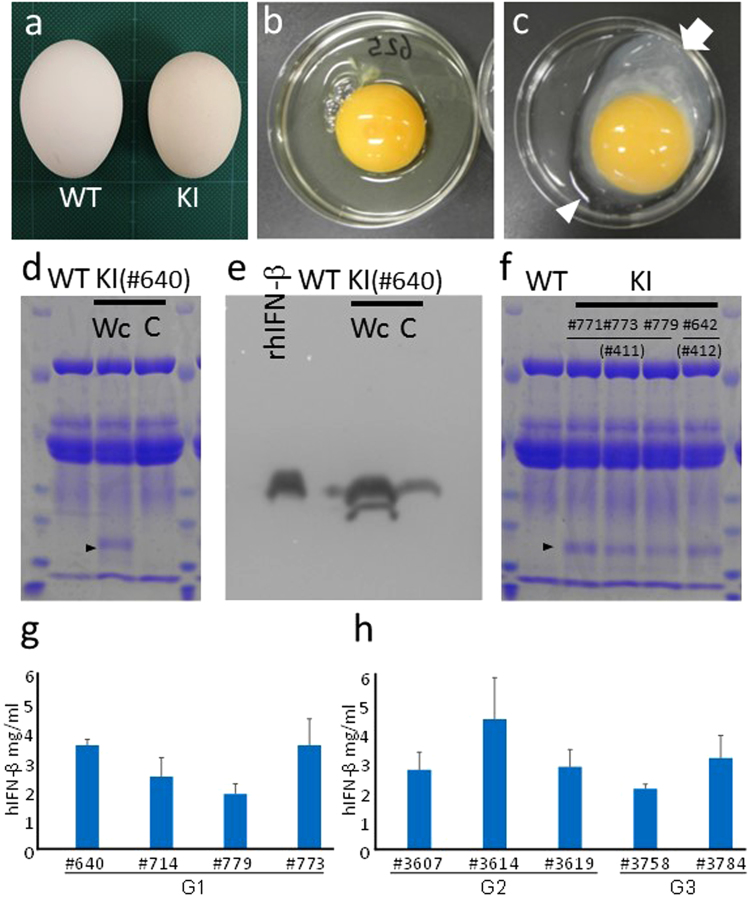
Transgenic chickens could potentially serve as bioreactors for commercial production of recombinant proteins in egg white. Many transgenic chickens have been generated by randomly integrating viral vectors into their genomes, but transgene expression has proved insufficient and/or limited to the initial cohort. Herein, we demonstrate the feasibility of integrating human interferon beta (hIFN-β) into the chicken ovalbumin locus and producing hIFN-β in egg white. We knocked in hIFN-β into primordial germ cells using a CRISPR/Cas9 protocol and then generated germline chimeric roosters by cell transplantation into recipient embryos. Two generation-zero founder roosters produced hIFN-β knock-in offspring, and all knock-in female offspring produced abundant egg-white hIFN-β (~3.5 mg/ml). Although female offspring of the first generation were sterile, their male counterparts were fertile and produced a second generation of knock-in hens, for which egg-white hIFN-β production was comparable with that of the first generation. The hIFN-β bioactivity represented only ~5% of total egg-white hIFN-β, but unfolding and refolding of hIFN-β in the egg white fully recovered the bioactivity. These results suggest that transgene insertion at the chicken ovalbumin locus can result in abundant and stable expression of an exogenous protein deposited into egg white and should be amenable to industrial applications.
转基因鸡有可能成为在蛋清中商业生产重组蛋白的生物反应器。许多转基因鸡是通过将病毒载体随机整合到它们的基因组中产生的,但转基因的表达被证明是不足的,并且/或者仅限于初始群体。在此,我们证明了将人干扰素-β(hIFN-β)整合到鸡卵清白蛋白基因座并在蛋清中产生 hIFN-β的可行性。我们使用 CRISPR/Cas9 方案将 hIFN-β敲入原始生殖细胞中,然后通过细胞移植到受体胚胎中生成种系嵌合公鸡。两只零代创始公鸡产生了 hIFN-β 敲入后代,所有敲入的雌性后代都产生了大量的蛋清 hIFN-β(~3.5mg/ml)。虽然第一代雌性后代是不育的,但它们的雄性后代是可育的,并产生了第二代敲入母鸡,其蛋清 hIFN-β 的产生与第一代相当。hIFN-β 的生物活性仅占蛋清中总 hIFN-β的约 5%,但 hIFN-β 在蛋清中的展开和重折叠完全恢复了其生物活性。这些结果表明,在鸡卵清白蛋白基因座上的转基因插入可以导致外源蛋白的大量和稳定表达,并沉积在蛋清中,这应该适用于工业应用。