Instituto de Investigaciones Bioquímicas de La Plata (INIBIOLP), CCT La Plata Consejo Nacional de Investigaciones Científicas y Técnicas (CONICET)-Universidad Nacional de La Plata (UNLP), La Plata, 1900, Argentina.
Centro Regional de Estudios Genómicos (CREG), Departamento de Ciencias Biológicas-Facultad de Ciencias Exactas-UNLP, La Plata, 1900, Argentina.
Sci Rep. 2018 Jul 5;8(1):10177. doi: 10.1038/s41598-018-28475-x.
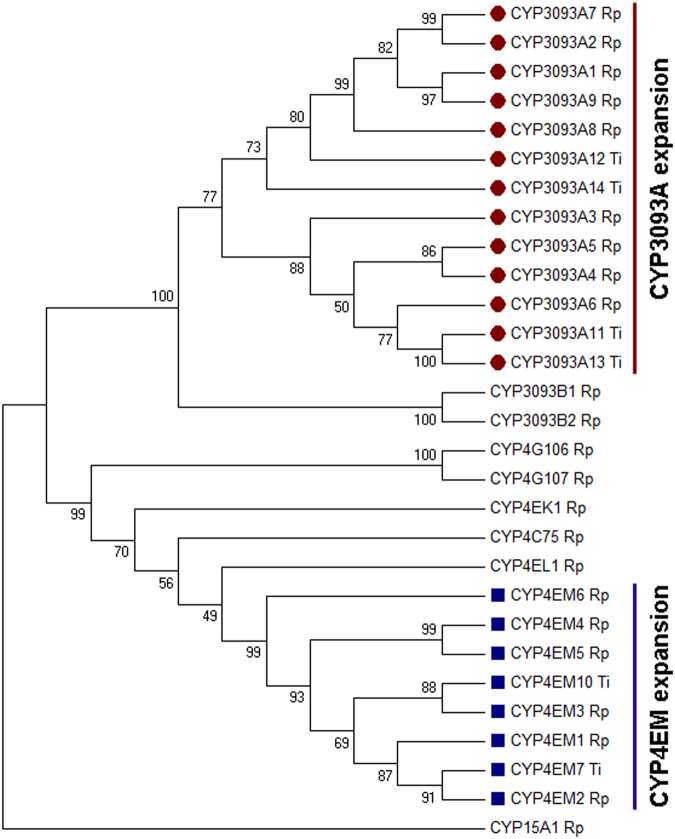
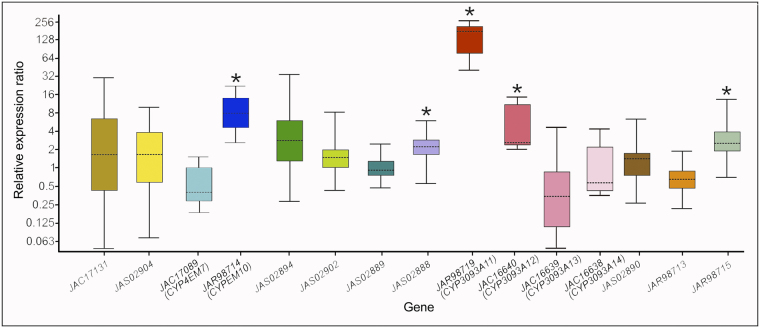
Insect resistance to chemical insecticides is attributed to a combination of different mechanisms, such as metabolic resistance, knockdown resistance, and the cuticular resistance or penetration factor. The insect integument offers an efficient barrier against contact insecticides and its role as penetration factor has been previously reported; however, there is no information about its potential function in the metabolic resistance. Cytochrome P450 genes (CYP) are highly expressed in the fat body of several insects and thus play a key role in their metabolic resistance. Here, we describe new members that belong to the highly genome-wide expanded CYP3093A and CYP4EM subfamilies in the Chagas disease vectors Rhodnius prolixus and Triatoma infestans. We modeled the docking of deltamethrin in their active site and detected differences in some amino acids between both species that are critical for a correct interaction with the substrate. We also knocked down the two constitutively most expressed genes in the integument of resistant T. infestans nymphs (CYP3093A11 and CYP4EM10) in order to find clues on their participation in deltamethrin resistance. This is the first report on the role of the insect integument in detoxification events; although these two CYP genes do not fully explain the resistance observed in T. infestans.
昆虫对化学杀虫剂的抗性归因于多种机制的结合,如代谢抗性、击倒抗性和表皮抗性或穿透因子。昆虫表皮提供了对接触性杀虫剂的有效屏障,其作为穿透因子的作用先前已有报道;然而,关于其在代谢抗性中的潜在功能尚没有信息。细胞色素 P450 基因(CYP)在几种昆虫的脂肪体中高度表达,因此在其代谢抗性中起着关键作用。在这里,我们描述了在恰加斯病传播媒介 R. prolixus 和 T. infestans 中属于高度基因组广泛扩展的 CYP3093A 和 CYP4EM 亚家族的新成员。我们对其活性位点中的溴氰菊酯进行了对接,并检测到两个物种之间一些氨基酸的差异,这些差异对与底物的正确相互作用至关重要。我们还敲低了抗性 T. infestans 若虫表皮中表达最丰富的两种组成型基因(CYP3093A11 和 CYP4EM10),以寻找它们参与溴氰菊酯抗性的线索。这是关于昆虫表皮在解毒事件中的作用的第一个报告;尽管这两个 CYP 基因不能完全解释在 T. infestans 中观察到的抗性。