Tan Bee Ling, Norhaizan Mohd Esa, Chan Lee Chin
Department of Nutrition and Dietetics, Faculty of Medicine and Health Sciences, Universiti Putra Malaysia, 43400 Serdang, Selangor, Malaysia.
Laboratory of Molecular Biomedicine, Institute of Bioscience, Universiti Putra Malaysia, 43400 Serdang, Selangor, Malaysia.
Evid Based Complement Alternat Med. 2018 Jun 6;2018:6578648. doi: 10.1155/2018/6578648. eCollection 2018.
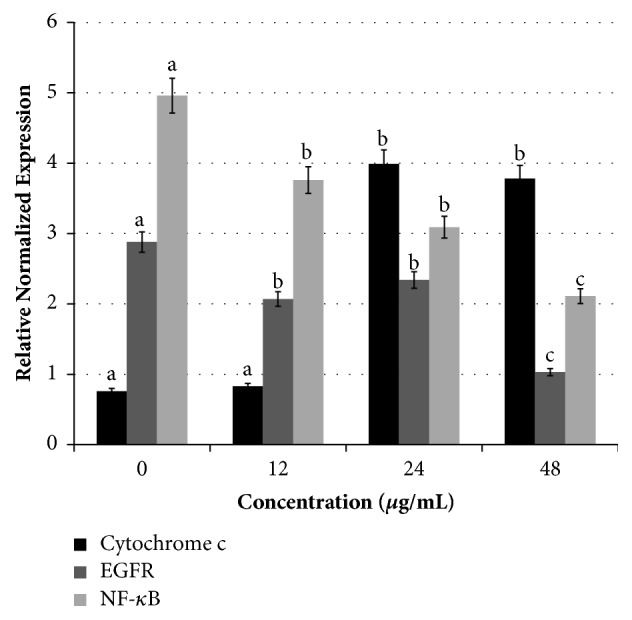
(L.) P. Royen (family: ) is commonly called sapodilla, or locally known as . The detailed mechanisms underlying leaf methanol extract against HeLa human cervical cancer cells have yet to be investigated. Therefore, our present study is designed to investigate the ability to induce apoptosis and the underlying mechanisms of leaf methanol extract inducing cytotoxicity in HeLa cells. The apoptotic cell death was assessed using Annexin V-propidium iodide staining. Intracellular reactive oxygen species (ROS) and mitochondrial membrane potential activities were measured using dichlorodihydrofluorescein diacetate and MitoLite Orange, respectively, by NovoCyte Flow Cytometer. Bax and Bcl-2 expression were evaluated using Enzyme-Linked Immunosorbent Assay. Caspase-3 activity was determined using a colorimetric assay. The associated biological interaction pathways were evaluated using quantitative real-time PCR. Our data showed that HeLa cells were relatively more sensitive to leaf methanol extract than other cancer cell lines studied. Overall analyses revealed that leaf methanol extract can inhibit the viability of HeLa cells, induce mitochondrial ROS generation, and inhibit nuclear factor-kappa B (NF-B) and epidermal growth factor receptor () transcriptional activities. Our results suggested that leaf methanol extract might represent a potential anticervical cancer agent.
(L.)人心果(科属: )通常被称为人心果,在当地也被叫做 。人心果叶甲醇提取物对人宫颈癌HeLa细胞作用的详细机制尚未得到研究。因此,我们目前的研究旨在探究人心果叶甲醇提取物诱导HeLa细胞凋亡的能力及其诱导细胞毒性的潜在机制。使用膜联蛋白V-碘化丙啶染色评估凋亡细胞死亡情况。分别使用二氯二氢荧光素二乙酸酯和MitoLite Orange,通过NovoCyte流式细胞仪测量细胞内活性氧(ROS)和线粒体膜电位活性。使用酶联免疫吸附测定法评估Bax和Bcl-2的表达。使用比色法测定半胱天冬酶-3活性。使用定量实时聚合酶链反应评估相关的生物相互作用途径。我们的数据表明,HeLa细胞对人心果叶甲醇提取物的敏感性相对高于所研究的其他癌细胞系。总体分析显示,人心果叶甲醇提取物可抑制HeLa细胞的活力,诱导线粒体ROS生成,并抑制核因子-κB(NF-κB)和表皮生长因子受体( )的转录活性。我们的结果表明,人心果叶甲醇提取物可能是一种潜在的抗宫颈癌药物。