Agroécologie, AgroSup Dijon, Institut National de la Recherche Agronomique (INRA), Université Bourgogne Franche-Comté, F-21000 Dijon, France.
INRA Orléans, US 1106, Unité INFOSOL, Orléans, France.
Sci Adv. 2018 Jul 4;4(7):eaat1808. doi: 10.1126/sciadv.aat1808. eCollection 2018 Jul.
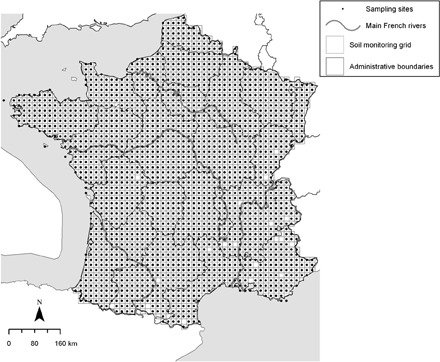
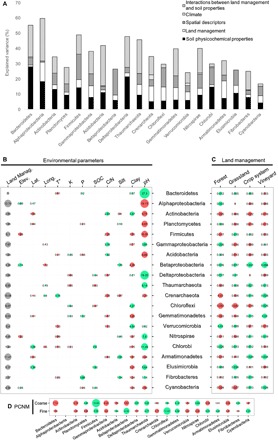
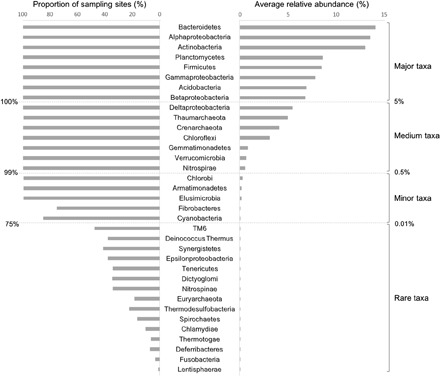
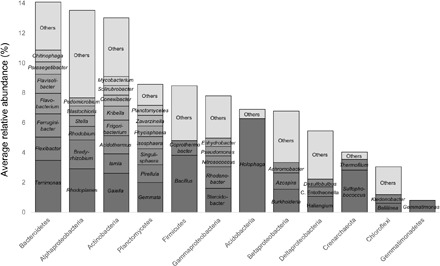
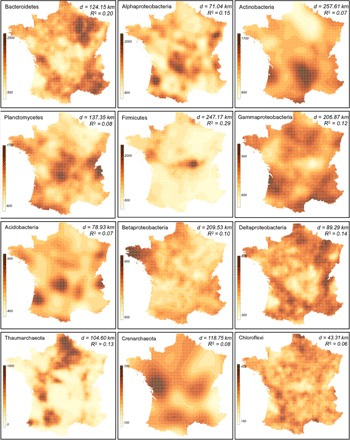
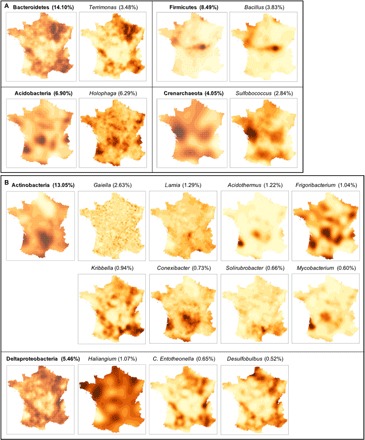
Over the last two decades, a considerable effort has been made to decipher the biogeography of soil microbial communities as a whole, from small to broad scales. In contrast, few studies have focused on the taxonomic groups constituting these communities; thus, our knowledge of their ecological attributes and the drivers determining their composition and distribution is limited. We applied a pyrosequencing approach targeting 16 ribosomal RNA (rRNA) genes in soil DNA to a set of 2173 soil samples from France to reach a comprehensive understanding of the spatial distribution of bacteria and archaea and to identify the ecological processes and environmental drivers involved. Taxonomic assignment of the soil 16 rRNA sequences indicated the presence of 32 bacterial phyla or subphyla and 3 archaeal phyla. Twenty of these 35 phyla were cosmopolitan and abundant, with heterogeneous spatial distributions structured in patches ranging from a 43- to 260-km radius. The hierarchy of the main environmental drivers of phyla distribution was soil pH > land management > soil texture > soil nutrients > climate. At a lower taxonomic level, 47 dominant genera belonging to 12 phyla aggregated 62.1% of the sequences. We also showed that the phylum-level distribution can be determined largely by the distribution of the dominant genus or, alternatively, reflect the combined distribution of all of the phylum members. Together, our study demonstrated that soil bacteria and archaea present highly diverse biogeographical patterns on a nationwide scale and that studies based on intensive and systematic sampling on a wide spatial scale provide a promising contribution for elucidating soil biodiversity determinism.
在过去的二十年中,人们已经付出了相当大的努力来破译土壤微生物群落的生物地理学,从小尺度到广尺度。相比之下,很少有研究关注构成这些群落的分类群;因此,我们对它们的生态属性以及决定其组成和分布的驱动因素的了解是有限的。我们应用靶向土壤 DNA 中 16S rRNA 基因的焦磷酸测序方法对来自法国的 2173 个土壤样本进行了研究,以全面了解细菌和古菌的空间分布,并确定涉及的生态过程和环境驱动因素。土壤 16S rRNA 序列的分类学分配表明存在 32 个细菌门或亚门和 3 个古菌门。在这 35 个门中,有 20 个是世界性的,丰富的,具有不均匀的空间分布,结构为 43-260 公里半径的斑块。门分布的主要环境驱动因素的层次结构为土壤 pH 值>土地管理>土壤质地>土壤养分>气候。在较低的分类学水平上,属于 12 个门的 47 个优势属聚集了 62.1%的序列。我们还表明,门水平的分布可以主要由优势属的分布来决定,或者反映所有门成员的组合分布。总之,我们的研究表明,土壤细菌和古菌在全国范围内呈现出高度多样化的生物地理格局,并且基于广泛空间尺度上的密集和系统采样的研究为阐明土壤生物多样性的决定因素提供了有希望的贡献。