Sung-Man Bae
Department of Psychology and Psychotherapy, College of Health Science, Dankook University, Cheonan, Republic of Korea.
Medicine (Baltimore). 2018 Jul;97(27):e11358. doi: 10.1097/MD.0000000000011358.
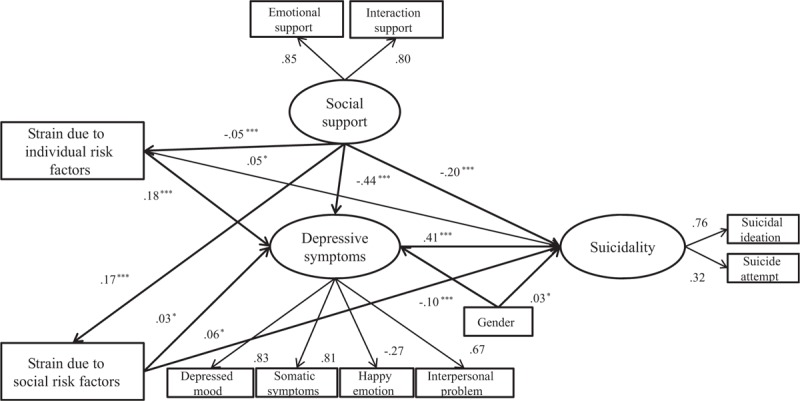
Suicide is the outcome of the interaction of biological, personal, and social risk factors. The purpose of this study was to verify the effects of strain due to individual risk factors and social risk factors on suicidality, and the mediating effect of depressive symptoms in relationship between strain related to individual risk factors and social risk factors and suicidality. The data from sociopsychological anxiety survey of Korea society conducted by the Korea Institute for Health and Social Affairs in 2015 were used in verifying the model. We analyzed the data of 7000 adults aged 19 to 79 years using Structural Equation Modeling. Strain due to individual risk factors was positively related to depressive symptoms and suicidality. Interestingly, strain induced by social risk factors was positively associated with depressive symptoms and suicidality. Social support is significantly associated with depressive symptoms and suicidality. Depressive symptoms directly affected suicidality. In addition, strain due to individual risk factors and social risk factors indirectly affected suicidality mediating depressive symptoms. These findings suggest that not only individual efforts such as social interaction and depression prevention but also government efforts such as preparation for aging may be needed to decrease suicide rate.
自杀是生物、个人和社会风险因素相互作用的结果。本研究的目的是验证个体风险因素和社会风险因素所导致的压力对自杀倾向的影响,以及抑郁症状在个体风险因素和社会风险因素相关压力与自杀倾向之间关系中的中介作用。韩国健康与社会事务研究所于2015年进行的韩国社会社会心理焦虑调查数据被用于验证该模型。我们使用结构方程模型分析了7000名年龄在19至79岁之间成年人的数据。个体风险因素所导致的压力与抑郁症状和自杀倾向呈正相关。有趣的是,社会风险因素所引发的压力与抑郁症状和自杀倾向也呈正相关。社会支持与抑郁症状和自杀倾向显著相关。抑郁症状直接影响自杀倾向。此外,个体风险因素和社会风险因素所导致的压力通过中介抑郁症状间接影响自杀倾向。这些研究结果表明,为降低自杀率,不仅需要诸如社交互动和预防抑郁等个人努力,还需要政府诸如应对老龄化等方面的努力。