Department of Nutrition, School of Public Health, University of Sao Paulo, Sao Paulo, Brazil.
Applied Physiology & Nutrition Research Group, Laboratory of Assessment and Conditioning in Rheumatology, Faculdade de Medicina FMUSP, Universidade de Sao Paulo, Sao Paulo, Brazil.
PLoS One. 2018 Jul 6;13(7):e0198401. doi: 10.1371/journal.pone.0198401. eCollection 2018.
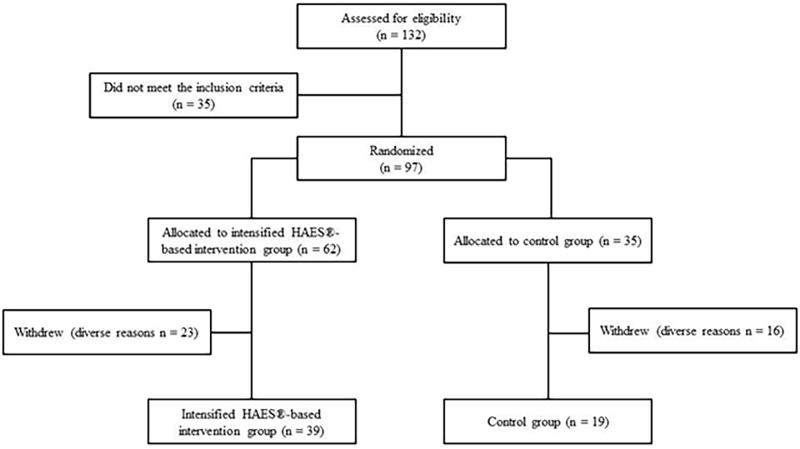
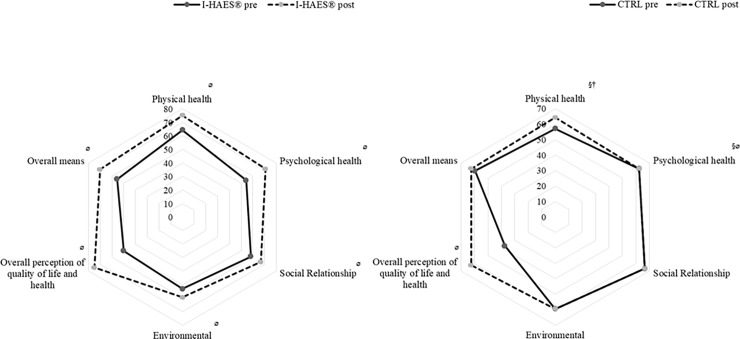
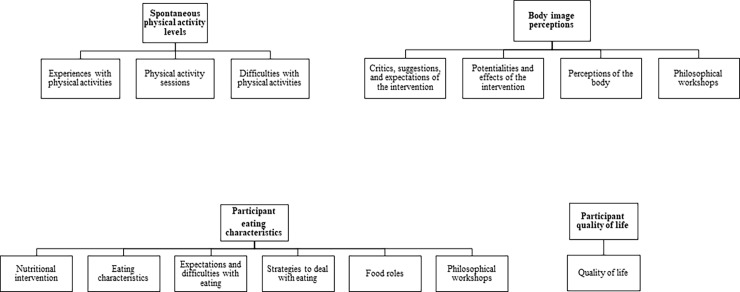
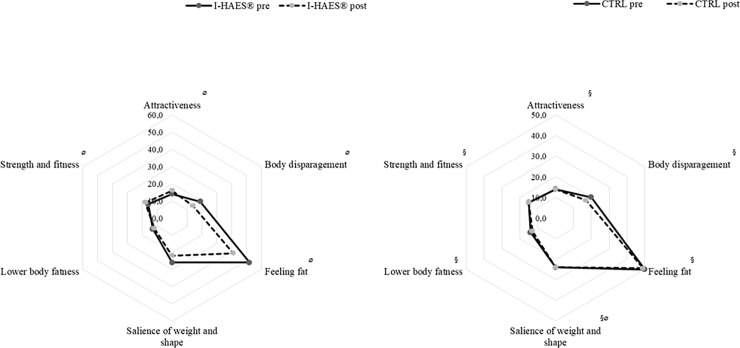
Health at Every Size® (HAES®) is a weight-neutral approach focused on promoting healthy behaviors in people with different body sizes. This study examined multiple physiological, attitudinal, nutritional, and behavioral effects of a newly developed, intensive, interdisciplinary HAES®-based intervention in obese women. This was a prospective, seven-month, randomized (2:1), controlled, mixed-method clinical trial. The intervention group (I-HAES®; n = 39) took part in an intensified HAES®-based intervention comprising a physical activity program, nutrition counseling sessions, and philosophical workshops. The control group (CTRL; n = 19) underwent a traditional HAES®-based intervention. Before and after the interventions, participants were assessed for physiological, psychological, and behavioral parameters (quantitative data) and took part in focus groups (qualitative data). Body weight, body mass index, and waist and hip circumferences did not significantly differ within or between groups (P > 0.05). I-HAES® showed increased peak oxygen uptake and improved performance in the timed-stand test (P = 0.004 and P = 0.004, between-group comparisons). No significant within- or between-group differences were observed for objectively measured physical activity levels, even though the majority of the I-HAES® participants indicated that they were engaged in or had plans to include physical activity in their routines. I-HAES® resulted in improvements in eating attitudes and practices. The I-HAES® group showed significantly improved all Body Attitude Questionnaire subscale and all Figure Rating Scale scores (P ≤ 0.05 for all parameters, within-group comparisons), whereas the CTRL group showed slight or no changes. Both groups had significant improvements in health-related quality of life parameters, although the I-HAES® group had superior gains in the "physical health," "psychological health," and "overall perception of quality of life and health" (P = 0.05, 0.03, and 0.02, respectively, between-group comparisons) domains. Finally, most of the quantitative improvements were explained by qualitative data. Our results show that this new intensified HAES®-based intervention improved participants' eating attitudes and practices, perception of body image, physical capacity, and health-related quality of life despite the lack of changes in body weight and physical activity levels, showing that our novel approach was superior to a traditional HAES®-based program.
健康体型(HAES)是一种体重中立的方法,专注于促进不同体型人群的健康行为。本研究检验了一种新开发的、强化的、跨学科的基于 HAES 的干预措施对肥胖女性的多种生理、态度、营养和行为影响。这是一项前瞻性、七个月、随机(2:1)、对照、混合方法的临床试验。干预组(I-HAES;n=39)参加了强化的基于 HAES 的干预,包括体育活动计划、营养咨询课程和哲学研讨会。对照组(CTRL;n=19)接受了传统的基于 HAES 的干预。在干预前后,参与者接受了生理、心理和行为参数的评估(定量数据)并参加了焦点小组(定性数据)。体重、体重指数和腰围和臀围在组内和组间均无显著差异(P>0.05)。I-HAES 显示最大摄氧量增加,定时站立测试的表现改善(P=0.004 和 P=0.004,组间比较)。虽然大多数 I-HAES 参与者表示他们正在或计划将体育活动纳入日常生活,但客观测量的身体活动水平在组内和组间均无显著差异。I-HAES 导致饮食态度和行为的改善。I-HAES 组的所有身体态度问卷亚量表和所有体型评分量表评分均显著改善(所有参数 P≤0.05,组内比较),而对照组仅略有改善或无变化。两组的健康相关生活质量参数均有显著改善,尽管 I-HAES 组在“身体健康”、“心理健康”和“整体生活质量和健康感知”(P=0.05、0.03 和 0.02,组间比较)领域的获益更优。最后,大多数定量改善都可以用定性数据来解释。我们的结果表明,这种新的强化基于 HAES 的干预措施改善了参与者的饮食态度和行为、身体形象感知、身体能力和健康相关生活质量,尽管体重和身体活动水平没有变化,表明我们的新方法优于传统的基于 HAES 的方案。