James P. Grant School of Public Health, BRAC University, Mohakhali, Dhaka, Bangladesh.
Foundation for Advancement of Innovations in Technology and Health (faith), Dhaka, Bangladesh.
PLoS One. 2018 Jul 6;13(7):e0200122. doi: 10.1371/journal.pone.0200122. eCollection 2018.
Work related Musculoskeletal Disorders (WMSDs) are one of the most common occupational diseases which mainly affects the lower back, neck and upper and lower extremities. The aim of this study was to determine prevalence of WMSDs in nine body regions among Ready Made Garment (RMG) workers in Bangladesh and ergonomics assessment of their exposure to risk factors for the development of WMSDs.
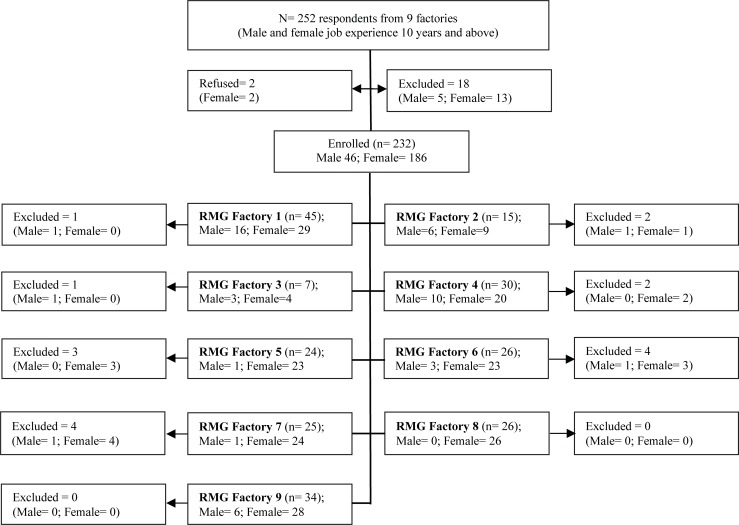
This cross-sectional study was conducted among 232 RMG employees (male: 46; female: 186; age: >18yrs) from nine RMG factories in Dhaka division during October 2015 to February 2016. Data were collected using a structured questionnaire consist of demographic questions, Nordic Musculoskeletal Questionnaire-Extended (NMQ-E) for WMSDs assessment in nine body regions and Quick Exposure Check (QEC) method for ergonomic assessment. Prevalence of WMSDs for each body region was determined. The association between WMSDs and ergonomic assessment of their exposure to risk factors were also analyzed.
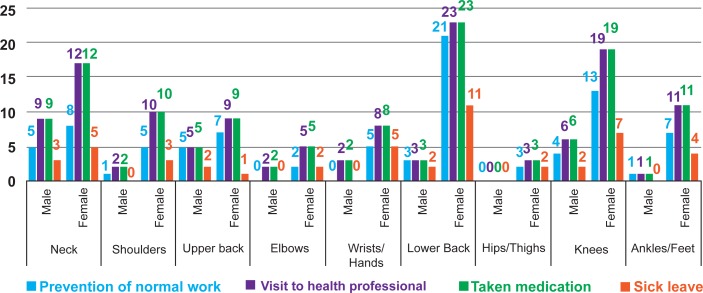
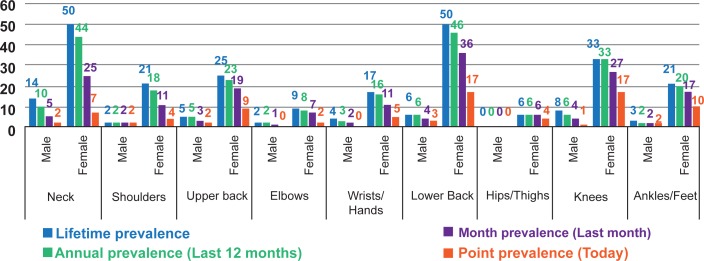
Respondents' mean age was 31.3 years (SD = 7). Their mean Body Mass Index (BMI) was 23.51 kg/m2 (SD = 3.74). Among 186 female respondents, 46 reported lower back pain (24.7%) and 44 reported neck pain (23.7%). Among 46 male respondents, 10 reported neck pain (21.7%) while 6 reported knee pain (13%). Statistically significant relationship was found between twelve month WMSDs in anatomical region in elbows (p = 0.02), hips (p = 0.01), knees (p = 0.01) and ankle (p = 0.05) with age; upper back (p = 0.001), elbows (p = 0.001), wrists (p = 0.03), hips (p = 0.001) and ankles (p = 0.01) with job experience; hips with BMI (p = 0.03); elbows (p = 0.04) with daily working hour. QEC assessment showed that level of exposure to WMSDs risk was high among 80% of the study population (p<0.003).
The study found that lower back and neck were the most affected areas among RMG workers. Moreover, QEC findings warned the level of exposure to WMSDs risks is high and ergonomics intervention along with investigation and change to decrease exposure level is essential. Addressing musculoskeletal risk factors through ergonomic interventions in terms of working space, workers sitting/standing posture, seat and hand position during work and work-rest cycle are encouraged in RMG sector and policy makers.
与工作相关的肌肉骨骼疾病(WMSD)是最常见的职业病之一,主要影响背部、颈部和上下肢。本研究旨在确定孟加拉国成衣(RMG)工人 9 个身体部位的 WMSD 患病率,并评估其接触导致 WMSD 发展的危险因素的情况。
本横断面研究于 2015 年 10 月至 2016 年 2 月期间在达卡地区的 9 家 RMG 工厂中进行,共纳入 232 名 RMG 员工(男性:46;女性:186;年龄:>18 岁)。使用包含人口统计学问题的结构化问卷、用于 9 个身体部位 WMSD 评估的北欧肌肉骨骼问卷扩展版(NMQ-E)和快速暴露检查(QEC)方法收集数据。确定了每个身体部位的 WMSD 患病率。还分析了 WMSD 与接触危险因素的工效学评估之间的关系。
受访者的平均年龄为 31.3 岁(SD=7)。他们的平均体重指数(BMI)为 23.51kg/m2(SD=3.74)。在 186 名女性受访者中,有 46 人报告背部疼痛(24.7%),44 人报告颈部疼痛(23.7%)。在 46 名男性受访者中,有 10 人报告颈部疼痛(21.7%),6 人报告膝盖疼痛(13%)。在肘部(p=0.02)、臀部(p=0.01)、膝盖(p=0.01)和脚踝(p=0.05)等解剖区域的 12 个月 WMSD 与年龄呈显著相关;在背部(p=0.001)、肘部(p=0.001)、手腕(p=0.03)、臀部(p=0.001)和脚踝(p=0.01)等部位的 WMSD 与工作经验有关;臀部与 BMI(p=0.03)有关;肘部(p=0.04)与每日工作时间有关。QEC 评估显示,80%的研究人群(p<0.003)存在高水平的 WMSD 风险暴露。
本研究发现,下背部和颈部是 RMG 工人最易受影响的部位。此外,QEC 发现警告说,接触 WMSD 风险的水平很高,需要进行工效学干预,以及调查和减少暴露水平。在 RMG 行业和政策制定者中鼓励针对工作空间、工人的坐/站姿势、工作时的座椅和手部位置以及工作-休息周期等肌肉骨骼风险因素进行工效学干预。