Department of Obstetrics and Gynecology, Seoul National University College of Medicine, Seoul, Korea.
Department of Obstetrics and Gynecology, Seoul National University Hospital, Seoul, Korea.
PLoS One. 2018 Jul 6;13(7):e0200311. doi: 10.1371/journal.pone.0200311. eCollection 2018.
We aimed to assess the correlations among multiple cytokine concentrations in the maternal plasma, cervicovaginal fluid (CVF), and amniotic fluid (AF) compartments in women with preterm premature rupture of membranes (pPROM), and to develop a prediction model based on non-invasive measures, having better sensitivity and specificity for the identification of microbial invasion of amniotic cavity (MIAC).
This retrospective study included 75 consecutive women with pPROM (20+0-34+0 weeks), who underwent amniocentesis. Both maternal plasma and CVF samples were collected at the time of amniocentesis. Stored AF, plasma and CVF samples were assayed for cytokine levels [interleukin (IL)-6, IL-8, monocyte chemotactic protein-1, macrophage inflammatory protein (MIP)-1α, MIP-1β] using a multiplex immunoassay kit.
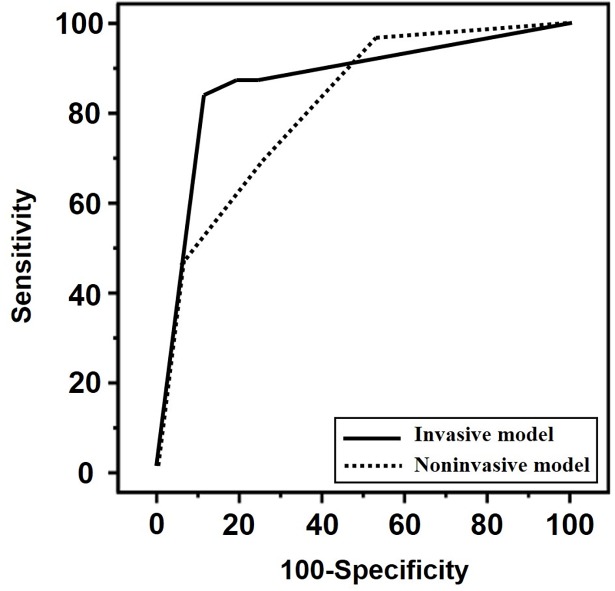
Levels of inflammatory proteins measured in the CVF were significantly correlated with AF proteins levels, whereas none of the proteins in plasma correlated significantly with any in the AF or CVF. Proteins levels measured in the AF and CVF were significantly higher in women with MIAC compared to those without, whereas only high levels of IL-6 in plasma were significantly associated with MIAC. By using stepwise regression analysis, a non-invasive model (using clinical factors and CVF cytokine levels) for the prediction of MIAC was developed; the area under curve of this non-invasive model was similar to that of the invasive model (using clinical factors and AF cytokines).
The levels of inflammatory proteins in the CVF correlated with those in the AF, whereas those in the plasma showed no correlation. A non-invasive model using clinical factors and CVF cytokine levels predicted the risk of MIAC in women with pPROM.
本研究旨在评估胎膜早破(pPROM)孕妇母体外周血、宫颈阴道分泌物(CVF)和羊水(AF)中多种细胞因子浓度之间的相关性,并建立基于非侵入性指标的预测模型,以提高对羊膜腔感染(MIAC)的识别能力。
本回顾性研究纳入了 75 例连续的 pPROM 孕妇(20+0-34+0 周),并进行了羊膜穿刺术。在羊膜穿刺术时采集母体外周血和 CVF 样本。使用多重免疫分析试剂盒检测储存的 AF、血浆和 CVF 样本中的细胞因子水平[白细胞介素(IL)-6、IL-8、单核细胞趋化蛋白-1、巨噬细胞炎症蛋白(MIP)-1α、MIP-1β]。
CVF 中测量的炎症蛋白水平与 AF 蛋白水平显著相关,而血浆中的任何蛋白均与 AF 或 CVF 中的蛋白无显著相关性。与无 MIAC 的孕妇相比,MIAC 孕妇的 AF 和 CVF 中的蛋白水平显著升高,而只有高水平的 IL-6 与 MIAC 显著相关。通过逐步回归分析,建立了一种非侵入性模型(使用临床因素和 CVF 细胞因子水平)来预测 MIAC;该非侵入性模型的曲线下面积与侵袭性模型(使用临床因素和 AF 细胞因子)相似。
CVF 中的炎症蛋白水平与 AF 中的蛋白水平相关,而血浆中的蛋白水平则无相关性。使用临床因素和 CVF 细胞因子水平的非侵入性模型预测了 pPROM 孕妇发生 MIAC 的风险。