• 文献检索
  • 文档翻译
  • 深度研究
  • 学术资讯
  • Suppr Zotero 插件Zotero 插件
  • 邀请有礼
  • 套餐&价格
  • 历史记录
应用&插件
Suppr Zotero 插件Zotero 插件浏览器插件Mac 客户端Windows 客户端微信小程序
定价
高级版会员购买积分包购买API积分包
服务
文献检索文档翻译深度研究API 文档MCP 服务
关于我们
关于 Suppr公司介绍联系我们用户协议隐私条款
关注我们

Suppr 超能文献

核心技术专利:CN118964589B侵权必究
粤ICP备2023148730 号-1Suppr @ 2026

文献检索

告别复杂PubMed语法,用中文像聊天一样搜索,搜遍4000万医学文献。AI智能推荐,让科研检索更轻松。

立即免费搜索

文件翻译

保留排版,准确专业,支持PDF/Word/PPT等文件格式,支持 12+语言互译。

免费翻译文档

深度研究

AI帮你快速写综述,25分钟生成高质量综述,智能提取关键信息,辅助科研写作。

立即免费体验

基于异质网络图卷积的罕见病表型驱动基因优先级排序

Phenotype-driven gene prioritization for rare diseases using graph convolution on heterogeneous networks.

机构信息

TCS Research and Innovation, Hyderabad, 500081, India.

出版信息

BMC Med Genomics. 2018 Jul 6;11(1):57. doi: 10.1186/s12920-018-0372-8.

DOI:10.1186/s12920-018-0372-8
PMID:29980210
原文链接:https://pmc.ncbi.nlm.nih.gov/articles/PMC6035401/
Abstract

BACKGROUND

One of the major goals of genomic medicine is the identification of causal genomic variants in a patient and their relation to the observed clinical phenotypes. Prioritizing the genomic variants by considering only the genotype information usually identifies a few hundred potential variants. Narrowing it down further to find the causal disease genes and relating them to the observed clinical phenotypes remains a significant challenge, especially for rare diseases.

METHODS

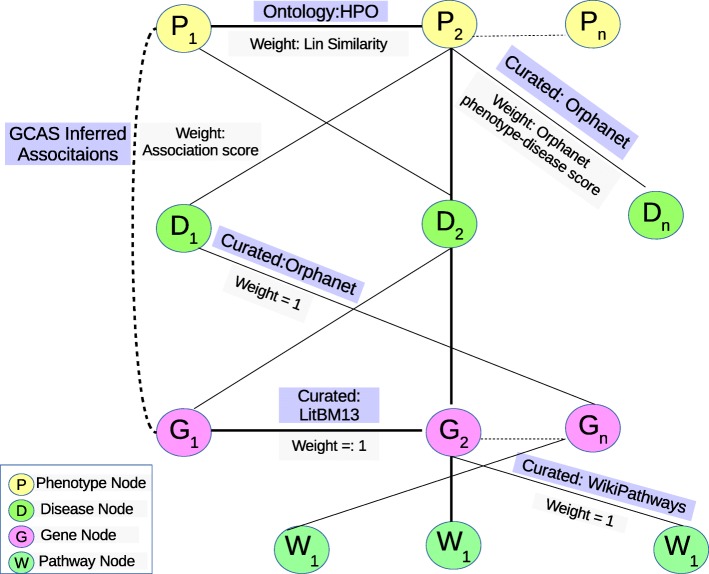
We propose a phenotype-driven gene prioritization approach using heterogeneous networks in the context of rare diseases. Towards this, we first built a heterogeneous network consisting of ontological associations as well as curated associations involving genes, diseases, phenotypes and pathways from multiple sources. Motivated by the recent progress in spectral graph convolutions, we developed a graph convolution based technique to infer new phenotype-gene associations from this initial set of associations. We included these inferred associations in the initial network and termed this integrated network HANRD (Heterogeneous Association Network for Rare Diseases). We validated this approach on 230 recently published rare disease clinical cases using the case phenotypes as input.

RESULTS

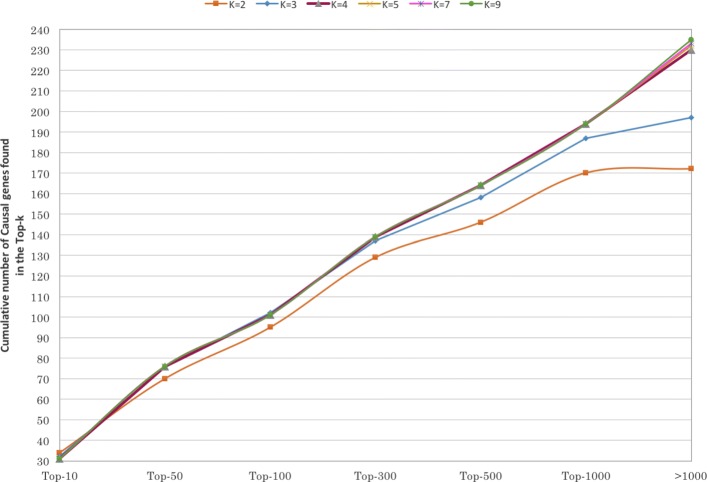
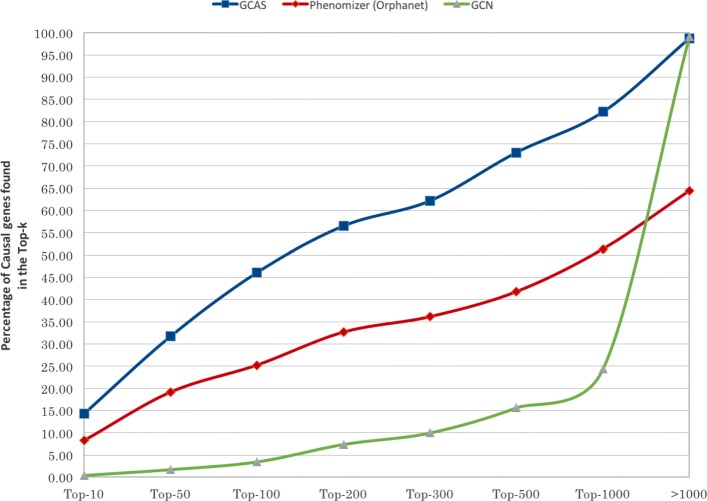
When HANRD was queried with the case phenotypes as input, the causal genes were captured within Top-50 for more than 31% of the cases and within Top-200 for more than 56% of the cases. The results showed improved performance when compared to other state-of-the-art tools.

CONCLUSIONS

In this study, we showed that the heterogeneous network HANRD, consisting of curated, ontological and inferred associations, helped improve causal gene identification in rare diseases. HANRD allows future enhancements by supporting incorporation of new entity types and additional information sources.

摘要

背景

基因组医学的主要目标之一是识别患者中与观察到的临床表型相关的因果基因组变异。仅考虑基因型信息对基因组变异进行优先级排序通常可以识别出几百个潜在的变异。进一步将其缩小范围以找到与观察到的临床表型相关的致病疾病基因仍然是一个重大挑战,尤其是对于罕见疾病。

方法

我们提出了一种基于表型的基因优先级排序方法,该方法在罕见疾病的背景下使用异构网络。为此,我们首先构建了一个异构网络,该网络由来自多个来源的基因、疾病、表型和途径的本体论关联以及精心策划的关联组成。受最近在光谱图卷积方面取得的进展的启发,我们开发了一种基于图卷积的技术,从这个初始关联集推断新的表型-基因关联。我们将这些推断出的关联纳入初始网络中,并将此集成网络命名为 HANRD(用于罕见疾病的异构关联网络)。我们使用 230 个最近发表的罕见病临床病例的病例表型作为输入,对该方法进行了验证。

结果

当 HANRD 以病例表型作为输入进行查询时,对于超过 31%的病例,因果基因在前 50 名中被捕获;对于超过 56%的病例,因果基因在前 200 名中被捕获。与其他最先进的工具相比,该方法的结果显示出了改进的性能。

结论

在这项研究中,我们表明由精心策划、本体和推断关联组成的异构网络 HANRD 有助于提高罕见疾病中的因果基因识别。HANRD 通过支持新实体类型和其他信息源的纳入,为未来的增强提供了可能。
https://cdn.ncbi.nlm.nih.gov/pmc/blobs/96bf/6035401/f1d138ef0c22/12920_2018_372_Fig7_HTML.jpg
https://cdn.ncbi.nlm.nih.gov/pmc/blobs/96bf/6035401/4e4a53737312/12920_2018_372_Fig1_HTML.jpg
https://cdn.ncbi.nlm.nih.gov/pmc/blobs/96bf/6035401/71393350711f/12920_2018_372_Fig2_HTML.jpg
https://cdn.ncbi.nlm.nih.gov/pmc/blobs/96bf/6035401/99c9339e6d72/12920_2018_372_Fig3_HTML.jpg
https://cdn.ncbi.nlm.nih.gov/pmc/blobs/96bf/6035401/378ce42b4500/12920_2018_372_Fig4_HTML.jpg
https://cdn.ncbi.nlm.nih.gov/pmc/blobs/96bf/6035401/1b9c3dba63cb/12920_2018_372_Fig5_HTML.jpg
https://cdn.ncbi.nlm.nih.gov/pmc/blobs/96bf/6035401/62f8f76b5b3b/12920_2018_372_Fig6_HTML.jpg
https://cdn.ncbi.nlm.nih.gov/pmc/blobs/96bf/6035401/f1d138ef0c22/12920_2018_372_Fig7_HTML.jpg
https://cdn.ncbi.nlm.nih.gov/pmc/blobs/96bf/6035401/4e4a53737312/12920_2018_372_Fig1_HTML.jpg
https://cdn.ncbi.nlm.nih.gov/pmc/blobs/96bf/6035401/71393350711f/12920_2018_372_Fig2_HTML.jpg
https://cdn.ncbi.nlm.nih.gov/pmc/blobs/96bf/6035401/99c9339e6d72/12920_2018_372_Fig3_HTML.jpg
https://cdn.ncbi.nlm.nih.gov/pmc/blobs/96bf/6035401/378ce42b4500/12920_2018_372_Fig4_HTML.jpg
https://cdn.ncbi.nlm.nih.gov/pmc/blobs/96bf/6035401/1b9c3dba63cb/12920_2018_372_Fig5_HTML.jpg
https://cdn.ncbi.nlm.nih.gov/pmc/blobs/96bf/6035401/62f8f76b5b3b/12920_2018_372_Fig6_HTML.jpg
https://cdn.ncbi.nlm.nih.gov/pmc/blobs/96bf/6035401/f1d138ef0c22/12920_2018_372_Fig7_HTML.jpg

相似文献

1
Phenotype-driven gene prioritization for rare diseases using graph convolution on heterogeneous networks.基于异质网络图卷积的罕见病表型驱动基因优先级排序
BMC Med Genomics. 2018 Jul 6;11(1):57. doi: 10.1186/s12920-018-0372-8.
2
PRIORI-T: A tool for rare disease gene prioritization using MEDLINE.PRIORI-T:一种使用 MEDLINE 进行罕见病基因优先级排序的工具。
PLoS One. 2020 Apr 21;15(4):e0231728. doi: 10.1371/journal.pone.0231728. eCollection 2020.
3
Critical assessment of variant prioritization methods for rare disease diagnosis within the rare genomes project.对罕见基因组项目中罕见病诊断的变异优先级方法的批判性评估。
Hum Genomics. 2024 Apr 29;18(1):44. doi: 10.1186/s40246-024-00604-w.
4
BioNet: a large-scale and heterogeneous biological network model for interaction prediction with graph convolution.BioNet:一种基于图卷积的大规模异质生物网络互作预测模型。
Brief Bioinform. 2022 Jan 17;23(1). doi: 10.1093/bib/bbab491.
5
Assessing the utility of large language models for phenotype-driven gene prioritization in the diagnosis of rare genetic disease.评估大型语言模型在罕见遗传疾病诊断中基于表型的基因优先级排序中的效用。
Am J Hum Genet. 2024 Oct 3;111(10):2190-2202. doi: 10.1016/j.ajhg.2024.08.010. Epub 2024 Sep 9.
6
Artificial intelligence enables comprehensive genome interpretation and nomination of candidate diagnoses for rare genetic diseases.人工智能能够全面解读基因组并为罕见遗传病提名候选诊断。
Genome Med. 2021 Oct 14;13(1):153. doi: 10.1186/s13073-021-00965-0.
7
Phenotype-genotype comorbidity analysis of patients with rare disorders provides insight into their pathological and molecular bases.对罕见疾病患者的表型-基因型共病分析为深入了解其病理和分子基础提供了线索。
PLoS Genet. 2020 Oct 1;16(10):e1009054. doi: 10.1371/journal.pgen.1009054. eCollection 2020 Oct.
8
Prioritization of New Candidate Genes for Rare Genetic Diseases by a Disease-Aware Evaluation of Heterogeneous Molecular Networks.通过对异质分子网络的疾病感知评估,为罕见遗传疾病的新候选基因进行优先级排序。
Int J Mol Sci. 2023 Jan 14;24(2):1661. doi: 10.3390/ijms24021661.
9
Modularity-based credible prediction of disease genes and detection of disease subtypes on the phenotype-gene heterogeneous network.基于模块性的疾病基因可信预测及表型-基因异质网络上疾病亚型的检测
BMC Syst Biol. 2011 May 20;5:79. doi: 10.1186/1752-0509-5-79.
10
Network analysis reveals rare disease signatures across multiple levels of biological organization.网络分析揭示了多个生物学组织层次上的罕见疾病特征。
Nat Commun. 2021 Nov 9;12(1):6306. doi: 10.1038/s41467-021-26674-1.

引用本文的文献

1
Survey and improvement strategies for gene prioritization with large language models.基于大语言模型的基因优先级排序的调查与改进策略
Bioinform Adv. 2025 Jun 24;5(1):vbaf148. doi: 10.1093/bioadv/vbaf148. eCollection 2025.
2
A Hypergraph powered approach to Phenotype-driven Gene Prioritization and Rare Disease Prediction.一种基于超图的方法用于表型驱动的基因优先级排序和罕见病预测。
Sci Rep. 2025 Jul 3;15(1):23780. doi: 10.1038/s41598-025-04428-z.
3
Few shot learning for phenotype-driven diagnosis of patients with rare genetic diseases.

本文引用的文献

1
Leveraging network analytics to infer patient syndrome and identify causal genes in rare disease cases.利用网络分析推断罕见病病例中的患者综合征并识别致病基因。
BMC Genomics. 2017 Aug 11;18(Suppl 5):551. doi: 10.1186/s12864-017-3910-4.
2
Whole Genome Sequencing Expands Diagnostic Utility and Improves Clinical Management in Pediatric Medicine.全基因组测序扩大了诊断效用并改善了儿科医学的临床管理。
NPJ Genom Med. 2016 Jan 13;1:15012-. doi: 10.1038/npjgenmed.2015.12.
3
PCAN: phenotype consensus analysis to support disease-gene association.
用于罕见遗传病患者表型驱动诊断的少样本学习。
NPJ Digit Med. 2025 Jun 20;8(1):380. doi: 10.1038/s41746-025-01749-1.
4
Leveraging Social Determinants of Health in Alzheimer's Research Using LLM-Augmented Literature Mining and Knowledge Graphs.利用基于大语言模型增强的文献挖掘和知识图谱,在阿尔茨海默病研究中利用健康的社会决定因素
AMIA Jt Summits Transl Sci Proc. 2025 Jun 10;2025:491-500. eCollection 2025.
5
A Systematic Review of the Application of Graph Neural Networks to Extract Candidate Genes and Biological Associations.图神经网络在提取候选基因和生物学关联中的应用系统综述
Am J Med Genet B Neuropsychiatr Genet. 2025 Sep;198(6):3-18. doi: 10.1002/ajmg.b.33031. Epub 2025 May 2.
6
A phenotype-based AI pipeline outperforms human experts in differentially diagnosing rare diseases using EHRs.一种基于表型的人工智能流程在使用电子健康记录对罕见疾病进行鉴别诊断方面比人类专家表现更出色。
NPJ Digit Med. 2025 Jan 28;8(1):68. doi: 10.1038/s41746-025-01452-1.
7
An end-to-end method for predicting compound-protein interactions based on simplified homogeneous graph convolutional network and pre-trained language model.一种基于简化同构图卷积网络和预训练语言模型预测化合物-蛋白质相互作用的端到端方法。
J Cheminform. 2024 Jun 7;16(1):67. doi: 10.1186/s13321-024-00862-9.
8
ReHoGCNES-MDA: prediction of miRNA-disease associations using homogenous graph convolutional networks based on regular graph with random edge sampler.ReHoGCNES-MDA:基于正则图和随机边采样器的同质图卷积网络预测 miRNA-疾病关联
Brief Bioinform. 2024 Jan 22;25(2). doi: 10.1093/bib/bbae103.
9
A novel candidate disease gene prioritization method using deep graph convolutional networks and semi-supervised learning.一种使用深度图卷积网络和半监督学习的新型候选疾病基因优先级排序方法。
BMC Bioinformatics. 2022 Oct 14;23(1):422. doi: 10.1186/s12859-022-04954-x.
10
Predicting non-small cell lung cancer-related genes by a new network-based machine learning method.通过一种基于新网络的机器学习方法预测非小细胞肺癌相关基因。
Front Oncol. 2022 Sep 20;12:981154. doi: 10.3389/fonc.2022.981154. eCollection 2022.
PCAN:表型共识分析支持疾病-基因关联。
BMC Bioinformatics. 2016 Dec 7;17(1):518. doi: 10.1186/s12859-016-1401-2.
4
The Human Phenotype Ontology in 2017.2017年的人类表型本体论。
Nucleic Acids Res. 2017 Jan 4;45(D1):D865-D876. doi: 10.1093/nar/gkw1039. Epub 2016 Nov 28.
5
VarElect: the phenotype-based variation prioritizer of the GeneCards Suite.VarElect:基因卡片套件中基于表型的变异优先级排序工具。
BMC Genomics. 2016 Jun 23;17 Suppl 2(Suppl 2):444. doi: 10.1186/s12864-016-2722-2.
6
A visual and curatorial approach to clinical variant prioritization and disease gene discovery in genome-wide diagnostics.一种用于全基因组诊断中临床变异优先级排序和疾病基因发现的可视化与策展方法。
Genome Med. 2016 Feb 2;8(1):13. doi: 10.1186/s13073-016-0261-8.
7
Next-generation diagnostics and disease-gene discovery with the Exomiser.使用Exomiser进行下一代诊断和疾病基因发现。
Nat Protoc. 2015 Dec;10(12):2004-15. doi: 10.1038/nprot.2015.124. Epub 2015 Nov 12.
8
Computational evaluation of exome sequence data using human and model organism phenotypes improves diagnostic efficiency.利用人类和模式生物表型对外显子组序列数据进行计算评估可提高诊断效率。
Genet Med. 2016 Jun;18(6):608-17. doi: 10.1038/gim.2015.137. Epub 2015 Nov 12.
9
WikiPathways: capturing the full diversity of pathway knowledge.维基途径:捕捉通路知识的全部多样性。
Nucleic Acids Res. 2016 Jan 4;44(D1):D488-94. doi: 10.1093/nar/gkv1024. Epub 2015 Oct 19.
10
OVA: integrating molecular and physical phenotype data from multiple biomedical domain ontologies with variant filtering for enhanced variant prioritization.OVA:整合来自多个生物医学领域本体的分子和物理表型数据,并进行变异过滤以增强变异优先级排序。
Bioinformatics. 2015 Dec 1;31(23):3822-9. doi: 10.1093/bioinformatics/btv473. Epub 2015 Aug 12.