Institute for Animal Nutrition, University of Veterinary Medicine Hannover, Foundation, Bischofsholer Damm 15, D-30173 Hanover, Germany.
Institute for Anatomy, University of Veterinary Medicine Hannover, Foundation, Bischofsholer Damm 15, D-30173 Hanover, Germany.
Poult Sci. 2018 Nov 1;97(11):4020-4030. doi: 10.3382/ps/pey276.
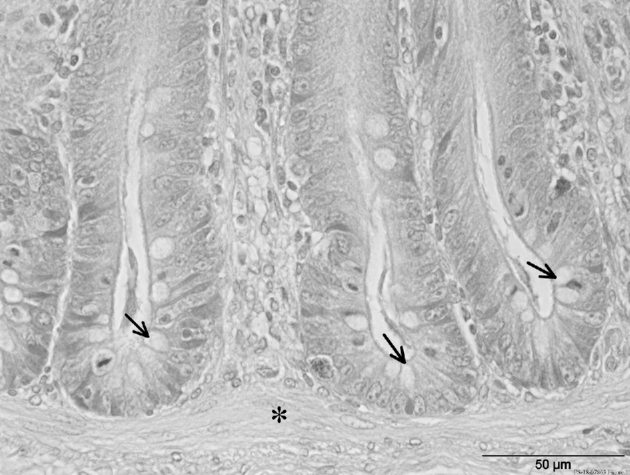
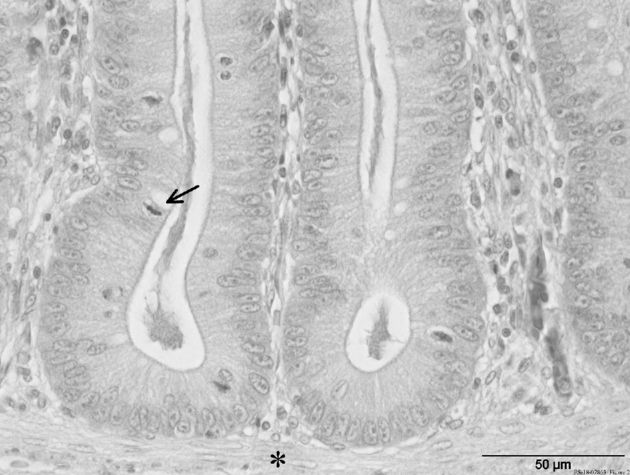
Campylobacter jejuni (C. jejuni) is one of the most important zoonotic pathogens worldwide. In Europe, the majority of the cases are caused by consuming contaminated poultry meat. The objective of the present study was to investigate potential effects of different crude protein levels in complete diets for broilers on infection dynamics of C. jejuni after experimental infection. In total, 300 commercial broilers line Ross 308 were divided into 4 different groups, including 5 replications of 15 chickens each. The chickens were fed a conventional diet (212 g CP/kg DM) and a protein-reduced test diet (190 g CP/kg DM) supplemented with essential amino acids. This resulted simultaneously in lower amino-acid concentrations preferentially utilized by C. jejuni, such as aspartate, glutamate, proline, and serine. One group of each feeding concept was infected artificially with C. jejuni at day 21 by applying an oral C. jejuni inoculum containing 4.17 ± 0.09 log10 cfu of C. jejuni to 3 of 15 chickens, called "seeders." Feeding the test diet resulted in a significant reduction (P < 0.001) in CP intake (31.5 ± 1.20 g CP/broiler/day and 27.7 ± 0.71 g CP/broiler/day, respectively), a significant decrease (P < 0.05) in crude mucin in excreta (55.7 ± 8.23 g/kg DM and 51.9 ± 7.62 g/kg DM, respectively), and in goblet cell number in cecal crypts (P < 0.05; 15.1 ± 5.71 vs. 13.6 ± 5.91 goblet cells/crypt). In groups receiving the test diet, the excretion of C. jejuni was significantly reduced in seeders by 1.9 log10 cfu/g excreta at day 23 (3.38a ± 2.55 vs. 1.47b ± 2.20; P = 0.033). At day 25, prevalence of C. jejuni in cloacal swabs amounted to 53.3% in the group fed the test diet and 75.7% in the control group, respectively (P < 0.05). In summary, a definite amino acid pattern in the broiler diets could contribute to a development of an effective feeding strategy to reduce the prevalence of C. jejuni infection in chickens (Patent No 17187659.2-1106).
空肠弯曲菌(C. jejuni)是世界上最重要的人畜共患病病原体之一。在欧洲,大多数病例是由食用受污染的家禽肉引起的。本研究的目的是调查肉鸡全价日粮中不同粗蛋白水平对实验感染后空肠弯曲菌感染动态的潜在影响。总共 300 只商业肉鸡品系罗斯 308 被分为 4 个不同组,每组包括 5 个重复,每个重复 15 只鸡。鸡群分别饲喂常规日粮(212g CP/kg DM)和蛋白质降低的试验日粮(190g CP/kg DM),并补充必需氨基酸。这同时导致空肠弯曲菌优先利用的氨基酸浓度降低,如天冬氨酸、谷氨酸、脯氨酸和丝氨酸。每个饲养方案的一组鸡在第 21 天通过口服接种含有 4.17±0.09log10 cfu 空肠弯曲菌的空肠弯曲菌接种物来人工感染空肠弯曲菌,称为“播种者”。饲喂试验日粮导致 CP 摄入量显著减少(P<0.001)(分别为 31.5±1.20g CP/鸡/天和 27.7±0.71g CP/鸡/天),粪便中粗粘蛋白显著降低(P<0.05)(分别为 55.7±8.23g/kg DM 和 51.9±7.62g/kg DM),回肠隐窝中杯状细胞数量减少(P<0.05;15.1±5.71 对 13.6±5.91 个杯状细胞/隐窝)。在接受试验日粮的组中,在第 23 天,粪便中 C. jejuni 的排泄量在播种者中减少了 1.9log10 cfu/g 粪便(3.38a±2.55 对 1.47b±2.20;P=0.033)。在第 25 天,试验日粮组的直肠拭子中 C. jejuni 的流行率为 53.3%,对照组为 75.7%(P<0.05)。总之,肉鸡日粮中的特定氨基酸模式有助于制定有效的饲养策略,以降低鸡空肠弯曲菌感染的流行率(专利号 17187659.2-1106)。