Mattos Amaranto Suarez, Aguilera Jairo, Salguero Edgar Augusto, Wiesner Carolina
Instituto Nacional de Cancerología, Bogota, Colombia.
Colomb Med (Cali). 2018 Mar 30;49(1):97-101. doi: 10.25100/cm.v49i1.3377.
In low-income countries, a child diagnosed with cancer has an 80% chance of dying, while in high-income countries more than 80% survive the disease. In Colombia, a middle-income country, the government issued new legislation that promotes the generation of comprehensive care units; nevertheless, seven years after its expedition, no institution has been recognized as such by the Ministry of Health. The objective of this study was to characterize the current offer of oncological services for cancer care in children and to identify the institutions that can be constituted in Units of Comprehensive Care of Childhood Cancer in Colombia.
descriptive study of secondary source, the Special Register of Health Providers of the Ministry of Health and Social Protection was consulted, in order to identify the institutions that had enabled hospitalization services of medium or high complexity, chemotherapy, specialized consultation, emergencies, oncological surgery, and radiotherapy or nuclear medicine. The information is reported in absolute frequencies.
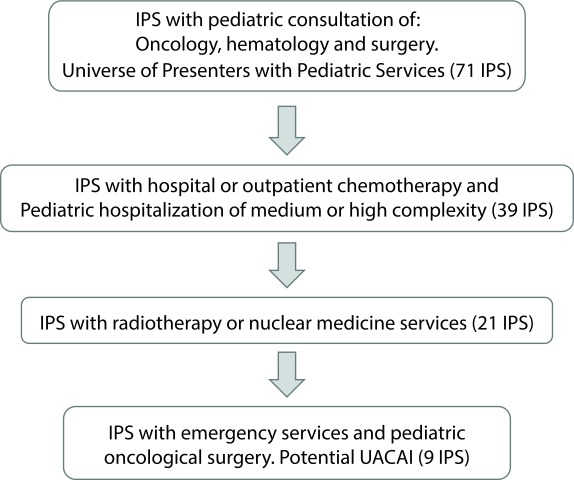
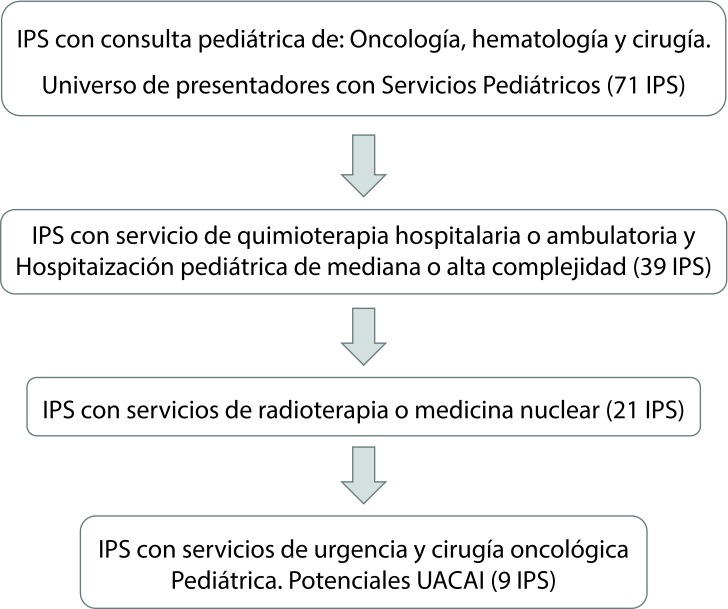
Seventy one institutions have hematology-oncology consultation, 39 institutions have chemotherapy and hospitalization services of medium or high complexity, and 18 have radiotherapy enabled. Only nine of the institutions include all the services that are necessary for comprehensive care.
Colombia has a sufficient supply of services for the care of children with cancer. Only a minority are in institutions that have the capacity to guarantee the integrality of the attention.
在低收入国家,被诊断患有癌症的儿童有80%的死亡几率,而在高收入国家,超过80%的患儿能从该疾病中存活下来。在中等收入国家哥伦比亚,政府颁布了新法规以促进综合护理单位的建立;然而,在法规颁布七年后,尚无机构被卫生部认定为综合护理单位。本研究的目的是描述目前为儿童癌症护理提供的肿瘤学服务,并确定哥伦比亚可组建为儿童癌症综合护理单位的机构。
对二手资料进行描述性研究,查阅了卫生和社会保障部卫生服务提供者特别登记册,以确定那些提供中等或高复杂性住院服务、化疗、专科会诊、急诊、肿瘤外科手术以及放疗或核医学服务的机构。信息以绝对频数报告。
71家机构设有血液肿瘤学会诊,39家机构提供中等或高复杂性化疗及住院服务,且18家机构具备放疗能力。只有9家机构提供综合护理所需的所有服务。
哥伦比亚有足够的服务资源用于照顾患癌儿童。只有少数机构有能力保证提供全面的护理。