School of Population and Public Health, University of British Columbia, Vancouver, BC, Canada.
Population Oncology, BC Cancer, Vancouver, BC, Canada.
Cancer Med. 2018 Aug;7(8):4044-4067. doi: 10.1002/cam4.1608. Epub 2018 Jul 9.
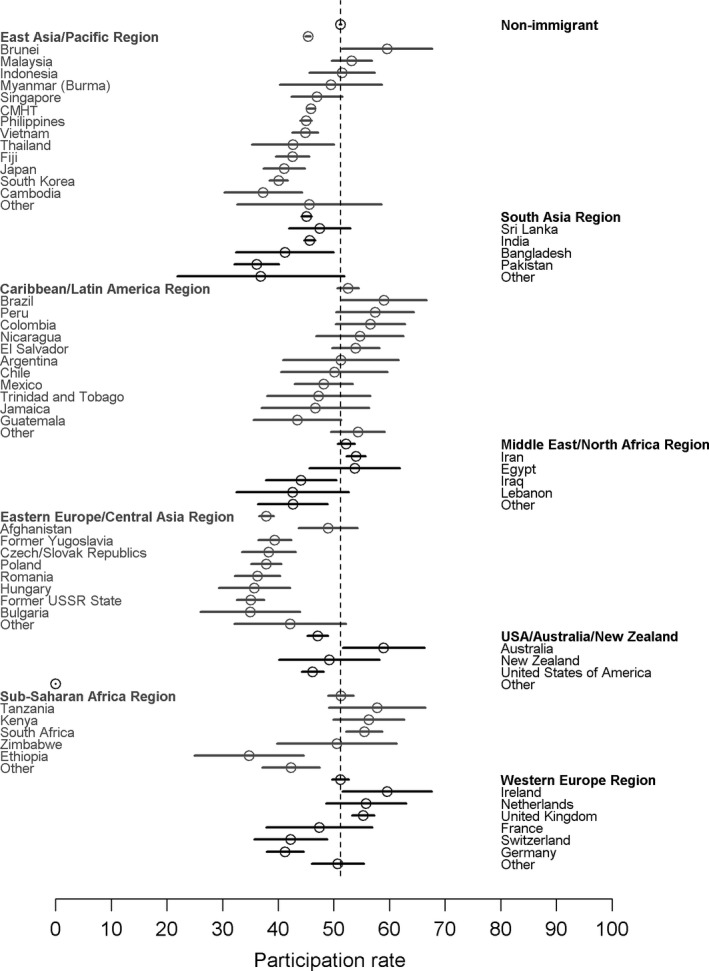
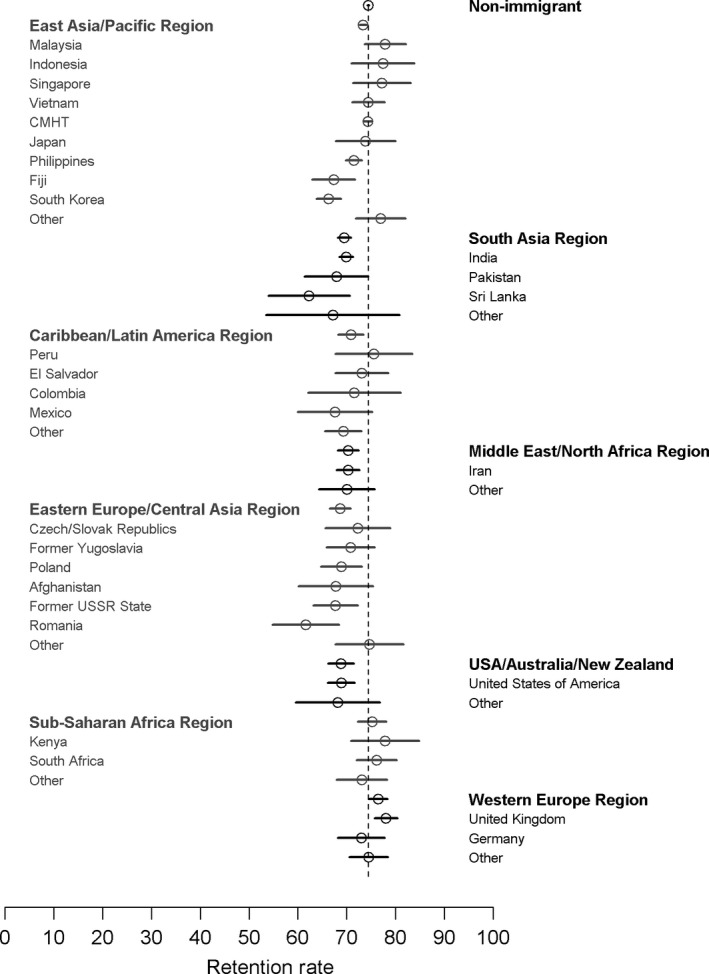
Breast cancer screening programs operate across Canada providing mammography to women in target age groups with the goal of reducing breast cancer mortality through early detection of tumors. Disparities in breast screening participation among socio-demographic groups, including immigrants, have been reported in Canada. Our objectives were to: (1) assess breast screening participation and retention among immigrant and nonimmigrant women in British Columbia (BC), Canada; and (2) to characterize factors associated with screening among screening-age recent immigrant women in BC. We examined 2 population-based cohorts of women eligible for breast screening participation (537 783 women) and retention (281 052 women) using linked health and immigration data. Breast screening rates were presented according to socio-demographic and health-related variables stratified by birth country. Factors associated with screening among recent immigrant women were explored using Poisson regression. We observed marked variation in screening participation across birth country cohorts. Eastern European/Central Asian women showed low participation (37.9%) with rates from individual countries ranging from 35.0% to 49.0%. Participation rates for immigrant women from the most common birth countries, such as China/Macau/Hong Kong/Taiwan (45.7%), India (44.5%), the Philippines (45.9%), and South Korea (39.0%), were lower than the nonimmigrant rates (51.2%). Retention rates showed less variation by birth country; however, some disparities between immigrant and nonimmigrant groups persisted. Associations between screening indicators and study factors varied considerably across immigrant groups. Primary care physician visits were consistently positively associated with screening participation; this variable was also the only predictor associated with screening within each of the groups of recent immigrants. Our study provides unique data on both screening participation and retention among Canadian immigrant women compiled by individual country of birth. Our results are further demonstration that screening disparities exist among immigrant populations as well as in comparison with nonimmigrant women.
加拿大各地都有乳腺癌筛查项目,为目标年龄段的女性提供乳房 X 光检查,旨在通过早期发现肿瘤来降低乳腺癌死亡率。在加拿大,已经报道了社会人口统计学群体(包括移民)之间的乳腺癌筛查参与率存在差异。我们的目标是:(1)评估不列颠哥伦比亚省(BC)移民和非移民妇女的乳腺癌筛查参与率和保留率;(2)描述不列颠哥伦比亚省筛查年龄的近期移民妇女中与筛查相关的因素。我们使用链接的健康和移民数据,检查了有资格参加乳腺癌筛查的两个基于人群的妇女队列(537783 名妇女)和保留队列(281052 名妇女)。根据出生国,按社会人口统计学和与健康相关的变量分层,呈现了乳腺癌筛查率。使用泊松回归探索了近期移民妇女中与筛查相关的因素。我们观察到,出生国队列之间的筛查参与率存在明显差异。东欧/中亚妇女的参与率较低(37.9%),个别国家的比例从 35.0%到 49.0%不等。来自最常见出生国的移民妇女的参与率较低,例如中国/澳门/香港/台湾(45.7%)、印度(44.5%)、菲律宾(45.9%)和韩国(39.0%),低于非移民的比例(51.2%)。保留率的出生国差异较小;然而,移民和非移民群体之间仍然存在一些差异。筛查指标与研究因素之间的关联在移民群体中差异很大。初级保健医生就诊与筛查参与率始终呈正相关;该变量也是每个最近移民群体中与筛查相关的唯一预测因素。我们的研究提供了有关加拿大移民妇女筛查参与率和保留率的独特数据,按出生国分别编制。我们的研究结果进一步表明,移民人群中存在筛查差异,与非移民妇女相比也存在差异。