Shetty Vinaya, Shetty N J, Harini B P, Ananthanarayana S R, Jha S K, Chaubey R C
Centre for Applied Genetics, J.B. Campus, Bangalore University, Bengaluru 560056, India.
Department of Sericulture, J.B. Campus, Bangalore University, Bengaluru 560056, India.
Parasite Epidemiol Control. 2016 Mar 2;1(2):26-35. doi: 10.1016/j.parepi.2016.02.007. eCollection 2016 Jun.
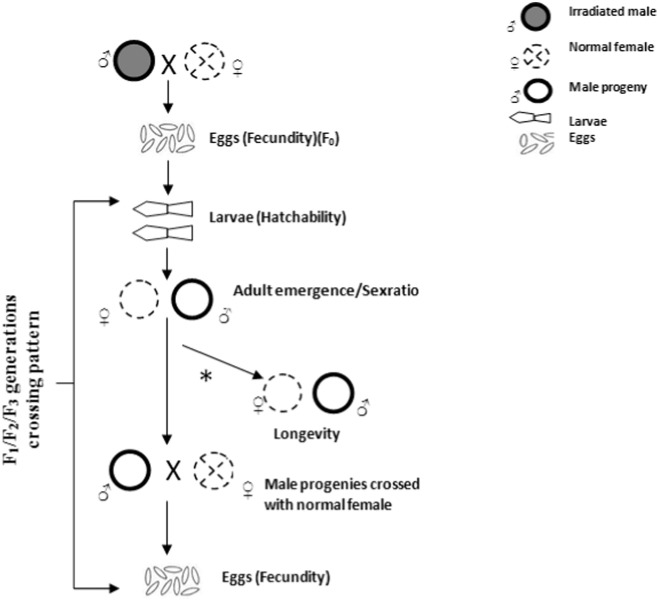
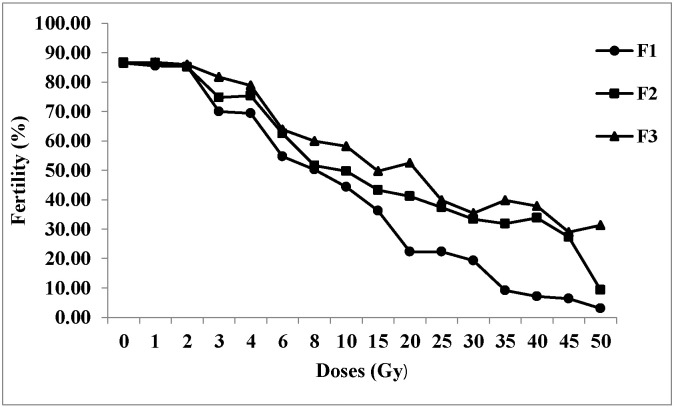
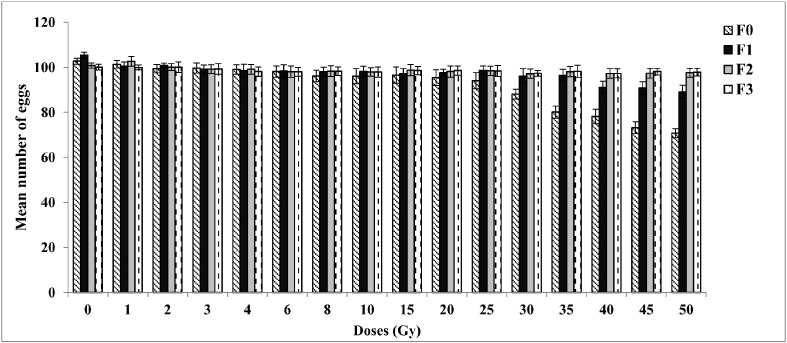
is an important vector for Dengue and Dengue hemorrhagic fever. Considering its medical importance and its relevance as a model system, this study was undertaken to evaluate the impact of different doses of gamma radiation for three generations of . Two to three days old virgin males of were irradiated with 15 doses of gamma radiation, ranging from 1 to 50 Gy and were immediately mass mated with the same aged virgin females. Observations were made for changes on their life history traits, particularly fecundity, hatchability, adult emergence, sex ratio and longevity, for three generations. Adult males exposed 30, 35, 40, 45 and 50 Gy doses showed a significant decrease in fecundity in F generations. While hatchability was observed to have decreased with increasing radiation doses from 3 Gy onwards in the F generation, samples irradiated with 30, 35, 40, 45 and 50 Gy maintained significant decline in hatchability in their succeeding generations, F and F also. Similarly, a decline was observed in adult emergence from 3 Gy onwards in all three generations. A male favoring sex ratio distortion was observed at the doses of 35, 40, 45 and 50 Gy in all three generations. Following exposure to 4 Gy, parental males and the resultant progeny showed increased longevity by 10.56 and 8.66 days respectively. Similarly, the F generations of samples irradiated with 30, 35 and 40 Gy exhibited an increase in longevity by 7.16, 7.44 and 6.64 days respectively. Dose response curve for fertility among the three generations was drawn and presented. The effect of radiological exposure on the life history traits of varies with dose for the three generations studied. These results have potential implications in mutational studies and risk assessment and also contribute to a better understanding towards employment of the sterile insect technique in , plausibly paving the way to an effective mosquito genetic control program.
是登革热和登革出血热的重要传播媒介。鉴于其医学重要性以及作为模型系统的相关性,本研究旨在评估不同剂量的伽马辐射对三代[昆虫名称未给出]的影响。将两到三日龄的[昆虫名称未给出]处女雄虫用15种剂量的伽马辐射进行照射,剂量范围为1至50 Gy,并立即与同龄的处女雌虫进行大量交配。对其三代的生活史特征变化进行了观察,特别是繁殖力、孵化率、成虫羽化、性别比和寿命。暴露于30、35、40、45和50 Gy剂量的成年雄虫在F代的繁殖力显著下降。虽然在F代中观察到从3 Gy起孵化率随辐射剂量增加而下降,但用30、35、40、45和50 Gy照射的样本在其后代F代和F代中孵化率也持续显著下降。同样,在所有三代中从3 Gy起成虫羽化率均下降。在所有三代中,在35、40、45和50 Gy剂量下均观察到偏向雄性的性别比扭曲。暴露于4 Gy后,亲代雄虫及其后代的寿命分别增加了10.56天和8.66天。同样,用30、35和40 Gy照射的样本的F代寿命分别增加了7.16天、7.44天和6.64天。绘制并呈现了三代之间生育力的剂量反应曲线。在所研究的三代中,辐射暴露对[昆虫名称未给出]生活史特征的影响随剂量而变化。这些结果在突变研究和风险评估中具有潜在意义,也有助于更好地理解在[昆虫名称未给出]中应用不育昆虫技术,有望为有效的蚊虫遗传控制计划铺平道路。