Thirunavukkarasu Nagarajan, Johnson Eric, Pillai Segaran, Hodge David, Stanker Larry, Wentz Travis, Singh BalRam, Venkateswaran Kodumudi, McNutt Patrick, Adler Michael, Brown Eric, Hammack Thomas, Burr Donald, Sharma Shashi
Division of Microbiology, Office of Regulatory Science, Center for Food Safety and Applied Nutrition, U.S. Food and Drug Administration, College Park, MD, United States.
Department of Bacteriology, University of Wisconsin-Madison, Madison, WI, United States.
Front Bioeng Biotechnol. 2018 Jun 22;6:80. doi: 10.3389/fbioe.2018.00080. eCollection 2018.
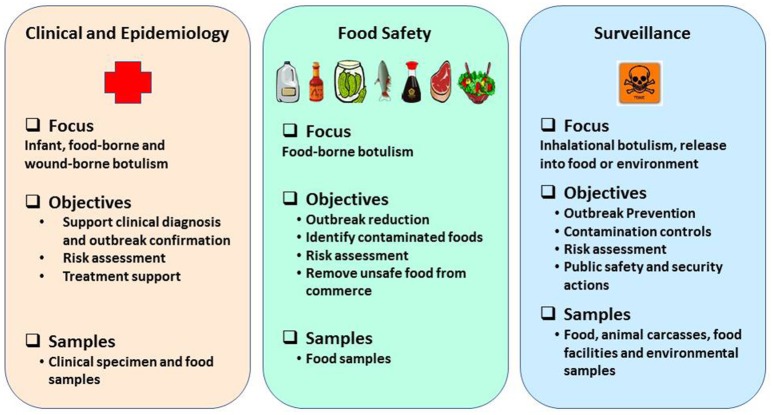
Botulism outbreak due to consumption of food contaminated with botulinum neurotoxins (BoNTs) is a public health emergency. The threat of bioterrorism through deliberate distribution in food sources and/or aerosolization of BoNTs raises global public health and security concerns due to the potential for high mortality and morbidity. Rapid and reliable detection methods are necessary to support clinical diagnosis and surveillance for identifying the source of contamination, performing epidemiological analysis of the outbreak, preventing and responding to botulism outbreaks. This review considers the applicability of various BoNT detection methods and examines their fitness-for-purpose in safeguarding the public health and security goals.
因食用受肉毒杆菌神经毒素(BoNTs)污染的食物而引发的肉毒中毒疫情是一种突发公共卫生事件。通过蓄意将BoNTs投放于食物来源和/或进行气溶胶化处理来实施生物恐怖主义的威胁,因其可能导致高死亡率和高发病率,引发了全球对公共卫生和安全的担忧。快速且可靠的检测方法对于支持临床诊断和监测以确定污染源、对疫情进行流行病学分析、预防和应对肉毒中毒疫情而言必不可少。本综述探讨了各种BoNT检测方法的适用性,并检验了它们在保障公共卫生和安全目标方面是否适用。