
与一次李斯特菌病暴发相关的、来自天然污染冰淇淋的单核细胞增生李斯特菌及相关微生物群落的富集动态。
Enrichment dynamics of Listeria monocytogenes and the associated microbiome from naturally contaminated ice cream linked to a listeriosis outbreak.
作者信息
Ottesen Andrea, Ramachandran Padmini, Reed Elizabeth, White James R, Hasan Nur, Subramanian Poorani, Ryan Gina, Jarvis Karen, Grim Christopher, Daquiqan Ninalynn, Hanes Darcy, Allard Marc, Colwell Rita, Brown Eric, Chen Yi
机构信息
Office of Regulatory Science, Center for Food Safety and Applied Nutrition, Food and Drug Administration, 5001 Campus Drive, College Park, MD, 20740, USA.
Resphera Biosciences, 1529 Lancaster Street, Baltimore, MD, 21231, USA.
出版信息
BMC Microbiol. 2016 Nov 16;16(1):275. doi: 10.1186/s12866-016-0894-1.
BACKGROUND
Microbiota that co-enrich during efforts to recover pathogens from foodborne outbreaks interfere with efficient detection and recovery. Here, dynamics of co-enriching microbiota during recovery of Listeria monocytogenes from naturally contaminated ice cream samples linked to an outbreak are described for three different initial enrichment formulations used by the Food and Drug Administration (FDA), the International Organization of Standardization (ISO), and the United States Department of Agriculture (USDA). Enrichment cultures were analyzed using DNA extraction and sequencing from samples taken every 4 h throughout 48 h of enrichment. Resphera Insight and CosmosID analysis tools were employed for high-resolution profiling of 16S rRNA amplicons and whole genome shotgun data, respectively.
RESULTS
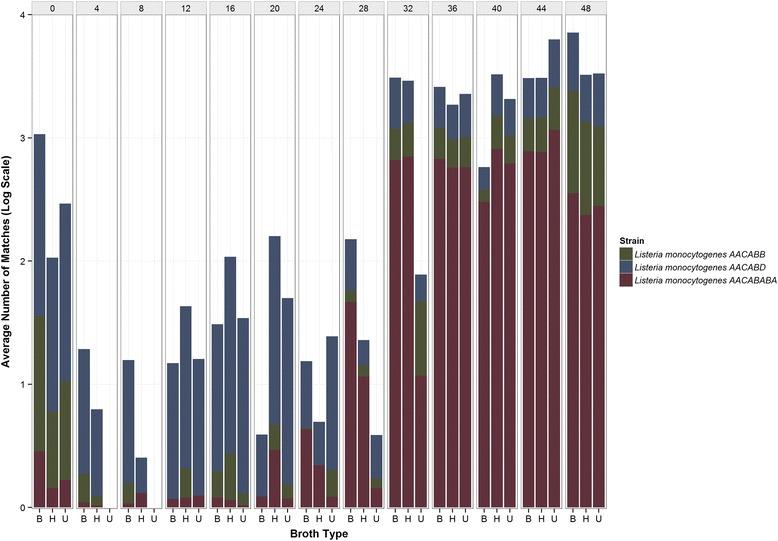
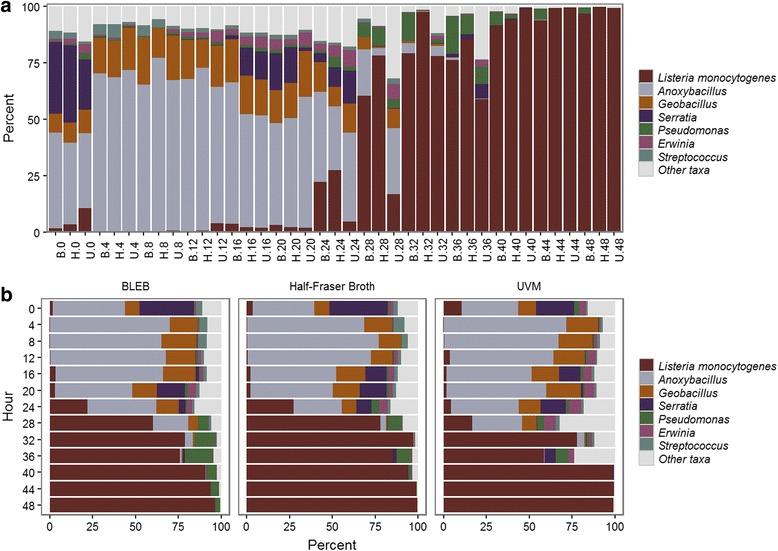
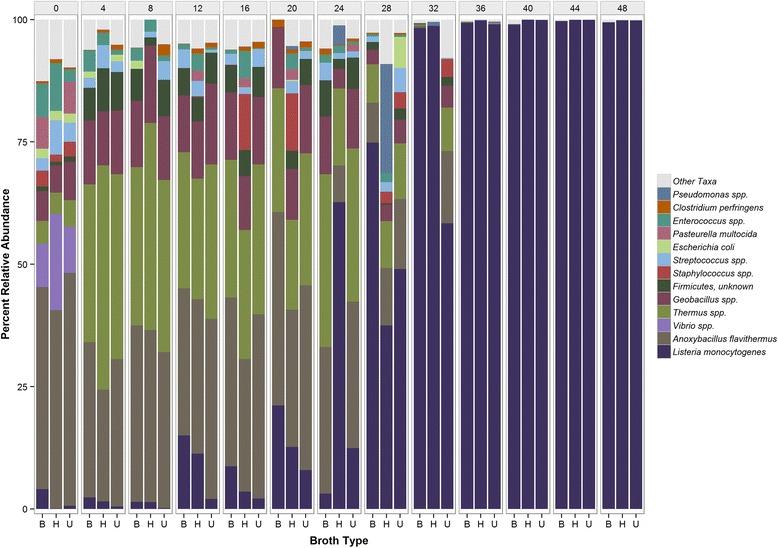
During enrichment, other bacterial taxa were identified, including Anoxybacillus, Geobacillus, Serratia, Pseudomonas, Erwinia, and Streptococcus spp. Surprisingly, incidence of L. monocytogenes was proportionally greater at hour 0 than when tested 4, 8, and 12 h later with all three enrichment schemes. The corresponding increase in Anoxybacillus and Geobacillus spp.indicated these taxa co-enriched in competition with L. monocytogenes during early enrichment hours. L. monocytogenes became dominant after 24 h in all three enrichments. DNA sequences obtained from shotgun metagenomic data of Listeria monocytogenes at 48 h were assembled to produce a consensus draft genome which appeared to have a similar tracking utility to pure culture isolates of L. monocytogenes.
CONCLUSIONS
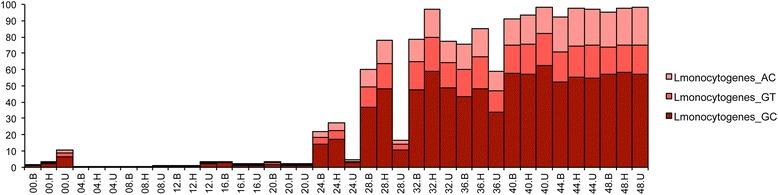
All three methods performed equally well for enrichment of Listeria monocytogenes. The observation of potential competitive exclusion of L. mono by Anoxybacillus and Geobacillus in early enrichment hours provided novel information that may be used to further optimize enrichment formulations. Application of Resphera Insight for high-resolution analysis of 16S amplicon sequences accurately identified L. monocytogenes. Both shotgun and 16S rRNA data supported the presence of three slightly variable genomes of L. monocytogenes. Moreover, the draft assembly of a consensus genome of L. monocytogenes from shotgun metagenomic data demonstrated the potential utility of this approach to expedite trace-back of outbreak-associated strains, although further validation will be needed to confirm this utility.
背景
在从食源性疾病暴发中回收病原体的过程中共同富集的微生物群会干扰有效的检测和回收。本文描述了在从与一次暴发相关的天然污染冰淇淋样本中回收单核细胞增生李斯特菌期间,美国食品药品监督管理局(FDA)、国际标准化组织(ISO)和美国农业部(USDA)使用的三种不同初始富集配方中共同富集的微生物群的动态变化。在48小时的富集过程中,每隔4小时从样本中提取DNA并进行测序,对富集培养物进行分析。分别使用Resphera Insight和CosmosID分析工具对16S rRNA扩增子和全基因组鸟枪法数据进行高分辨率分析。
结果
在富集过程中,鉴定出了其他细菌类群,包括嗜热栖热放线菌属、嗜热栖热放线菌属、沙雷氏菌属、假单胞菌属、欧文氏菌属和链球菌属。令人惊讶的是,在所有三种富集方案中,单核细胞增生李斯特菌在0小时时的发生率比在4、8和12小时后测试时按比例更高。嗜热栖热放线菌属和嗜热栖热放线菌属的相应增加表明,这些类群在早期富集阶段与单核细胞增生李斯特菌竞争共同富集。在所有三种富集中,单核细胞增生李斯特菌在24小时后占主导地位。对48小时时单核细胞增生李斯特菌的鸟枪法宏基因组数据获得的DNA序列进行组装,以产生一个共有基因组草图,该草图似乎具有与单核细胞增生李斯特菌纯培养分离株相似的追踪效用。
结论
所有三种方法在富集单核细胞增生李斯特菌方面表现同样出色。在早期富集阶段观察到嗜热栖热放线菌属和嗜热栖热放线菌属对单核细胞增生李斯特菌的潜在竞争性排斥提供了新信息,可用于进一步优化富集配方。使用Resphera Insight对16S扩增子序列进行高分辨率分析准确鉴定了单核细胞增生李斯特菌。鸟枪法和16S rRNA数据均支持存在三种略有差异的单核细胞增生李斯特菌基因组。此外,从鸟枪法宏基因组数据组装的单核细胞增生李斯特菌共有基因组草图证明了这种方法在加快与暴发相关菌株溯源方面的潜在效用,尽管需要进一步验证来确认这种效用。
 Zotero 插件