Calgary Pediatric Stroke Program, University of Calgary, Calgary, AB, Canada.
Calgary Pediatric Stroke Program, University of Calgary, Calgary, AB, Canada; Department of Pediatrics, Cumming School of Medicine, University of Calgary, Calgary, AB, Canada; Alberta Children's Hospital Research Institute, University of Calgary, Calgary, AB, Canada.
Neuroimage Clin. 2018 Jun 27;20:7-15. doi: 10.1016/j.nicl.2018.06.028. eCollection 2018.
Stroke is a leading cause of perinatal brain injury with variable outcomes including cerebral palsy and epilepsy. The biological processes that underlie these heterogeneous outcomes are poorly understood. Alterations in developmental myelination are recognized as a major determinant of outcome in preterm brain injury but have not been explored in perinatal stroke. We aimed to characterize myelination in hemiparetic children after arterial perinatal stroke, hypothesizing that ipsilesional myelination would be impaired, the degree of which would correlate with poor outcome.
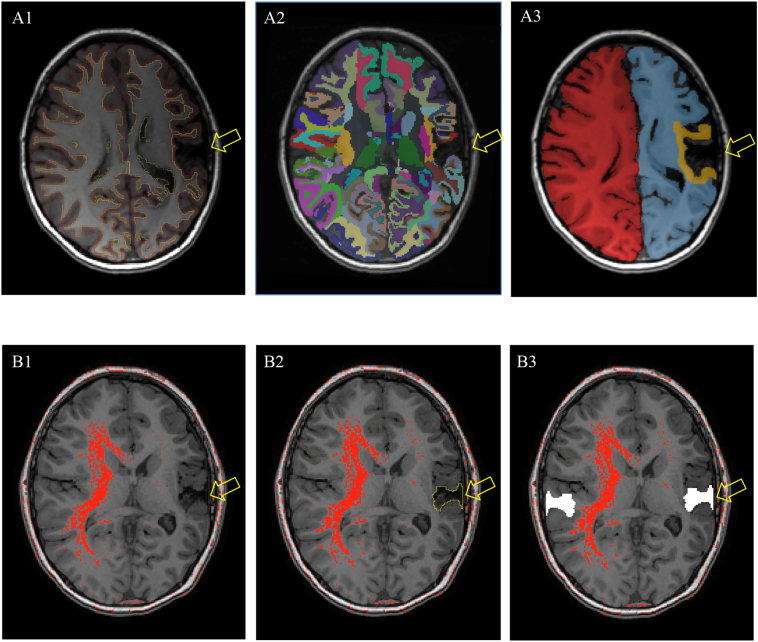
Retrospective, controlled cohort study. Participants were identified through the Alberta Perinatal Stroke Project (APSP), a population-based research cohort (n > 400). Inclusion criteria were: 1) MRI-confirmed, unilateral arterial perinatal stroke, 2) T1-weighted MRI after 6 months of age, 3) absence of other neurological disorders, 4) neurological outcome that included at least one of the following tests - Pediatric Stroke Outcome Measure (PSOM), Assisting Hand Assessment (AHA), Melbourne Assessment (MA), neuropsychological evaluation (NPE), and robotic sensorimotor measurements. FreeSurfer software measured hemispheric asymmetry in myelination intensity (primary outcome). A second method using ImageJ software validated the detection of myelination asymmetry. A repeated measures ANOVA was used to compare perilesional, ipsilesional remote, and contralesional homologous region myelination between stroke cases and typically developing controls. Myelination metrics were compared to clinical outcome measures (-test, Pearson's correlation).
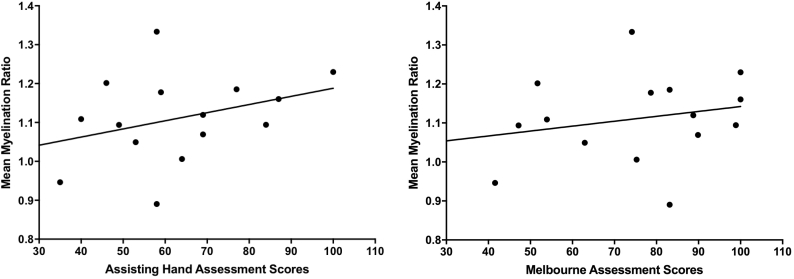
Twenty youth with arterial stroke (mean age: 13.4 ± 4.2yo) and 27 typically developing controls (mean age: 12.5 ± 3.7yo) were studied in FreeSurfer. Participants with stroke demonstrated lower myelination in the ipsilesional hemisphere (p < 0.0001). Myelination in perilesional regions had lower intensity compared to ipsilesional remote areas (p < .00001) and contralesional homologous areas (p < 0.00001). Ipsilesional remote regions had decreased myelination compared to homologous regions on the contralesional hemisphere (p = 0.016). Contralesional myelination was decreased compared to controls (p < 0.00001). Myelination metrics were not strongly associated with clinical motor, robotic sensorimotor, or neuropsychological outcomes though some complex tests requiring speeded responses had moderate effect sizes.
Myelination of apparently uninjured brain in both the ipsilesional and contralesional hemispheres is decreased after perinatal stroke. Differences appear to radiate outward from the lesion. Further study is needed to determine clinical significance.
中风是围产期脑损伤的主要原因,其结果包括脑瘫和癫痫。这些异质结果的生物学过程尚不清楚。发育性髓鞘形成的改变被认为是早产儿脑损伤预后的主要决定因素,但在围产期中风中尚未得到探讨。我们旨在描述动脉性围产期中风后偏瘫儿童的髓鞘形成情况,假设同侧髓鞘形成会受损,其程度与不良结局相关。
回顾性对照队列研究。参与者是通过艾伯塔围产期中风项目(APSP)确定的,这是一个基于人群的研究队列(n>400)。纳入标准为:1)MRI 证实的单侧动脉性围产期中风,2)6 个月后进行 T1 加权 MRI,3)无其他神经障碍,4)神经学结局至少包括以下一项测试 - 儿科中风结局量表(PSOM)、辅助手评估(AHA)、墨尔本评估(MA)、神经心理学评估(NPE)和机器人感觉运动测量。FreeSurfer 软件测量了髓鞘化强度的半球不对称性(主要结局)。使用 ImageJ 软件的第二种方法验证了髓鞘化不对称的检测。采用重复测量方差分析比较中风病例和典型发育对照组的病变周围、同侧远隔和对侧同源区域髓鞘化。髓鞘化指标与临床结局指标进行比较(-检验,皮尔逊相关)。
在 FreeSurfer 中研究了 20 名动脉性中风的年轻人(平均年龄:13.4±4.2 岁)和 27 名典型发育对照组(平均年龄:12.5±3.7 岁)。中风患者同侧半球的髓鞘化程度较低(p<0.0001)。病变周围区域的髓鞘化强度低于同侧远隔区(p<0.00001)和对侧同源区(p<0.00001)。同侧远隔区的髓鞘化程度低于对侧半球的同源区(p=0.016)。对侧髓鞘化程度低于对照组(p<0.00001)。髓鞘化指标与临床运动、机器人感觉运动或神经心理学结局无明显相关性,但一些需要快速反应的复杂测试具有中等效应大小。
围产期中风后,同侧和对侧半球未受伤的脑髓鞘化均减少。差异似乎从病变处向外辐射。需要进一步研究以确定其临床意义。