Arbor Research Collaborative for Health, Ann Arbor, Michigan.
Arbor Research Collaborative for Health, Ann Arbor, Michigan.
J Urol. 2018 Dec;200(6):1323-1331. doi: 10.1016/j.juro.2018.06.068. Epub 2018 Jul 7.
Women with lower urinary tract symptoms are often diagnosed based on a predefined symptom complex or a predominant symptom. There are many limitations to this paradigm as often patients present with multiple urinary symptoms which do not perfectly fit the preestablished diagnoses. We used cluster analysis to identify novel, symptom based subtypes of women with lower urinary tract symptoms.
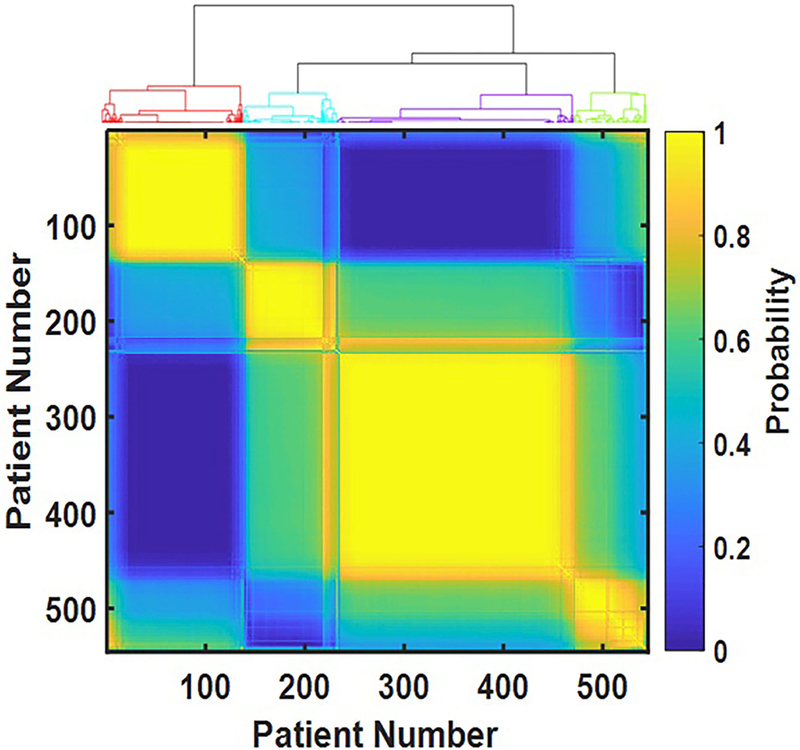
We analyzed baseline urinary symptom questionnaire data obtained from 545 care seeking female participants enrolled in the LURN (Symptoms of Lower Urinary Tract Dysfunction Research Network) Observational Cohort Study. Symptoms were measured with the LUTS (lower urinary tract symptoms) Tool and the AUA SI (American Urological Association Symptom Index), and analyzed using a probability based consensus clustering algorithm.
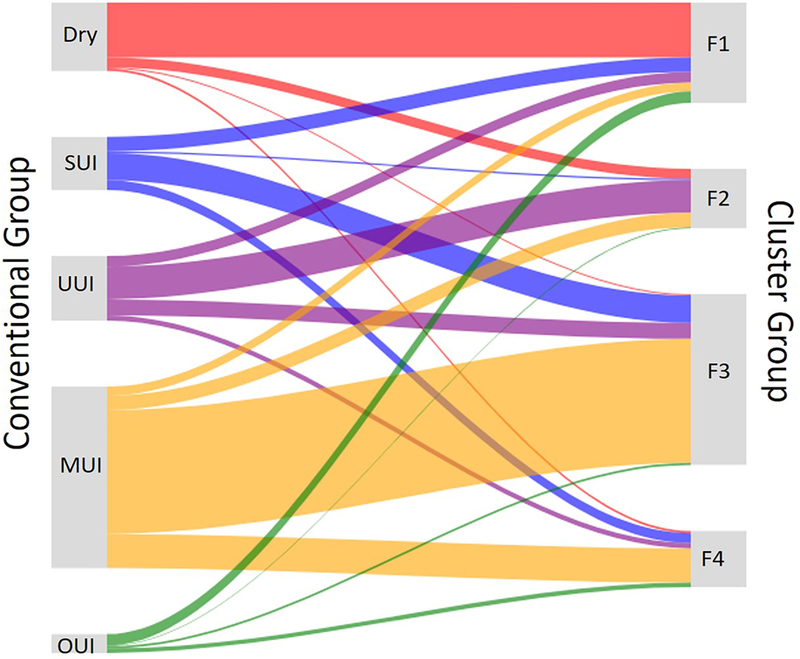
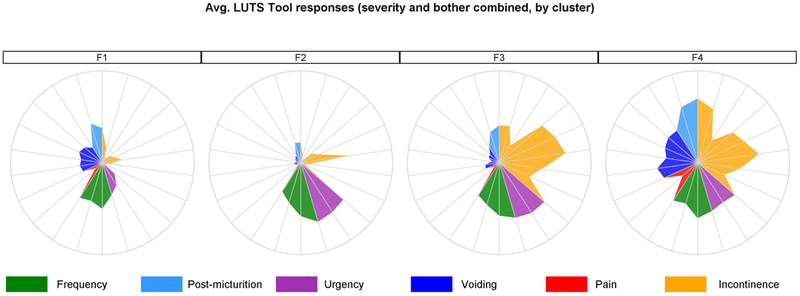
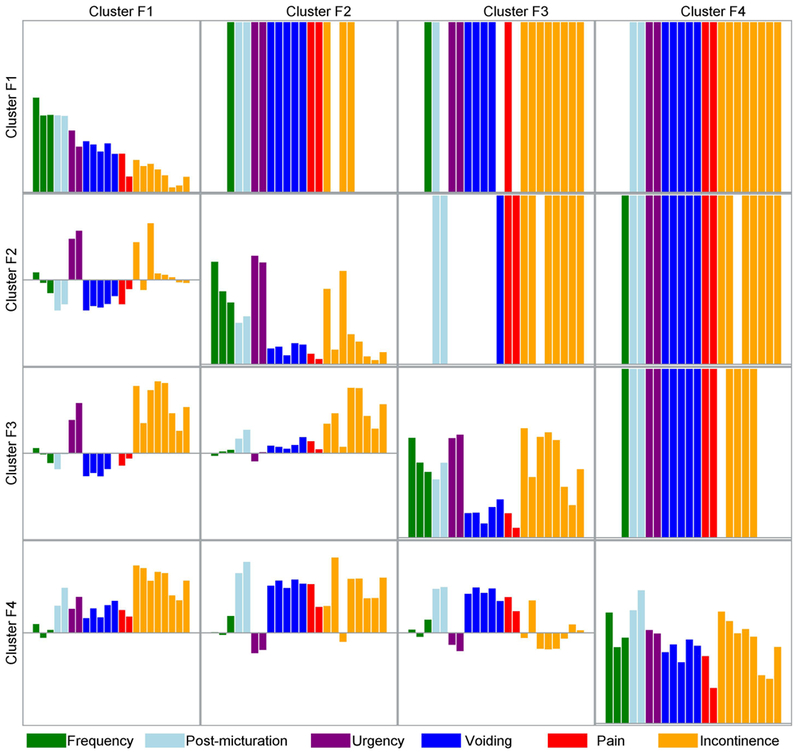
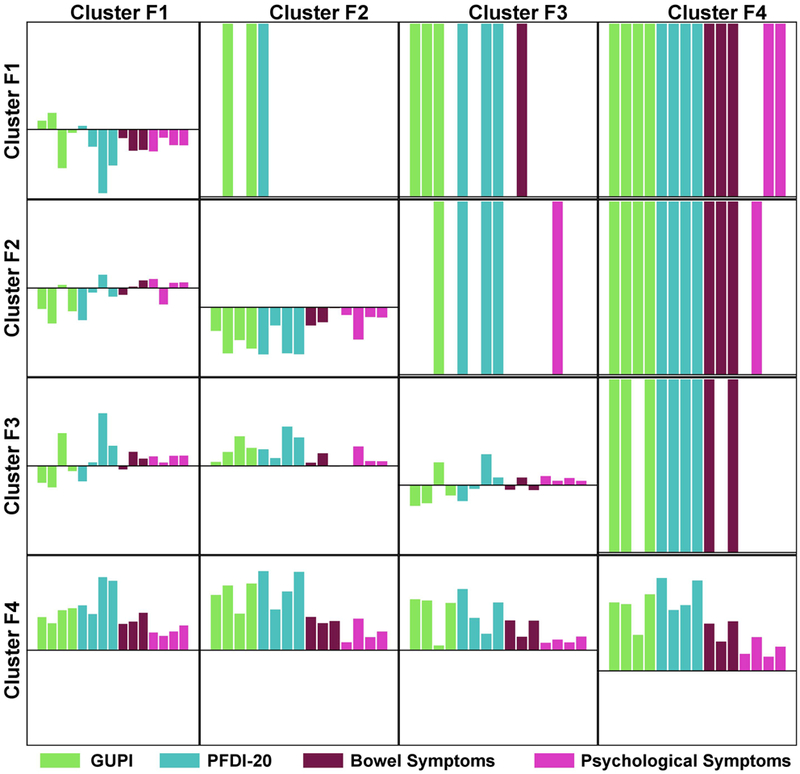
Four clusters were identified. The 138 women in cluster F1 did not report incontinence but experienced post-void dribbling, frequency and voiding symptoms. The 80 women in cluster F2 reported urgency incontinence as well as urgency and frequency but minimal voiding symptoms or stress incontinence. Cluster F3 included 244 women who reported all types of incontinence, urgency, frequency and mild voiding symptoms. The 83 women in cluster F4 reported all lower urinary tract symptoms at uniformly high levels. All but 2 of 44 LUTS Tool and 8 AUA SI questions significantly differed between at least 2 clusters (p <0.05). All clusters contained at least 1 member from each conventional group, including continence, and stress, urgency, mixed and other incontinence.
Women seeking care for lower urinary tract symptoms cluster into 4 distinct symptom groups which differ from conventional clinical diagnostic groups. Further validation is needed to determine whether management improves using this new classification.
下尿路症状女性患者的诊断通常基于预先设定的症状综合或主要症状。但这种方法存在许多局限性,因为患者常常出现多种不完全符合既定诊断的尿路症状。我们使用聚类分析来确定下尿路症状女性患者的新型、基于症状的亚型。
我们分析了来自 545 名寻求治疗的女性参与者的基线尿症状问卷数据,这些参与者参加了 LURN(下尿路功能障碍症状研究网络)观察性队列研究。使用 LUTS(下尿路症状)工具和 AUA SI(美国泌尿协会症状指数)测量症状,并使用基于概率的共识聚类算法进行分析。
确定了 4 个聚类。F1 聚类的 138 名女性没有报告尿失禁,但经历了排尿后滴沥、频率和排尿症状。F2 聚类的 80 名女性报告了急迫性尿失禁以及急迫性和频率,但排尿症状或压力性尿失禁轻微。F3 聚类包括 244 名报告所有类型尿失禁、急迫性、频率和轻度排尿症状的女性。F4 聚类的 83 名女性报告所有下尿路症状均处于统一的高水平。至少有 2 个聚类之间的 44 个 LUTS 工具和 8 个 AUA SI 问题显著不同(p<0.05)。所有聚类都至少包含来自每个传统组的 1 名成员,包括控尿、压力性、急迫性、混合性和其他尿失禁。
寻求下尿路症状治疗的女性患者分为 4 个不同的症状组,与传统的临床诊断组不同。需要进一步验证是否使用这种新分类可以改善管理。