Quantitative Biomedical Research Center, Department of Clinical Sciences, University of Texas Southwestern Medical Center, Dallas, Texas, 75390, USA.
Department of Computer Sciences, Massachusetts Institute of Technology, Cambridge, MA, USA.
Sci Rep. 2018 Jul 10;8(1):10393. doi: 10.1038/s41598-018-27707-4.
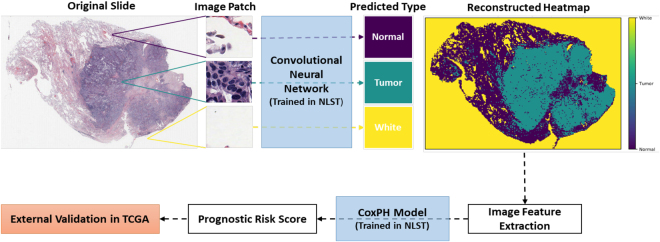
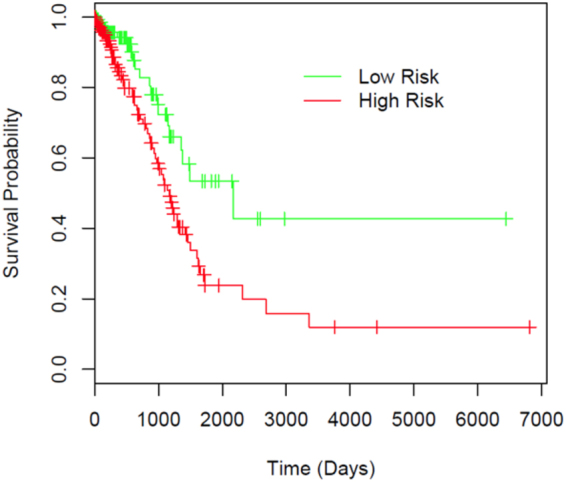
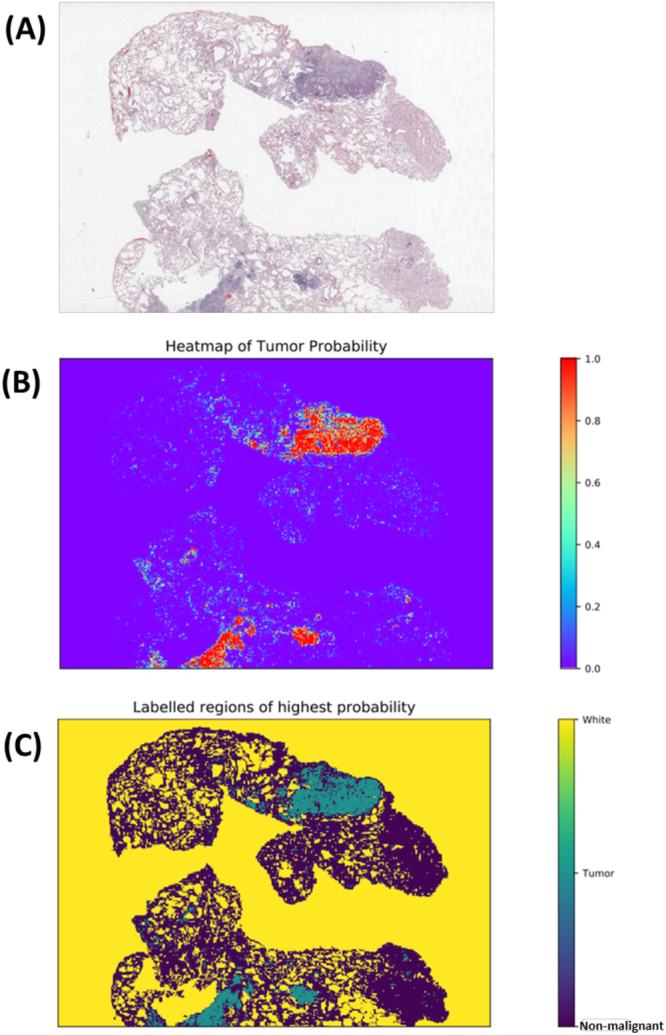
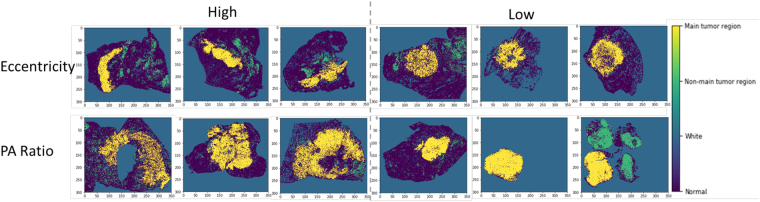
Pathology images capture tumor histomorphological details in high resolution. However, manual detection and characterization of tumor regions in pathology images is labor intensive and subjective. Using a deep convolutional neural network (CNN), we developed an automated tumor region recognition system for lung cancer pathology images. From the identified tumor regions, we extracted 22 well-defined shape and boundary features and found that 15 of them were significantly associated with patient survival outcome in lung adenocarcinoma patients from the National Lung Screening Trial. A tumor region shape-based prognostic model was developed and validated in an independent patient cohort (n = 389). The predicted high-risk group had significantly worse survival than the low-risk group (p value = 0.0029). Predicted risk group serves as an independent prognostic factor (high-risk vs. low-risk, hazard ratio = 2.25, 95% CI 1.34-3.77, p value = 0.0022) after adjusting for age, gender, smoking status, and stage. This study provides new insights into the relationship between tumor shape and patient prognosis.
病理学图像以高分辨率捕捉肿瘤组织形态学细节。然而,手动检测和描绘病理学图像中的肿瘤区域既费力又主观。我们使用深度卷积神经网络(CNN)开发了一种用于肺癌病理学图像的自动肿瘤区域识别系统。从识别的肿瘤区域中,我们提取了 22 个定义明确的形状和边界特征,发现在来自国家肺癌筛查试验的肺腺癌患者中,其中 15 个特征与患者生存结果显著相关。在一个独立的患者队列(n=389)中开发并验证了基于肿瘤区域形状的预后模型。预测的高危组的生存明显差于低危组(p 值=0.0029)。预测的风险组在调整年龄、性别、吸烟状况和分期后是一个独立的预后因素(高危 vs. 低危,风险比=2.25,95%CI 1.34-3.77,p 值=0.0022)。本研究为肿瘤形状与患者预后之间的关系提供了新的见解。