• 文献检索
  • 文档翻译
  • 深度研究
  • 学术资讯
  • Suppr Zotero 插件Zotero 插件
  • 邀请有礼
  • 套餐&价格
  • 历史记录
应用&插件
Suppr Zotero 插件Zotero 插件浏览器插件Mac 客户端Windows 客户端微信小程序
定价
高级版会员购买积分包购买API积分包
服务
文献检索文档翻译深度研究API 文档MCP 服务
关于我们
关于 Suppr公司介绍联系我们用户协议隐私条款
关注我们

Suppr 超能文献

核心技术专利:CN118964589B侵权必究
粤ICP备2023148730 号-1Suppr @ 2026

文献检索

告别复杂PubMed语法,用中文像聊天一样搜索,搜遍4000万医学文献。AI智能推荐,让科研检索更轻松。

立即免费搜索

文件翻译

保留排版,准确专业,支持PDF/Word/PPT等文件格式,支持 12+语言互译。

免费翻译文档

深度研究

AI帮你快速写综述,25分钟生成高质量综述,智能提取关键信息,辅助科研写作。

立即免费体验

卷积神经网络评分和最小化在 D3R 2017 社区挑战赛中。

Convolutional neural network scoring and minimization in the D3R 2017 community challenge.

机构信息

Department of Computational & Systems Biology, School of Medicine, University of Pittsburgh, 3501 Fifth Avenue, Suite 3064, Biomedical Science Tower 3 (BST3), Pittsburgh, PA, 15260, USA.

出版信息

J Comput Aided Mol Des. 2019 Jan;33(1):19-34. doi: 10.1007/s10822-018-0133-y. Epub 2018 Jul 10.

DOI:10.1007/s10822-018-0133-y
PMID:29992528
原文链接:https://pmc.ncbi.nlm.nih.gov/articles/PMC6931043/
Abstract

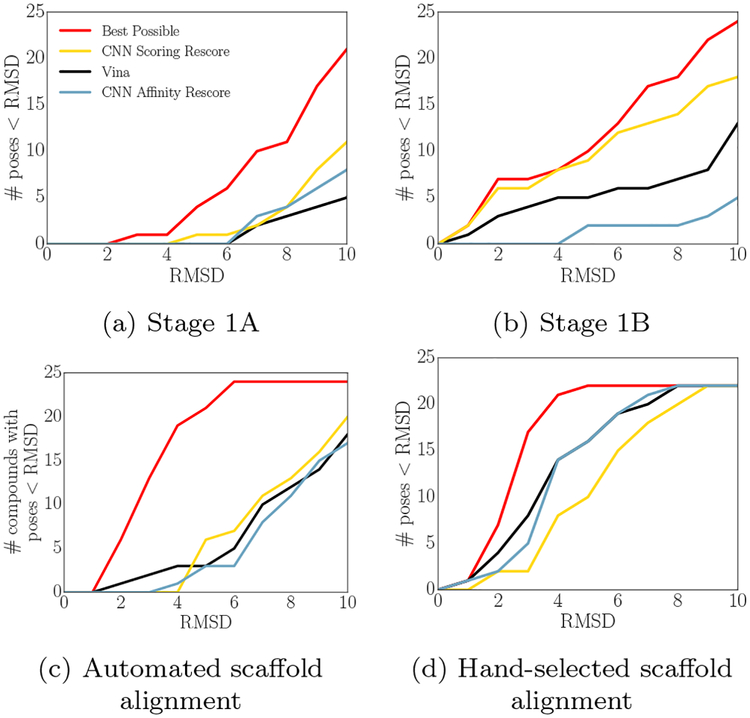
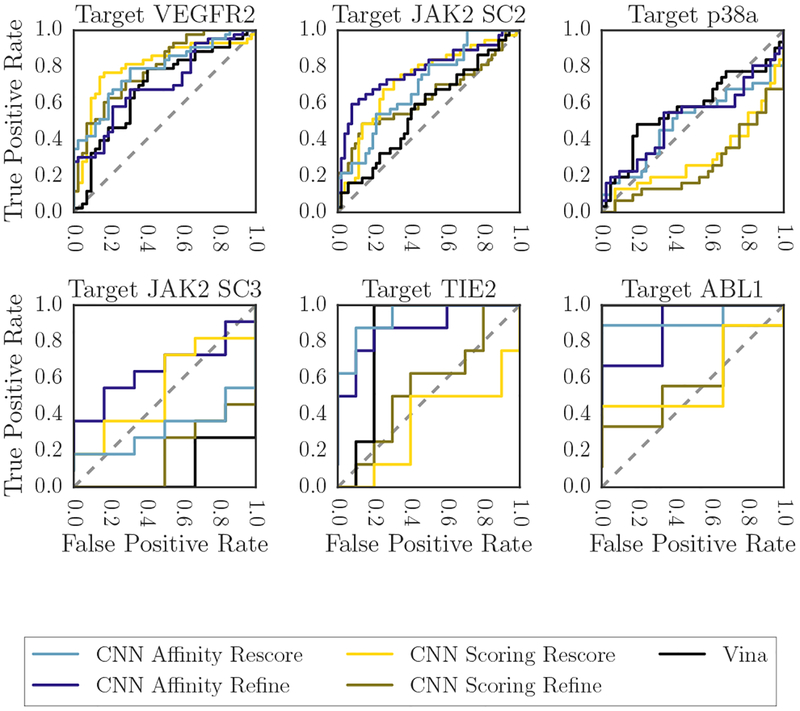
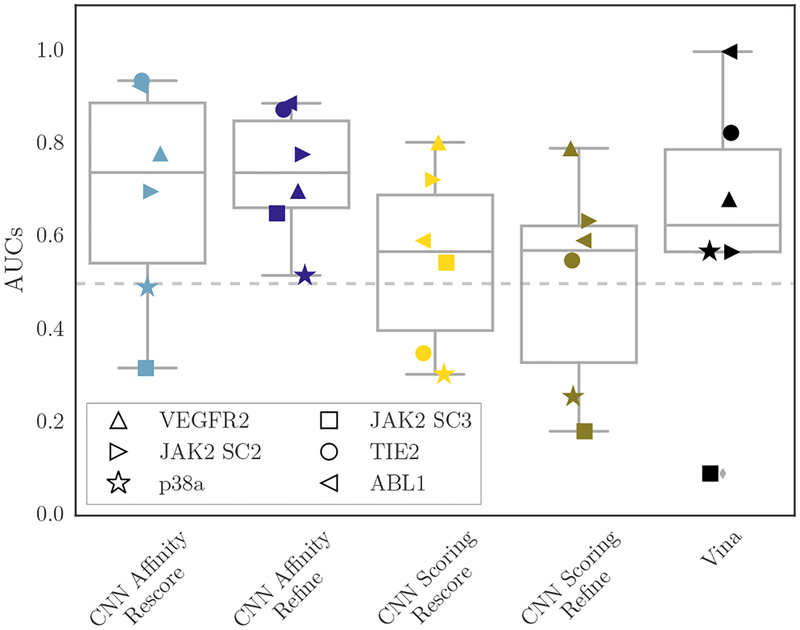
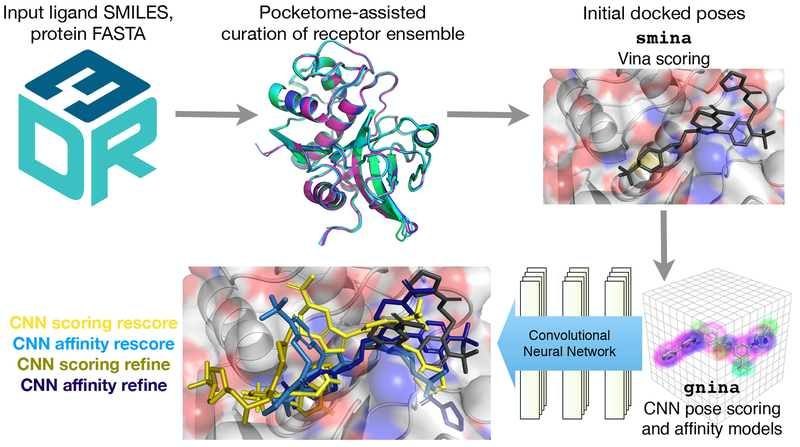
We assess the ability of our convolutional neural network (CNN)-based scoring functions to perform several common tasks in the domain of drug discovery. These include correctly identifying ligand poses near and far from the true binding mode when given a set of reference receptors and classifying ligands as active or inactive using structural information. We use the CNN to re-score or refine poses generated using a conventional scoring function, Autodock Vina, and compare the performance of each of these methods to using the conventional scoring function alone. Furthermore, we assess several ways of choosing appropriate reference receptors in the context of the D3R 2017 community benchmarking challenge. We find that our CNN scoring function outperforms Vina on most tasks without requiring manual inspection by a knowledgeable operator, but that the pose prediction target chosen for the challenge, Cathepsin S, was particularly challenging for de novo docking. However, the CNN provided best-in-class performance on several virtual screening tasks, underscoring the relevance of deep learning to the field of drug discovery.

摘要

我们评估了基于卷积神经网络 (CNN) 的评分函数在药物发现领域执行几个常见任务的能力。这些任务包括在给定一组参考受体时正确识别靠近和远离真实结合模式的配体构象,以及使用结构信息将配体分类为活性或非活性。我们使用 CNN 重新评分或改进使用传统评分函数(Autodock Vina)生成的构象,并将每种方法的性能与仅使用传统评分函数进行比较。此外,我们评估了在 D3R 2017 社区基准测试挑战的背景下选择合适参考受体的几种方法。我们发现,我们的 CNN 评分函数在大多数任务上都优于 Vina,而无需由有知识的操作员进行手动检查,但为挑战选择的 Cathepsin S 构象预测目标对从头开始对接特别具有挑战性。然而,CNN 在几个虚拟筛选任务中提供了同类最佳的性能,突显了深度学习在药物发现领域的相关性。
https://cdn.ncbi.nlm.nih.gov/pmc/blobs/41d5/6931043/7b39e97b865f/nihms-1063496-f0015.jpg
https://cdn.ncbi.nlm.nih.gov/pmc/blobs/41d5/6931043/d78804448b61/nihms-1063496-f0001.jpg
https://cdn.ncbi.nlm.nih.gov/pmc/blobs/41d5/6931043/e47f1707af1e/nihms-1063496-f0002.jpg
https://cdn.ncbi.nlm.nih.gov/pmc/blobs/41d5/6931043/a60da13ab636/nihms-1063496-f0003.jpg
https://cdn.ncbi.nlm.nih.gov/pmc/blobs/41d5/6931043/556ea7c44450/nihms-1063496-f0004.jpg
https://cdn.ncbi.nlm.nih.gov/pmc/blobs/41d5/6931043/c5c23b2467b9/nihms-1063496-f0005.jpg
https://cdn.ncbi.nlm.nih.gov/pmc/blobs/41d5/6931043/f77d19d0e9ee/nihms-1063496-f0006.jpg
https://cdn.ncbi.nlm.nih.gov/pmc/blobs/41d5/6931043/97f0d99c5071/nihms-1063496-f0007.jpg
https://cdn.ncbi.nlm.nih.gov/pmc/blobs/41d5/6931043/81fb2f6c9a85/nihms-1063496-f0008.jpg
https://cdn.ncbi.nlm.nih.gov/pmc/blobs/41d5/6931043/531a1a13b35a/nihms-1063496-f0009.jpg
https://cdn.ncbi.nlm.nih.gov/pmc/blobs/41d5/6931043/b71a687b0e1e/nihms-1063496-f0010.jpg
https://cdn.ncbi.nlm.nih.gov/pmc/blobs/41d5/6931043/ff030cc8feb9/nihms-1063496-f0011.jpg
https://cdn.ncbi.nlm.nih.gov/pmc/blobs/41d5/6931043/c678bcced06c/nihms-1063496-f0012.jpg
https://cdn.ncbi.nlm.nih.gov/pmc/blobs/41d5/6931043/cd57d57b76d7/nihms-1063496-f0013.jpg
https://cdn.ncbi.nlm.nih.gov/pmc/blobs/41d5/6931043/9cf3c6f3afe4/nihms-1063496-f0014.jpg
https://cdn.ncbi.nlm.nih.gov/pmc/blobs/41d5/6931043/7b39e97b865f/nihms-1063496-f0015.jpg
https://cdn.ncbi.nlm.nih.gov/pmc/blobs/41d5/6931043/d78804448b61/nihms-1063496-f0001.jpg
https://cdn.ncbi.nlm.nih.gov/pmc/blobs/41d5/6931043/e47f1707af1e/nihms-1063496-f0002.jpg
https://cdn.ncbi.nlm.nih.gov/pmc/blobs/41d5/6931043/a60da13ab636/nihms-1063496-f0003.jpg
https://cdn.ncbi.nlm.nih.gov/pmc/blobs/41d5/6931043/556ea7c44450/nihms-1063496-f0004.jpg
https://cdn.ncbi.nlm.nih.gov/pmc/blobs/41d5/6931043/c5c23b2467b9/nihms-1063496-f0005.jpg
https://cdn.ncbi.nlm.nih.gov/pmc/blobs/41d5/6931043/f77d19d0e9ee/nihms-1063496-f0006.jpg
https://cdn.ncbi.nlm.nih.gov/pmc/blobs/41d5/6931043/97f0d99c5071/nihms-1063496-f0007.jpg
https://cdn.ncbi.nlm.nih.gov/pmc/blobs/41d5/6931043/81fb2f6c9a85/nihms-1063496-f0008.jpg
https://cdn.ncbi.nlm.nih.gov/pmc/blobs/41d5/6931043/531a1a13b35a/nihms-1063496-f0009.jpg
https://cdn.ncbi.nlm.nih.gov/pmc/blobs/41d5/6931043/b71a687b0e1e/nihms-1063496-f0010.jpg
https://cdn.ncbi.nlm.nih.gov/pmc/blobs/41d5/6931043/ff030cc8feb9/nihms-1063496-f0011.jpg
https://cdn.ncbi.nlm.nih.gov/pmc/blobs/41d5/6931043/c678bcced06c/nihms-1063496-f0012.jpg
https://cdn.ncbi.nlm.nih.gov/pmc/blobs/41d5/6931043/cd57d57b76d7/nihms-1063496-f0013.jpg
https://cdn.ncbi.nlm.nih.gov/pmc/blobs/41d5/6931043/9cf3c6f3afe4/nihms-1063496-f0014.jpg
https://cdn.ncbi.nlm.nih.gov/pmc/blobs/41d5/6931043/7b39e97b865f/nihms-1063496-f0015.jpg

相似文献

1
Convolutional neural network scoring and minimization in the D3R 2017 community challenge.卷积神经网络评分和最小化在 D3R 2017 社区挑战赛中。
J Comput Aided Mol Des. 2019 Jan;33(1):19-34. doi: 10.1007/s10822-018-0133-y. Epub 2018 Jul 10.
2
Protein-Ligand Scoring with Convolutional Neural Networks.基于卷积神经网络的蛋白质-配体评分
J Chem Inf Model. 2017 Apr 24;57(4):942-957. doi: 10.1021/acs.jcim.6b00740. Epub 2017 Apr 11.
3
Calculate protein-ligand binding affinities with the extended linear interaction energy method: application on the Cathepsin S set in the D3R Grand Challenge 3.用扩展线性相互作用能方法计算蛋白质-配体结合亲和力:在 D3R 大挑战 3 中的组织蛋白酶 S 集上的应用。
J Comput Aided Mol Des. 2019 Jan;33(1):105-117. doi: 10.1007/s10822-018-0162-6. Epub 2018 Sep 14.
4
Mathematical deep learning for pose and binding affinity prediction and ranking in D3R Grand Challenges.用于 D3R 大挑战中的构象和结合亲和力预测和排序的数学深度学习。
J Comput Aided Mol Des. 2019 Jan;33(1):71-82. doi: 10.1007/s10822-018-0146-6. Epub 2018 Aug 16.
5
Boosted neural networks scoring functions for accurate ligand docking and ranking.用于精确配体对接和排序的增强神经网络评分函数。
J Bioinform Comput Biol. 2018 Apr;16(2):1850004. doi: 10.1142/S021972001850004X. Epub 2018 Feb 4.
6
Task-Specific Scoring Functions for Predicting Ligand Binding Poses and Affinity and for Screening Enrichment.用于预测配体结合构象和亲和力以及进行筛选富集的任务特定评分函数。
J Chem Inf Model. 2018 Jan 22;58(1):119-133. doi: 10.1021/acs.jcim.7b00309. Epub 2017 Dec 20.
7
Docking of small molecules to farnesoid X receptors using AutoDock Vina with the Convex-PL potential: lessons learned from D3R Grand Challenge 2.使用 AutoDock Vina 和 Convex-PL 势能对接法对接法尼醇 X 受体上的小分子:从 D3R 大挑战 2 中学到的经验教训。
J Comput Aided Mol Des. 2018 Jan;32(1):151-162. doi: 10.1007/s10822-017-0062-1. Epub 2017 Sep 14.
8
Exploring fragment-based target-specific ranking protocol with machine learning on cathepsin S.基于半胱氨酸蛋白酶 S 的机器学习探索片段基靶标特异性排序协议。
J Comput Aided Mol Des. 2019 Dec;33(12):1095-1105. doi: 10.1007/s10822-019-00247-3. Epub 2019 Nov 15.
9
D3R Grand Challenge 4: prospective pose prediction of BACE1 ligands with AutoDock-GPU.D3R 大挑战 4:使用 AutoDock-GPU 对 BACE1 配体进行前瞻性构象预测。
J Comput Aided Mol Des. 2019 Dec;33(12):1071-1081. doi: 10.1007/s10822-019-00241-9. Epub 2019 Nov 6.
10
Hybrid receptor structure/ligand-based docking and activity prediction in ICM: development and evaluation in D3R Grand Challenge 3.ICM 中的混合受体结构/配体对接和活性预测:D3R 大挑战 3 的开发和评估。
J Comput Aided Mol Des. 2019 Jan;33(1):35-46. doi: 10.1007/s10822-018-0139-5. Epub 2018 Aug 9.

引用本文的文献

1
High-Throughput, High-Quality: Benchmarking GNINA and AutoDock Vina for Precision Virtual Screening Workflow.高通量、高质量:对GNINA和AutoDock Vina进行基准测试以实现精确虚拟筛选工作流程
Molecules. 2025 Aug 13;30(16):3361. doi: 10.3390/molecules30163361.
2
Advances in machine-learning approaches to RNA-targeted drug design.用于RNA靶向药物设计的机器学习方法的进展。
Artif Intell Chem. 2024 Jun;2(1). doi: 10.1016/j.aichem.2024.100053. Epub 2024 Feb 6.
3
RNA-ligand molecular docking: advances and challenges.RNA-配体分子对接:进展与挑战

本文引用的文献

1
Visualizing convolutional neural network protein-ligand scoring.可视化卷积神经网络的蛋白质配体评分。
J Mol Graph Model. 2018 Sep;84:96-108. doi: 10.1016/j.jmgm.2018.06.005. Epub 2018 Jun 18.
2
Statistical and machine learning approaches to predicting protein-ligand interactions.统计和机器学习方法在预测蛋白质-配体相互作用中的应用。
Curr Opin Struct Biol. 2018 Apr;49:123-128. doi: 10.1016/j.sbi.2018.01.006. Epub 2018 Feb 20.
3
K: Protein-Ligand Absolute Binding Affinity Prediction via 3D-Convolutional Neural Networks.基于 3D 卷积神经网络的蛋白-配体绝对结合亲和力预测
Wiley Interdiscip Rev Comput Mol Sci. 2022 May-Jun;12(3). doi: 10.1002/wcms.1571. Epub 2021 Aug 16.
4
AI-accelerated protein-ligand docking for SARS-CoV-2 is 100-fold faster with no significant change in detection.AI 加速的 SARS-CoV-2 蛋白-配体对接速度提高了 100 倍,而检测结果没有明显变化。
Sci Rep. 2023 Feb 6;13(1):2105. doi: 10.1038/s41598-023-28785-9.
5
Beyond sequence: Structure-based machine learning.超越序列:基于结构的机器学习。
Comput Struct Biotechnol J. 2022 Dec 29;21:630-643. doi: 10.1016/j.csbj.2022.12.039. eCollection 2023.
6
Opportunities and challenges in application of artificial intelligence in pharmacology.人工智能在药理学应用中的机遇与挑战。
Pharmacol Rep. 2023 Feb;75(1):3-18. doi: 10.1007/s43440-022-00445-1. Epub 2023 Jan 9.
7
Scoring Functions for Protein-Ligand Binding Affinity Prediction using Structure-Based Deep Learning: A Review.基于结构的深度学习预测蛋白质-配体结合亲和力的评分函数综述
Front Bioinform. 2022 Jun 17;2. doi: 10.3389/fbinf.2022.885983.
8
Protein Science Meets Artificial Intelligence: A Systematic Review and a Biochemical Meta-Analysis of an Inter-Field.蛋白质科学与人工智能相遇:跨领域的系统评价与生化荟萃分析
Front Bioeng Biotechnol. 2022 Jul 7;10:788300. doi: 10.3389/fbioe.2022.788300. eCollection 2022.
9
Delta Machine Learning to Improve Scoring-Ranking-Screening Performances of Protein-Ligand Scoring Functions.利用 Delta 机器学习改进蛋白质配体打分函数的评分-排名-筛选性能。
J Chem Inf Model. 2022 Jun 13;62(11):2696-2712. doi: 10.1021/acs.jcim.2c00485. Epub 2022 May 17.
10
Virtual Screening with Gnina 1.0.Gnina 1.0 虚拟筛选。
Molecules. 2021 Dec 4;26(23):7369. doi: 10.3390/molecules26237369.
J Chem Inf Model. 2018 Feb 26;58(2):287-296. doi: 10.1021/acs.jcim.7b00650. Epub 2018 Jan 29.
4
D3R Grand Challenge 2: blind prediction of protein-ligand poses, affinity rankings, and relative binding free energies.D3R 大挑战 2:蛋白质-配体构象、亲和力排序和相对结合自由能的盲预测。
J Comput Aided Mol Des. 2018 Jan;32(1):1-20. doi: 10.1007/s10822-017-0088-4. Epub 2017 Dec 4.
5
Protein-Ligand Scoring with Convolutional Neural Networks.基于卷积神经网络的蛋白质-配体评分
J Chem Inf Model. 2017 Apr 24;57(4):942-957. doi: 10.1021/acs.jcim.6b00740. Epub 2017 Apr 11.
6
Forging the Basis for Developing Protein-Ligand Interaction Scoring Functions.为开发蛋白质-配体相互作用评分函数奠定基础。
Acc Chem Res. 2017 Feb 21;50(2):302-309. doi: 10.1021/acs.accounts.6b00491. Epub 2017 Feb 9.
7
D3R grand challenge 2015: Evaluation of protein-ligand pose and affinity predictions.2015年D3R重大挑战:蛋白质-配体构象与亲和力预测评估
J Comput Aided Mol Des. 2016 Sep;30(9):651-668. doi: 10.1007/s10822-016-9946-8. Epub 2016 Sep 30.
8
Lessons Learned over Four Benchmark Exercises from the Community Structure-Activity Resource.从社区结构-活性资源的四项基准练习中学到的经验教训。
J Chem Inf Model. 2016 Jun 27;56(6):951-4. doi: 10.1021/acs.jcim.6b00182.
9
CSAR 2014: A Benchmark Exercise Using Unpublished Data from Pharma.2014年临床研究分析报告:一项使用制药行业未公开数据的基准测试。
J Chem Inf Model. 2016 Jun 27;56(6):1063-77. doi: 10.1021/acs.jcim.5b00523. Epub 2016 May 17.
10
Accurate calculation of the absolute free energy of binding for drug molecules.药物分子结合绝对自由能的精确计算。
Chem Sci. 2016 Jan 14;7(1):207-218. doi: 10.1039/c5sc02678d. Epub 2015 Oct 7.