Department of Mechanical Engineering, University of Maryland, College Park, USA.
School of Mechanical Engineering, Chonnam National University, Gwangju, South Korea.
Sci Rep. 2018 Jul 11;8(1):10433. doi: 10.1038/s41598-018-28604-6.
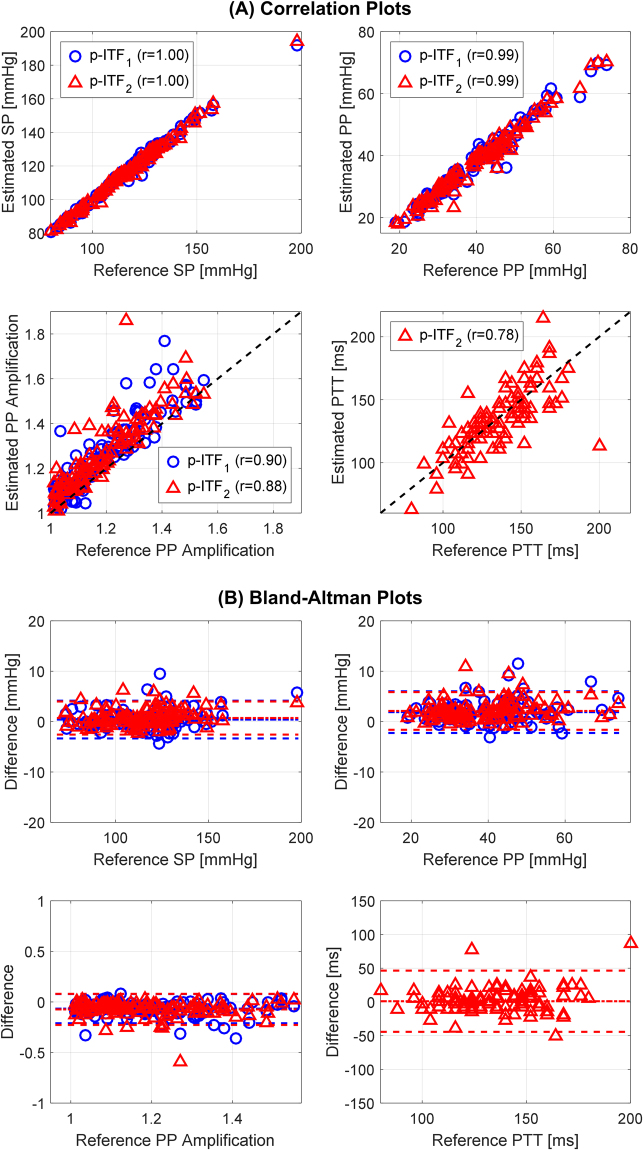
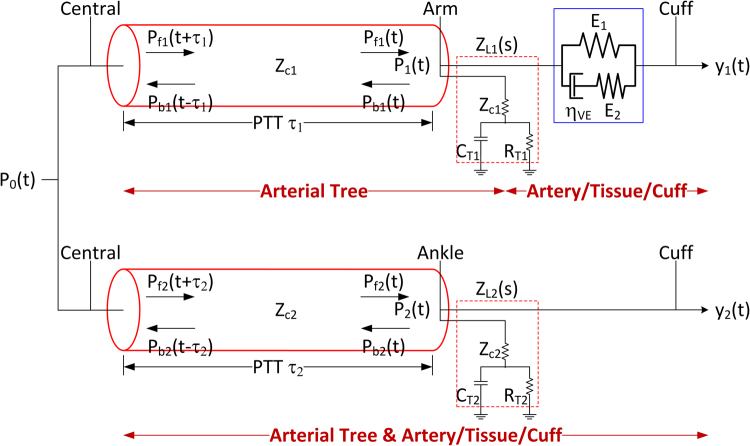
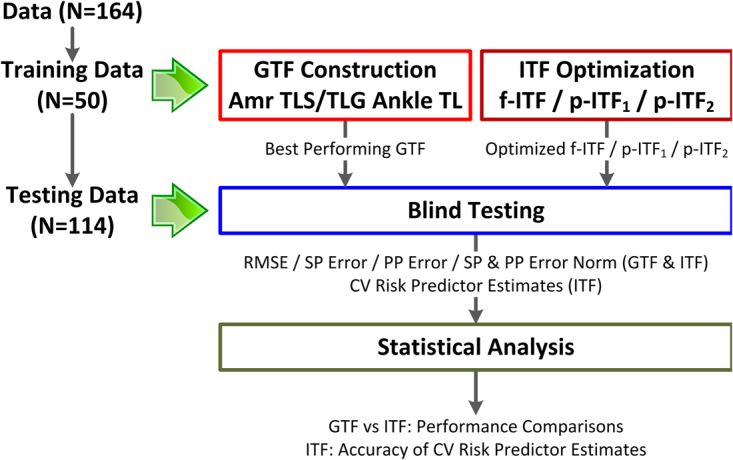
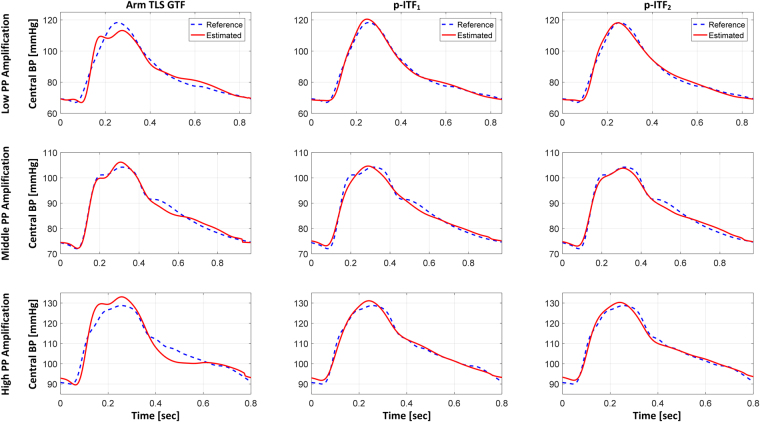
This paper presents a novel multiple measurement information fusion approach to the estimation of cardiovascular risk predictors from non-invasive pulse volume waveforms measured at the body's diametric (arm and ankle) locations. Leveraging the fact that diametric pulse volume waveforms originate from the common central pulse waveform, the approach estimates cardiovascular risk predictors in three steps by: (1) deriving lumped-parameter models of the central-diametric arterial lines from diametric pulse volume waveforms, (2) estimating central blood pressure waveform by analyzing the diametric pulse volume waveforms using the derived arterial line models, and (3) estimating cardiovascular risk predictors (including central systolic and pulse pressures, pulse pressure amplification, and pulse transit time) from the arterial line models and central blood pressure waveform in conjunction with the diametric pulse volume waveforms. Experimental results obtained from 164 human subjects with a wide blood pressure range (systolic 144 mmHg and diastolic 103 mmHg) showed that the approach could estimate cardiovascular risk predictors accurately (r ≥ 0.78). Further analysis showed that the approach outperformed a generalized transfer function regardless of the degree of pulse pressure amplification. The approach may be integrated with already available medical devices to enable convenient out-of-clinic cardiovascular risk prediction.
本文提出了一种新颖的多测量信息融合方法,用于从身体直径(手臂和脚踝)位置测量的无创脉搏体积波中估计心血管风险预测因子。利用直径脉搏体积波源自共同的中心脉搏波这一事实,该方法通过以下三个步骤来估计心血管风险预测因子:(1)从直径脉搏体积波推导出中心-直径动脉线的集总参数模型;(2)通过使用推导出的动脉线模型分析直径脉搏体积波来估计中心血压波形;(3)通过将动脉线模型和中心血压波形与直径脉搏体积波结合,从动脉线模型和中心血压波形中估计心血管风险预测因子(包括中心收缩压和脉搏压、脉搏压放大和脉搏传输时间)。从血压范围广泛的 164 名人类受试者(收缩压 144mmHg 和舒张压 103mmHg)获得的实验结果表明,该方法可以准确估计心血管风险预测因子(r≥0.78)。进一步的分析表明,该方法优于广义传递函数,无论脉搏压放大程度如何。该方法可以与现有的医疗设备集成,以实现方便的诊所外心血管风险预测。