Werkhausen Amelie, Albracht Kirsten, Cronin Neil J, Paulsen Gøran, Bojsen-Møller Jens, Seynnes Olivier R
Department of Physical Performance, Norwegian School of Sport Sciences, Oslo, Norway.
Institute of Biomechanics and Orthopaedics, German Sport University Cologne, Cologne, Germany.
Front Physiol. 2018 Jun 26;9:794. doi: 10.3389/fphys.2018.00794. eCollection 2018.
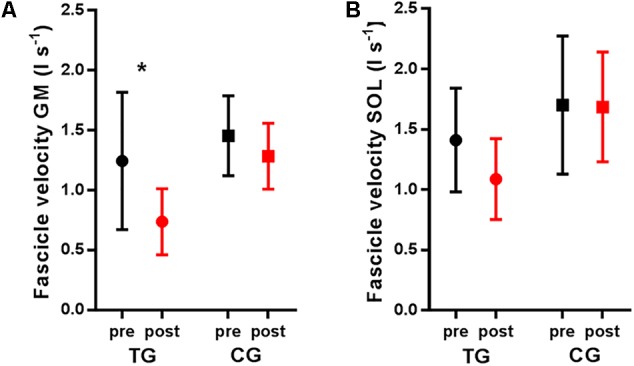
During rapid deceleration of the body, tendons buffer part of the elongation of the muscle-tendon unit (MTU), enabling safe energy dissipation via eccentric muscle contraction. Yet, the influence of changes in tendon stiffness within the physiological range upon these lengthening contractions is unknown. This study aimed to examine the effect of training-induced stiffening of the Achilles tendon on triceps surae muscle-tendon behavior during a landing task. Twenty-one male subjects were assigned to either a 10-week resistance-training program consisting of single-leg isometric plantarflexion ( = 11) or to a non-training control group ( = 10). Before and after the training period, plantarflexion force, peak Achilles tendon strain and stiffness were measured during isometric contractions, using a combination of dynamometry, ultrasound and kinematics data. Additionally, testing included a step-landing task, during which joint mechanics and lengths of gastrocnemius and soleus fascicles, Achilles tendon, and MTU were determined using synchronized ultrasound, kinematics and kinetics data collection. After training, plantarflexion strength and Achilles tendon stiffness increased (15 and 18%, respectively), and tendon strain during landing remained similar. Likewise, lengthening and negative work produced by the gastrocnemius MTU did not change detectably. However, in the training group, gastrocnemius fascicle length was offset (8%) to a longer length at touch down and, surprisingly, fascicle lengthening and velocity were reduced by 27 and 21%, respectively. These changes were not observed for soleus fascicles when accounting for variation in task execution between tests. These results indicate that a training-induced increase in tendon stiffness does not noticeably affect the buffering action of the tendon when the MTU is rapidly stretched. Reductions in gastrocnemius fascicle lengthening and lengthening velocity during landing occurred independently from tendon strain. Future studies are required to provide insight into the mechanisms underpinning these observations and their influence on energy dissipation.
在身体快速减速过程中,肌腱缓冲肌肉 - 肌腱单元(MTU)伸长的一部分,通过离心肌肉收缩实现安全的能量耗散。然而,生理范围内肌腱刚度变化对这些拉长收缩的影响尚不清楚。本研究旨在探讨训练诱导的跟腱刚度增加对落地任务期间小腿三头肌肌腱行为的影响。21名男性受试者被分配到一个为期10周的阻力训练计划,包括单腿等长跖屈(n = 11)或非训练对照组(n = 10)。在训练期前后,通过测力计、超声和运动学数据相结合的方式,在等长收缩过程中测量跖屈力、跟腱峰值应变和刚度。此外,测试包括一个单步落地任务,在此期间,使用同步超声、运动学和动力学数据采集来确定腓肠肌和比目鱼肌束、跟腱和MTU的关节力学和长度。训练后跖屈力量和跟腱刚度增加(分别为15%和18%),落地时的肌腱应变保持相似。同样,腓肠肌MTU产生的拉长和负功没有明显变化。然而,在训练组中,腓肠肌束长度在触地时偏移到更长的长度(8%),并且令人惊讶的是,肌束拉长和速度分别降低了27%和21%。在考虑测试之间任务执行的差异时,比目鱼肌束未观察到这些变化。这些结果表明,当MTU快速拉伸时,训练诱导的肌腱刚度增加不会明显影响肌腱 的缓冲作用。落地时腓肠肌束拉长和拉长速度的降低与肌腱应变无关。需要进一步的研究来深入了解这些观察结果背后的机制及其对能量耗散的影响。