Yang Yunben, Xu Chunjing, Wu Dang, Wang Zhen, Wu Pin, Li Lili, Huang Jian, Qiu Fuming
Cancer Institute (Key Laboratory of Cancer Prevention and Intervention, National Ministry of Education), The Second Affiliated Hospital, Zhejiang University School of Medicine, Zhejiang University, Hangzhou, China.
Department of Medical Oncology, The Second Affiliated Hospital, Zhejiang University School of Medicine, Zhejiang University, Hangzhou, China.
Front Immunol. 2018 Jun 26;9:1483. doi: 10.3389/fimmu.2018.01483. eCollection 2018.
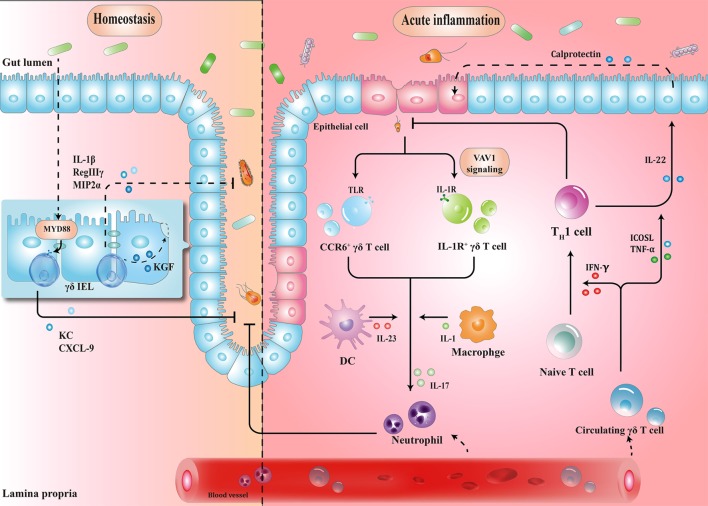
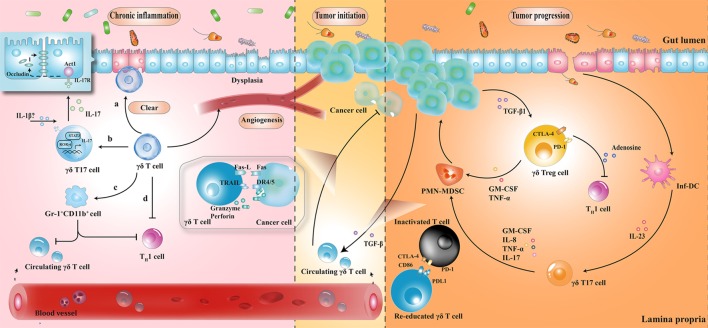
Increasing evidence suggests that intestinal microbiota dysbiosis and chronic inflammation contribute to colorectal cancer (CRC) development. γδ T cells represent a major innate immune cell population in the intestinal epithelium that is involved in the maintenance of gut homeostasis, inflammation regulation, and carcinogenesis. The important contributions of γδ T cells are (i) to perform a protective role in the context of barrier damage and pathogenic microorganism translocation; (ii) to exert either pro- or anti-inflammatory effects at different inflammatory stages; and (iii) to boost the crosstalk between immune cells and tumor microenvironment, inducing a cascade of suppressive immune responses. Understanding the crucial role of γδ T cells would enable us to manipulate these cells during the CRC sequence and improve the efficacy of tumor therapy.
越来越多的证据表明,肠道微生物群失调和慢性炎症促进了结直肠癌(CRC)的发展。γδ T细胞是肠道上皮中的主要先天性免疫细胞群体,参与维持肠道稳态、炎症调节和致癌作用。γδ T细胞的重要作用包括:(i)在屏障损伤和病原微生物易位的情况下发挥保护作用;(ii)在不同炎症阶段发挥促炎或抗炎作用;(iii)促进免疫细胞与肿瘤微环境之间的相互作用,诱导一系列抑制性免疫反应。了解γδ T细胞的关键作用将使我们能够在CRC病程中操控这些细胞,并提高肿瘤治疗的疗效。