Demers Eric, Pendenza Jonathan, Radevich Valentin, Preuss Richard
School of Physical and Occupational Therapy, McGill University, Montreal, QC, CANADA.
Constance-Lethbridge Rehabilitation Center, Research Site of the Center for Interdisciplinary Research in Rehabilitation, Montreal, QC, CANADA.
Int J Exerc Sci. 2018 Jun 1;11(1):764-775. doi: 10.70252/BWZE8275. eCollection 2018.
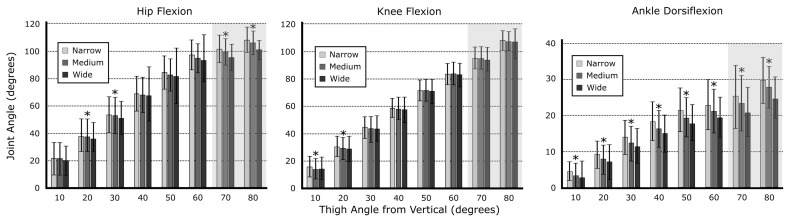
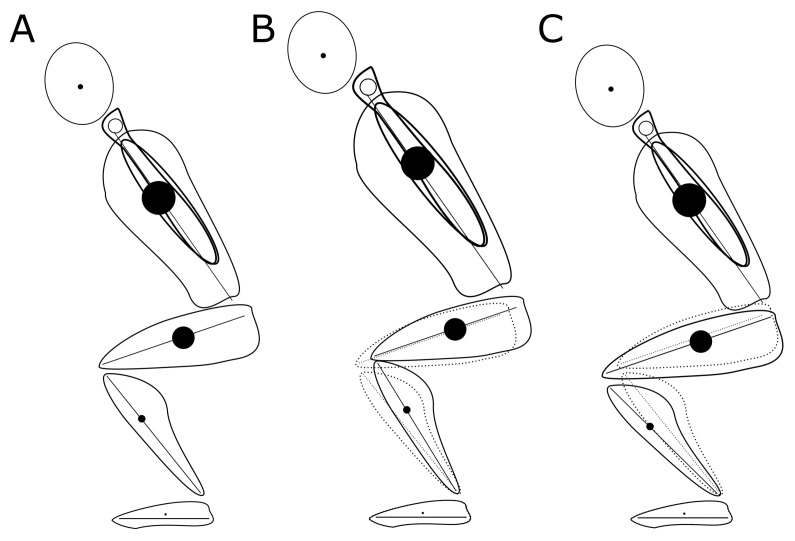
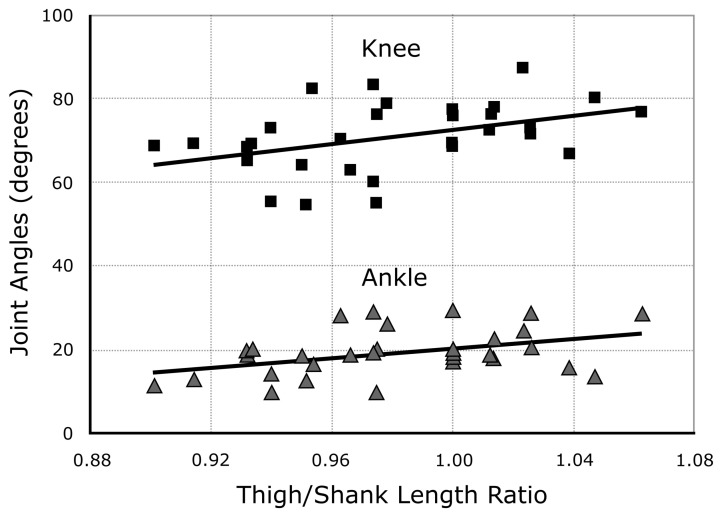
The purpose of this study was to assess whether changing the stance width has an effect on the range of motion of hip flexion, knee flexion, and ankle dorsiflexion during an unloaded back squat, and whether these joint movements are affected by anthropometric differences. Thirty-two healthy, young adults performed unloaded back squats at three different stance widths, normalized to pelvic width. Joint angles were assessed using electromagnetic motion capture sensors on the sacrum, and thigh, shank and foot of the dominant leg. ANOVA comparison of joint angles for the three stance widths, at 10° intervals of thigh orientation during the squat, indicated that joint angles tended to be larger when stance width was narrower, with the most significant effects on ankle dorsiflexion. A greater trunk/thigh length ratio (relatively long trunk) also tended to be associated with lower ankle and knee angles, while a greater thigh/shank length ratio (relatively long thigh) tended to be associated with higher ankle and knee angles, for the two narrower stance widths. The most practical implication of our findings is that individuals with limited ankle dorsiflexion, or with particularly long legs / thighs, may benefit from a wider stance width when squatting.
本研究的目的是评估改变站立宽度是否会对无负重后蹲过程中髋关节屈曲、膝关节屈曲和踝关节背屈的活动范围产生影响,以及这些关节运动是否会受到人体测量差异的影响。32名健康的年轻成年人以三种不同的站立宽度进行无负重后蹲,站立宽度以骨盆宽度为标准进行归一化。使用电磁运动捕捉传感器对优势腿的骶骨、大腿、小腿和足部的关节角度进行评估。在深蹲过程中,以大腿方向每间隔10°对三种站立宽度的关节角度进行方差分析比较,结果表明,站立宽度较窄时关节角度往往更大,对踝关节背屈的影响最为显著。对于两种较窄的站立宽度,更大的躯干/大腿长度比(相对较长的躯干)也往往与较低的踝关节和膝关节角度相关,而更大的大腿/小腿长度比(相对较长的大腿)则往往与较高的踝关节和膝关节角度相关。我们研究结果最实际的意义在于,踝关节背屈受限或腿部/大腿特别长的个体在深蹲时可能会受益于更宽的站立宽度。