Pile Victoria, Smith Patrick, Leamy Mary, Blackwell Simon E, Meiser-Stedman Richard, Stringer Dominic, Ryan Elizabeth G, Dunn Barnaby D, Holmes Emily A, Lau Jennifer Y F
1Department of Psychology, Institute of Psychiatry, Psychology and Neuroscience, King's College London, De Crespigny Park, London, SE5 8AF UK.
2Florence Nightingale Faculty of Nursing and Midwifery, King's College London, London, UK.
Pilot Feasibility Stud. 2018 Jul 4;4:97. doi: 10.1186/s40814-018-0287-3. eCollection 2018.
Adolescent depression is common and impairing. There is an urgent need to develop early interventions to prevent depression becoming entrenched. However, current psychological interventions are difficult to access and show limited evidence of effectiveness. Schools offer a promising setting to enhance access to interventions, including reducing common barriers such as time away from education. Distressing negative mental images and a deficit in positive future images, alongside overgeneral autobiographical memories, have been implicated in depression across the lifespan, and interventions targeting them in adults have shown promise. Here, we combine techniques targeting these cognitive processes into a novel, brief psychological intervention for adolescent depression. This feasibility randomised controlled trial will test the feasibility and acceptability of delivering this imagery-based cognitive behavioural intervention in schools.
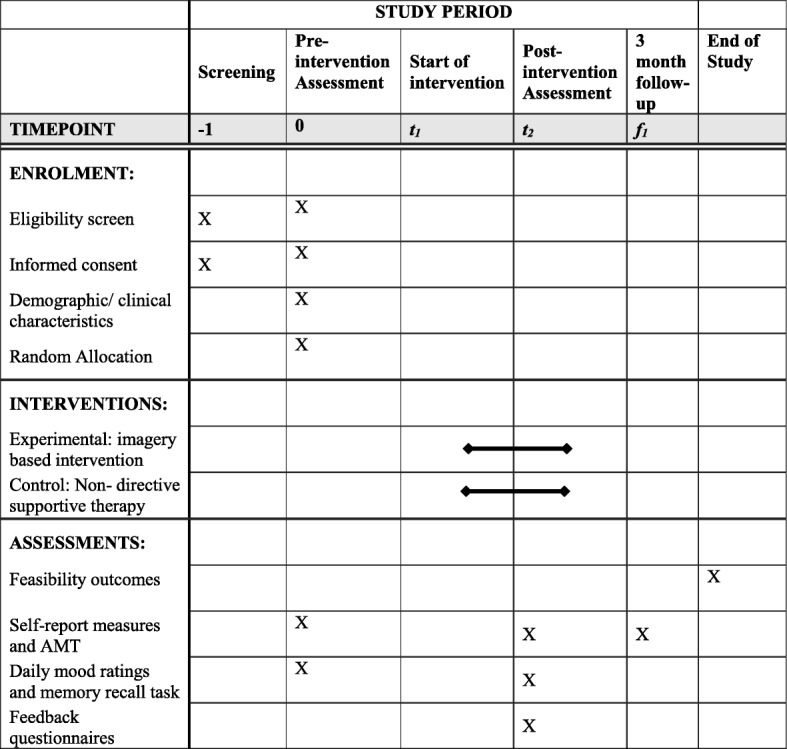
METHODS/DESIGN: Fifty-six adolescents (aged 16-18) with high symptoms of depression will be recruited from schools. Participants will be randomly allocated to the imagery-based cognitive behavioural intervention (ICBI) or the control intervention, non-directive supportive therapy (NDST). Data on feasibility and acceptability will be recorded throughout, including data on recruitment, retention and adherence rates as well as adverse events. In addition, symptom assessment will take place pre-intervention, post-intervention and at 3-month follow-up. Primarily, the trial aims to establish whether it is feasible and acceptable to carry out this project in a school setting. Secondary objectives include collecting data on clinical measures, including depression and anxiety, and measures of the mechanisms proposed to be targeted by the intervention. The acceptability of using technology in assessment and treatment will also be evaluated.
Feasibility, acceptability and symptom data for this brief intervention will inform whether an efficacy randomised controlled trial is warranted and aid planning of this trial. If this intervention is shown in a subsequent definitive trial to be safe, clinically effective and cost-effective, it has potential to be rolled out as an intervention and so would significantly extend the range of therapies available for adolescent depression. This psychological intervention draws on cognitive mechanism research suggesting a powerful relationship between emotion and memory and uses imagery as a cognitive target in an attempt to improve interventions for adolescent depression.
ISRCTN85369879.
青少年抑郁症很常见且会造成损害。迫切需要开发早期干预措施以防止抑郁症变得根深蒂固。然而,当前的心理干预措施难以获得,且有效性证据有限。学校为增加干预措施的可及性提供了一个有前景的环境,包括减少诸如缺课等常见障碍。令人痛苦的负面心理意象和积极未来意象的缺失,以及过度概括的自传体记忆,在整个生命周期的抑郁症中都有涉及,针对成年人的此类干预措施已显示出前景。在此,我们将针对这些认知过程的技术结合成一种新颖、简短的青少年抑郁症心理干预措施。这项可行性随机对照试验将测试在学校实施这种基于意象的认知行为干预的可行性和可接受性。
方法/设计:将从学校招募56名有高度抑郁症状的青少年(年龄在16 - 18岁)。参与者将被随机分配到基于意象的认知行为干预(ICBI)组或对照干预组,即非指导性支持疗法(NDST)组。将全程记录关于可行性和可接受性的数据,包括招募、留存和依从率以及不良事件的数据。此外,将在干预前、干预后和3个月随访时进行症状评估。该试验主要旨在确定在学校环境中开展此项目是否可行和可接受。次要目标包括收集关于临床指标的数据,包括抑郁和焦虑,以及拟作为干预目标的机制的测量数据。还将评估在评估和治疗中使用技术的可接受性。
这种简短干预的可行性、可接受性和症状数据将为是否有必要进行疗效随机对照试验提供信息,并有助于该试验的规划。如果在随后的确定性试验中表明这种干预是安全、临床有效且具有成本效益的,那么它有可能作为一种干预措施推广,从而将显著扩大可用于青少年抑郁症的治疗方法范围。这种心理干预借鉴了认知机制研究,该研究表明情绪与记忆之间存在强大关联,并将意象作为认知靶点,试图改善青少年抑郁症的干预措施。试验注册:ISRCTN85369879。