Wiegand Anna, Ritter Alexander, Graf Nicole, Arampatzis Spyridon, Sidler Daniel, Hadaya Karine, Müller Thomas F, Wagner Carsten A, Wüthrich Rudolf P, Mohebbi Nilufar
Division of Nephrology, University Hospital Zurich, Zurich, Switzerland.
Graf Biostatistics, Wintherthur, Switzerland.
BMC Nephrol. 2018 Jul 13;19(1):177. doi: 10.1186/s12882-018-0956-8.
Graft survival after kidney transplantation has significantly improved within the last decades but there is a substantial number of patients with declining transplant function and graft loss. Over the past years several studies have shown that metabolic acidosis plays an important role in the progression of Chronic Kidney Disease (CKD) and that alkalinizing therapies significantly delayed progression of CKD. Importantly, metabolic acidosis is highly prevalent in renal transplant patients and a recent retrospective study has shown that metabolic acidosis is associated with increased risk of graft loss and patient death in kidney transplant recipients. However, no prospective trial has been initiated yet to test the role of alkali treatment on renal allograft function.
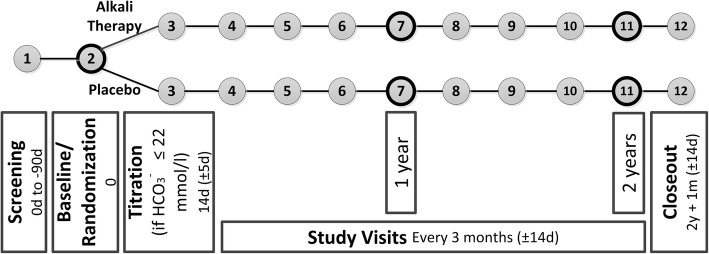
The Preserve-Transplant Study is an investigator-initiated, prospective, patient-blinded, multi-center, randomized, controlled phase-IV trial with two parallel-groups comparing sodium bicarbonate to placebo. The primary objective is to test if alkali treatment will preserve kidney graft function and diminish the progression of CKD in renal transplant patients by assesing the change in eGFR over 2 years from baseline. Additionally we want to investigate the underlying pathomechanisms of nephrotoxicity of metabolic acidosis.
This study has the potential to provide evidence that alkali treatment may slow or reduce the progression towards graft failure and significantly decrease the rate of end stage renal disease (ESRD), thus prolonging long-term graft survival. The implementation of alkali therapy into the drug regimen of kidney transplant recipients would have a favorable risk-benefit ratio since alkali supplements are routinely used in CKD patients and represent a well-tolerated, safe and cost-effective treatment.
ClinicalTrials.gov NCT03102996 . Trial registration was completed on April 6, 2017.
在过去几十年中,肾移植后的移植物存活率有了显著提高,但仍有相当数量的患者移植肾功能下降并出现移植物丢失。在过去几年中,多项研究表明,代谢性酸中毒在慢性肾脏病(CKD)的进展中起重要作用,碱化治疗可显著延缓CKD的进展。重要的是,代谢性酸中毒在肾移植患者中非常普遍,最近一项回顾性研究表明,代谢性酸中毒与肾移植受者移植物丢失和患者死亡风险增加有关。然而,尚未启动前瞻性试验来检验碱处理对同种异体肾移植功能的作用。
“Preserve-Transplant研究”是一项由研究者发起的前瞻性、患者盲法、多中心、随机、对照的IV期试验,有两个平行组,比较碳酸氢钠与安慰剂。主要目的是通过评估2年内估算肾小球滤过率(eGFR)相对于基线的变化,来检验碱处理是否能维持肾移植患者的肾移植功能并减缓CKD的进展。此外,我们还想研究代谢性酸中毒肾毒性的潜在发病机制。
本研究有可能提供证据表明,碱处理可能减缓或减少移植物衰竭的进展,并显著降低终末期肾病(ESRD)的发生率,从而延长移植物长期存活时间。将碱疗法纳入肾移植受者的药物治疗方案中,其风险效益比将是有利的,因为碱补充剂在CKD患者中常规使用,是一种耐受性良好、安全且具有成本效益的治疗方法。
ClinicalTrials.gov NCT03102996。试验注册于2017年4月6日完成。