Axelrad Jordan E, Lebwohl Benjamin, Cuaresma Edward, Cadwell Ken, Green Peter H R, Freedberg Daniel E
1Division of Gastroenterology, Department of Medicine, Inflammatory Bowel Disease Center, NYU Langone Health, 240 East 38th Street, 23rd Floor, New York, NY USA.
2Division of Digestive and Liver Disease, Department of Medicine, Columbia University Medical Center, New York, NY USA.
Gut Pathog. 2018 Jul 9;10:28. doi: 10.1186/s13099-018-0259-4. eCollection 2018.
Gut colonization with vancomycin-resistant (VRE) is associated with poor outcomes. This study evaluated the impact of VRE colonization on subsequent acquisition of enteric pathogens.
We performed a retrospective cohort study of adults admitted to an ICU from 2012 to 2017 who were screened for VRE colonization and subsequently underwent stool testing with a gastrointestinal pathogen PCR panel (GI PCR) with or without PCR testing for . Our primary outcome was the presence of any enteric pathogen. Cox proportional hazards modeling was used to adjust for factors associated with enteric infection.
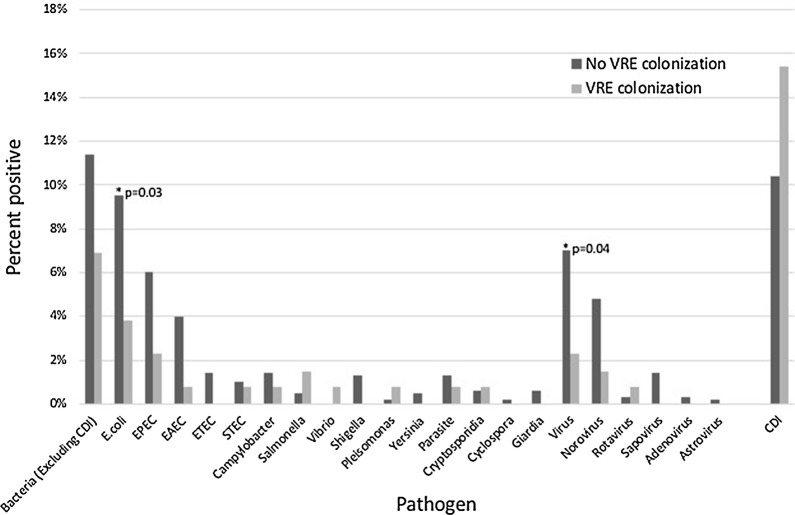
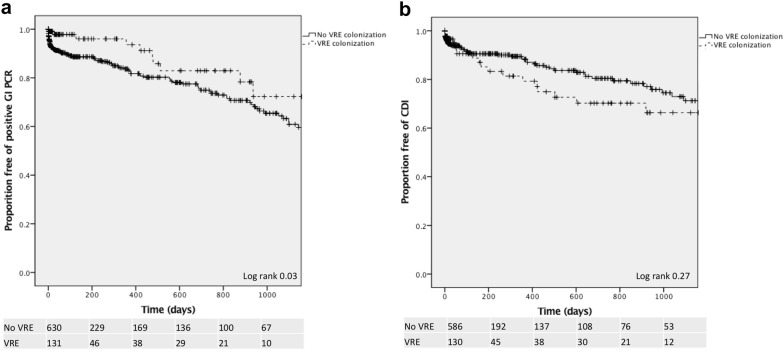
Of 761 patients who underwent VRE screening and subsequent GI PCR, 131 (17%) were colonized with VRE. Patients with VRE colonization were less likely to test positive on GI PCR compared to patients without VRE (9.2% vs 18%, p = 0.01); specifically for species (p = 0.03) and viral (p = 0.04) enteric infections. In 716 patients who underwent testing, there was a trend towards more infections in patients colonized with VRE (15% vs 10%, p = 0.11). On multivariable analysis, patients with VRE had a decreased risk of a positive GI PCR (aHR 0.47, 95% CI 0.25-0.88, p = 0.02) but not infection, effects which persisted during 5 years of follow-up. Among positive tests, there was a greater proportion of with VRE (57% vs 28%, p < 0.01).
VRE colonization was associated with a decreased risk of subsequent non- enteric infection. VRE domination of the gut microbiome may protect against acquisition of common enteric pathogens.
耐万古霉素肠球菌(VRE)肠道定植与不良预后相关。本研究评估了VRE定植对后续肠道病原体感染的影响。
我们对2012年至2017年入住重症监护病房(ICU)的成年人进行了一项回顾性队列研究,这些患者接受了VRE定植筛查,随后进行了粪便检测,使用了胃肠道病原体PCR检测板(GI PCR),部分患者还进行了或未进行针对[具体病原体]的PCR检测。我们的主要结局是是否存在任何肠道病原体。采用Cox比例风险模型对与肠道感染相关的因素进行校正。
在761例接受VRE筛查及后续GI PCR检测的患者中,131例(17%)被VRE定植。与未被VRE定植的患者相比,VRE定植患者在GI PCR检测中呈阳性的可能性较小(9.2%对18%,p = 0.01);特别是对于[具体病原体]种属(p = 0.03)和病毒性(p = 0.04)肠道感染。在716例接受[具体病原体]检测的患者中,VRE定植患者的[具体病原体]感染有增加趋势(15%对10%,p = 0.11)。多变量分析显示,VRE定植患者GI PCR检测呈阳性的风险降低(校正风险比0.47,95%置信区间0.25 - 0.88,p = 0.02),但[具体病原体]感染风险未降低,这些影响在5年随访期间持续存在。在阳性检测结果中,VRE定植患者中[具体病原体]的比例更高(57%对28%,p < 0.01)。
VRE定植与后续非[具体病原体]肠道感染风险降低相关。肠道微生物群中VRE占优势可能有助于预防常见肠道病原体的感染。