Storey Caroline M, Gyton Matthew R, Andrew Rhiann E, Chaplin Adrian B
Department of Chemistry, University of Warwick, Gibbet Hill Road, Coventry, CV4 7AL, UK.
Angew Chem Int Ed Engl. 2018 Sep 10;57(37):12003-12006. doi: 10.1002/anie.201807028. Epub 2018 Aug 20.
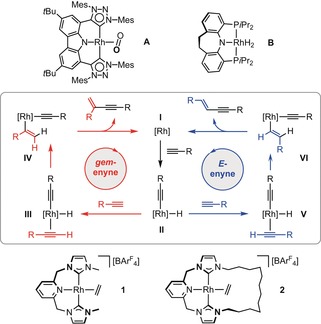
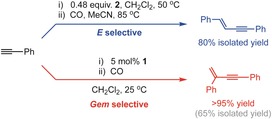
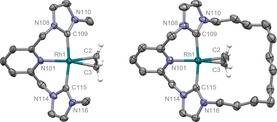
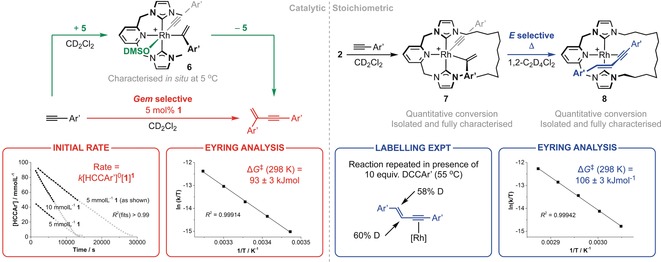
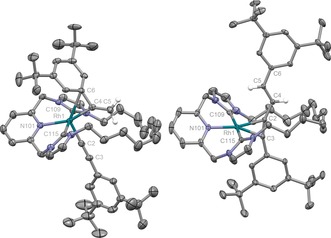
The mechanism and selectivity of terminal alkyne coupling reactions promoted by rhodium(I) complexes of NHC-based CNC pincer ligands have been investigated. Synthetic and kinetic experiments support E- and gem-enyne formation through a common reaction sequence involving hydrometallation and rate-determining C-C bond reductive elimination. The latter is significantly affected by the ligand topology: Employment of a macrocyclic variant enforced exclusive head-to-head coupling, contrasting the high selectivity for head-to-tail coupling observed for the corresponding acyclic pincer ligand.
已对基于氮杂环卡宾的CNC钳形配体的铑(I)配合物促进的末端炔烃偶联反应的机理和选择性进行了研究。合成和动力学实验支持通过涉及氢金属化和速率决定步骤的C-C键还原消除的常见反应序列形成E型和偕二烯炔。后者受配体拓扑结构的显著影响:使用大环变体强制实现排他性的头对头偶联,这与相应的非环状钳形配体所观察到的高选择性头对尾偶联形成对比。