Epi-Centre for Healthy Ageing, School of Medicine, IMPACT SRC, Deakin University, PO Box 281 (Barwon Health), Geelong, VIC, 3220, Australia.
Australian Institute for Musculoskeletal Science (AIMSS), The University of Melbourne and Western Health, St Albans, VIC, Australia.
BMC Public Health. 2018 Jul 13;18(1):876. doi: 10.1186/s12889-018-5751-8.
The term health literacy refers to the abilities and resources required to find, understand and use health information in managing health. This definition is reflected in the recent development of multidimensional health literacy tools that measure multiple facets of health literacy. The aim of this study was to determine the health literacy profile of a randomly selected, population-based sample of Australian women using a multidimensional tool, the Health Literacy Questionnaire (HLQ). A second aim was to investigate associations between independent HLQ scales, sociodemographic characteristics and lifestyle and anthropometric risk factors for chronic disease.
We surveyed women involved in the Geelong Osteoporosis Study (GOS), a longitudinal, population-based study. We included demographic data, lifestyle information and anthropometric measures as well as the HLQ. The HLQ has 44 items, scored on either 4- or 5-point scales, within nine conceptually distinct scales. Means for each scale were calculated, and HLQ scales were regressed on educational level and socioeconomic status. Risk factors for chronic disease were investigated using analysis of variance (ANOVA) and calculation of effect sizes.
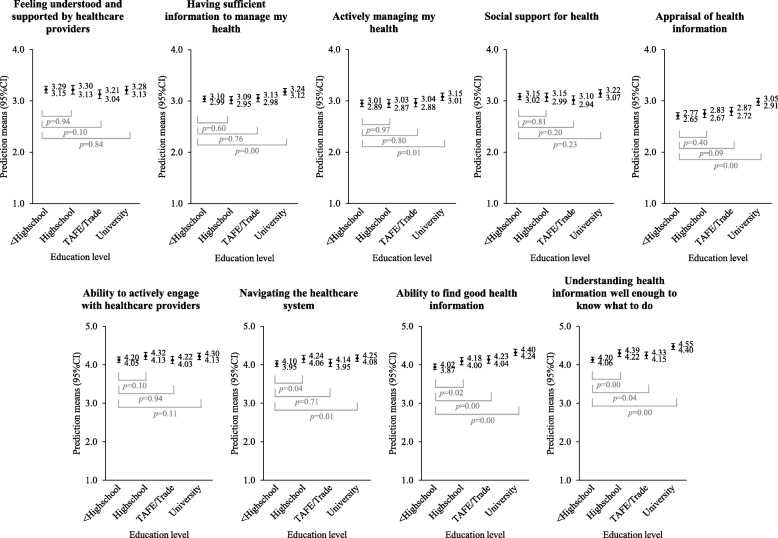
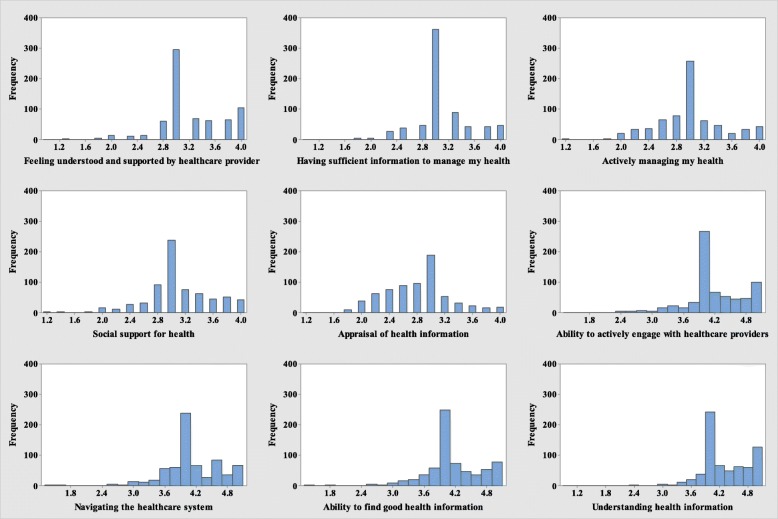
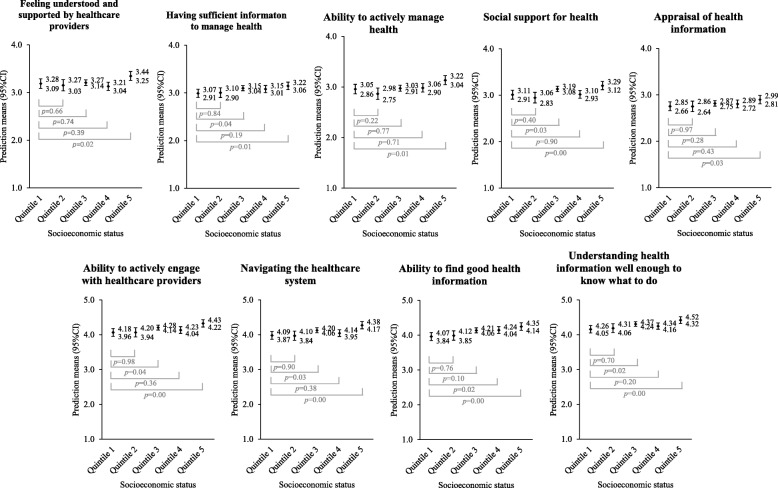
Higher mean scores were seen for the scales 'Feeling understood and supported by healthcare professionals' (mean 3.20, ± SD 0.52) and 'Understanding health information well enough to know what to do' (mean 4.28, ±SD 0.54), and lower mean scores were seen for 'Appraisal of health information' (mean 2.81, ±SD 0.48) and 'Navigating the healthcare system' (mean 4.09, ± SD 0.57). Associations were also seen between lower HLQ scores and poor health behaviours including smoking and being more sedentary, in addition to greater body mass index and waist circumference. Positive gradients were seen between several HLQ scales and education level, as well as SES. For some HLQ scales, these associations were non-linear.
The profile of this population-based cohort of women demonstrated associations between low health literacy and low SES, lower levels of education, increasing age, and anthropometric and lifestyle risk factors for chronic disease. These findings suggest implications of health literacy for health policy makers focusing on improving lifestyle prevention of chronic disease and promoting health equity at a population level.
健康素养是指在管理健康时查找、理解和使用健康信息所需的能力和资源。这一定义反映在最近开发的多维健康素养工具中,这些工具衡量健康素养的多个方面。本研究的目的是使用多维工具《健康素养问卷》(HLQ)确定澳大利亚女性随机抽样的人群健康素养概况。第二个目的是调查独立 HLQ 量表、社会人口统计学特征以及生活方式和慢性病的人体测量风险因素之间的关联。
我们调查了参与基隆骨质疏松研究(GOS)的女性,这是一项纵向、基于人群的研究。我们包括人口统计学数据、生活方式信息和人体测量指标以及 HLQ。HLQ 有 44 个项目,分为 4 分制或 5 分制,共 9 个概念上不同的量表。计算每个量表的平均值,并根据教育水平和社会经济地位对 HLQ 量表进行回归。使用方差分析(ANOVA)和效应量计算来研究慢性病的风险因素。
在量表“感受到医护人员的理解和支持”(平均 3.20,±SD 0.52)和“足够理解健康信息以知道该怎么做”(平均 4.28,±SD 0.54)上的平均分数较高,而在“评估健康信息”(平均 2.81,±SD 0.48)和“导航医疗保健系统”(平均 4.09,±SD 0.57)上的平均分数较低。HLQ 得分较低与不良健康行为也存在关联,包括吸烟和久坐不动,此外还有更高的体重指数和腰围。在几个 HLQ 量表和教育水平以及 SES 之间也存在正相关关系。对于一些 HLQ 量表,这些关联是非线性的。
该基于人群的女性队列的特征表明,低健康素养与 SES 低、教育水平低、年龄增长以及慢性病的人体测量和生活方式风险因素有关。这些发现表明,健康素养对关注改善生活方式预防慢性病和促进人口健康公平的卫生政策制定者具有影响。