Tseng Chih-Han, Tu K N, Chen Chih
Department of Materials Science and Engineering, National Chiao Tung University, Hsinchu, Taiwan, 30010, Republic of China.
International College of Semiconductor Technology, National Chiao Tung University, Hsinchu, Taiwan, 30010, Republic of China.
Sci Rep. 2018 Jul 13;8(1):10671. doi: 10.1038/s41598-018-28812-0.
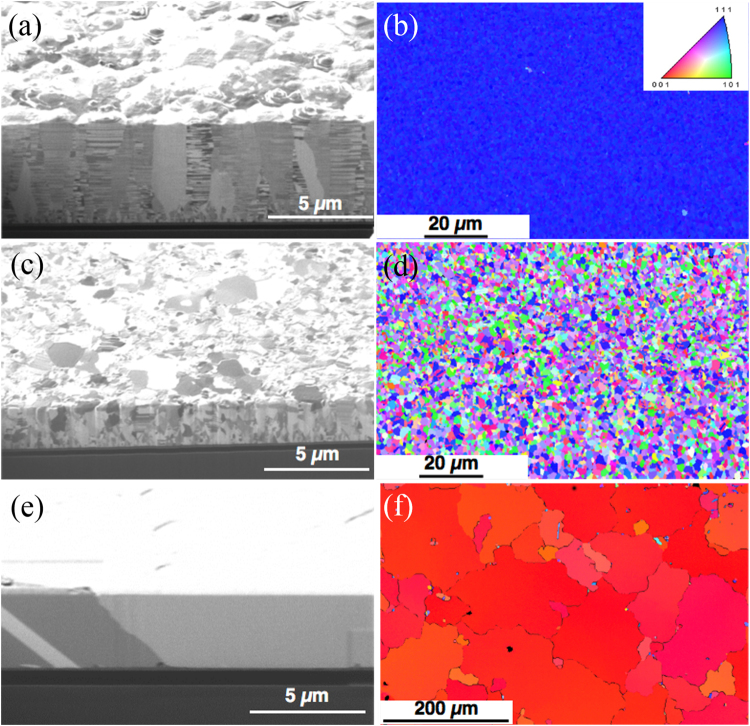
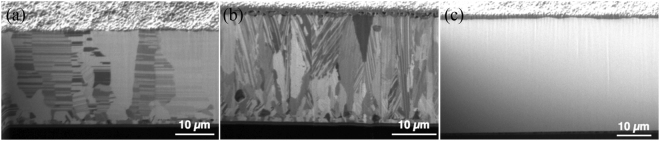
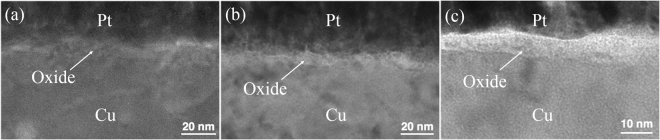
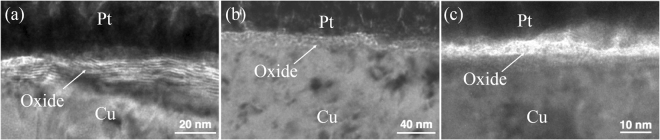
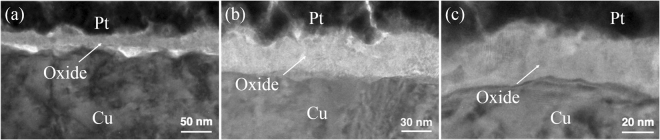
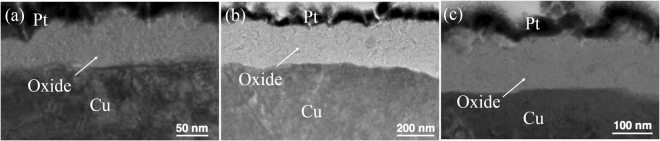
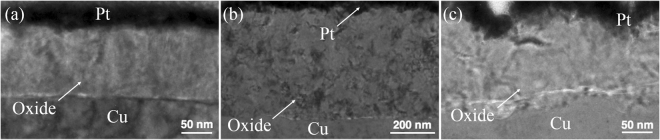
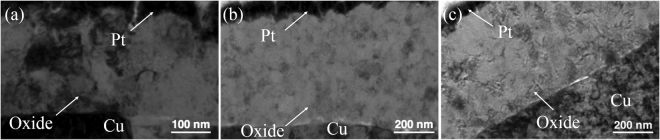
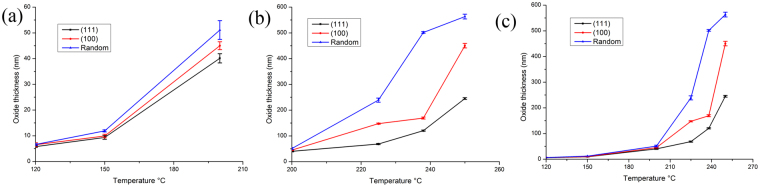
Cu-to-Cu direct bonding has attracted attention because it has been implemented in CMOS image sensors. Prior to the bonding, the oxides on the Cu surface needs to be removed, yet the surface may oxidize right after cleaning. Thus, oxidation is an inherent issue in the application of Cu direct bonding. Our previous study reported that Cu direct bonding can be achieved below 250 °C by using (111)-oriented nanotwinned Cu because it has the fastest surface diffusivity. However, the oxidation behavior of the nanotwinned Cu is unclear. Here, we examined the oxidation behavior of highly (111) and (200) oriented, and randomly-oriented Cu films at temperatures ranging from 120 to 250 °C. Transmission electron microscopy was used to measure the oxide thickness. The results show that the oxidation rate of (111)-oriented nanotwinned Cu has the lowest oxidation rate among them. Together, it is unique to possess the combination of the fastest surface diffusivity and the lowest oxidation rate.
铜到铜直接键合因其已应用于CMOS图像传感器而备受关注。在键合之前,需要去除铜表面的氧化物,但表面在清洁后可能会立即氧化。因此,氧化是铜直接键合应用中固有的问题。我们之前的研究报告称,通过使用(111)取向的纳米孪晶铜,可以在250°C以下实现铜直接键合,因为它具有最快的表面扩散率。然而,纳米孪晶铜的氧化行为尚不清楚。在这里,我们研究了高度(111)和(200)取向以及随机取向的铜膜在120至250°C温度范围内的氧化行为。使用透射电子显微镜测量氧化物厚度。结果表明,(111)取向的纳米孪晶铜的氧化速率在其中是最低的。总之,拥有最快的表面扩散率和最低的氧化速率的组合是独一无二的。