Bednarek Anna, Bodajko-Grochowska Anna, Bartkowiak-Emeryk Małgorzata, Klepacz Robert, Ciółkowski Janusz, Zarzycka Danuta, Emeryk Andrzej
Department of Pediatric Nursing, Faculty of Nursing and Health Science, Medical University of Lublin, Lublin, Poland.
Department of Pulmonary Diseases and Pediatric Rheumatology, University Children's Hospital, Lublin, Poland.
Postepy Dermatol Alergol. 2018 Jun;35(3):259-266. doi: 10.5114/ada.2018.76221. Epub 2018 Jun 18.
Asthma control is an important measure of disease stabilization, which is linked to the treatment and lifestyle recommendations.
To assess the impact of selected factors on asthma control in adolescents, as assessed using the Asthma Control Test (ACT™).
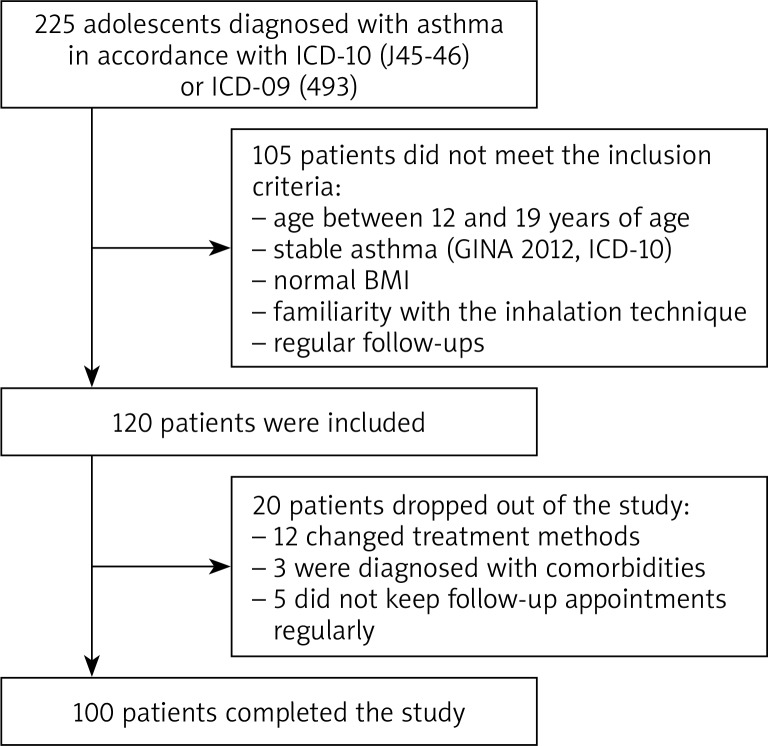
The prospective study included 100 asthma patients aged between 12 and 19. Asthma was assessed in three consecutive follow-up visits spaced 3 months apart, using the standardized ACT™ questionnaire.
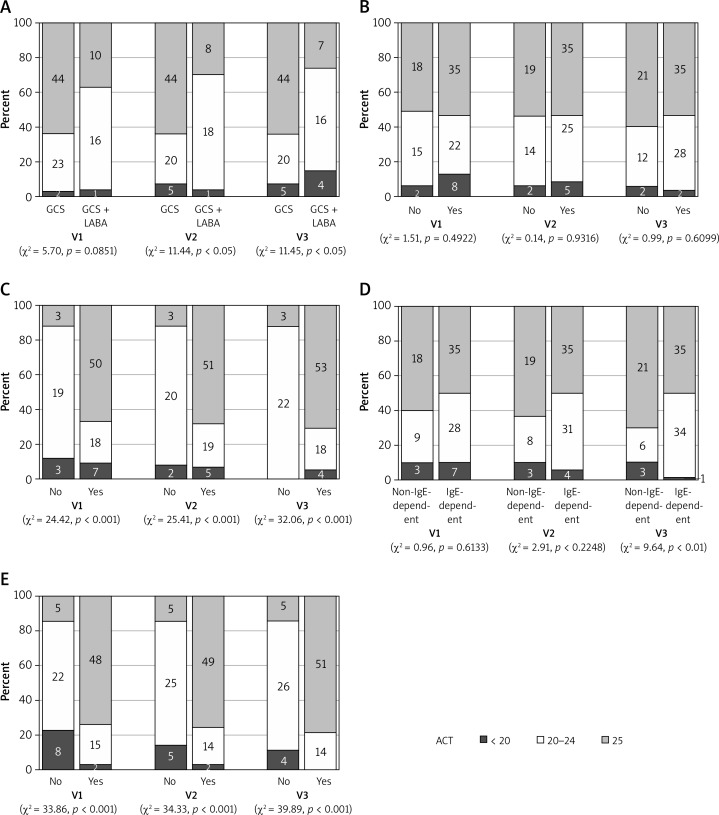
Asthma was fully controlled (ACT score = 25 points) in more than half of the patients in all follow-up visits (53.0%, 54.0%, and 56.0%, respectively). More than one third of the participants scored between 20 and 24 points (37.0% vs. 39.0% vs. 40.0%). A minority of patients had uncontrolled asthma (scores below 20), and the group consistently diminished in subsequent visits (10% vs. 7% vs. 4%). Uncontrolled asthma was found significantly more often in female patients (33.33%; < 0.001) and those living in rural areas (20.59%; < 0.01). Treatment with a combination of inhaled corticosteroids (ICS) and LABAs was associated with worse asthma control (14.81%; < 0.05). Better asthma control was found in patients with a family history of allergies (73.85% vs. 75.38% vs. 78.46%; < 0.001) and in those with concurrent allergies (66.67% vs. 68.00% vs. 70.67%; < 0.001).
Asthma control in adolescents differs by sex and residence. Concurrent allergies and family history of allergies improve asthma self-control in adolescents.
哮喘控制是疾病稳定的一项重要指标,与治疗及生活方式建议相关。
使用哮喘控制测试(ACT™)评估选定因素对青少年哮喘控制的影响。
这项前瞻性研究纳入了100名年龄在12至19岁之间的哮喘患者。在相隔3个月的连续三次随访中,使用标准化的ACT™问卷对哮喘进行评估。
在所有随访中,超过一半的患者哮喘得到完全控制(ACT评分 = 25分)(分别为53.0%、54.0%和56.0%)。超过三分之一的参与者得分在20至24分之间(分别为37.0%、39.0%和40.0%)。少数患者哮喘未得到控制(得分低于20分),且该组在后续随访中持续减少(分别为10%、7%和4%)。未得到控制的哮喘在女性患者中显著更常见(33.33%;<0.001)以及居住在农村地区的患者中(20.59%;<0.01)。吸入性糖皮质激素(ICS)和长效β2受体激动剂(LABA)联合治疗与较差的哮喘控制相关(14.81%;<0.05)。有过敏家族史的患者哮喘控制更好(分别为73.85%、75.38%和78.46%;<0.001)以及患有并发过敏的患者(分别为66.67%、68.00%和70.67%;<0.001)。
青少年哮喘控制因性别和居住地而异。并发过敏和过敏家族史可改善青少年哮喘自我控制。