Zhang Ximing, Qu Tianjiao, Mosier Nathan S, Han Lujia, Xiao Weihua
1Laboratory of Renewable Resources Engineering, Department of Agricultural and Biological Engineering, Purdue University, West Lafayette, IN 47907 USA.
2Laboratory of Biomass and Bioprocessing Engineering, College of Engineering, China Agricultural University (East Campus), P.O. Box 191, 17 Qing-Hua-Dong-Lu, Haidian District, Beijing, 100083 People's Republic of China.
Biotechnol Biofuels. 2018 Jul 13;11:191. doi: 10.1186/s13068-018-1191-z. eCollection 2018.
The invention of efficient systems for lignocellulose conversion is essential for economically feasible production of bio-based chemicals and biofuels. One limiting step is highly selective processes to quickly decrystallize the compact cellulose structure for efficient hydrolysis. We evaluated the impact of trifluoroacetic acid (TFA) and phosphorous acid (PA)-induced swelling of crystalline cellulose on enhancement of enzymatic digestion.
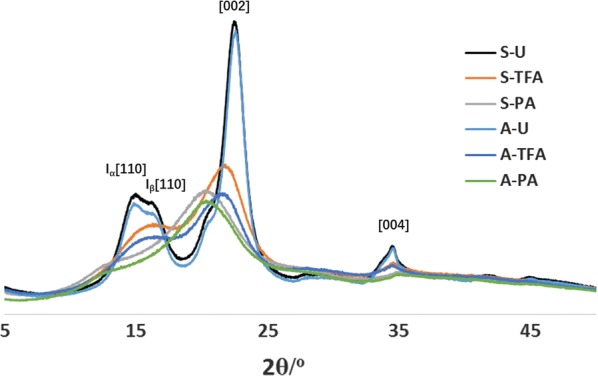
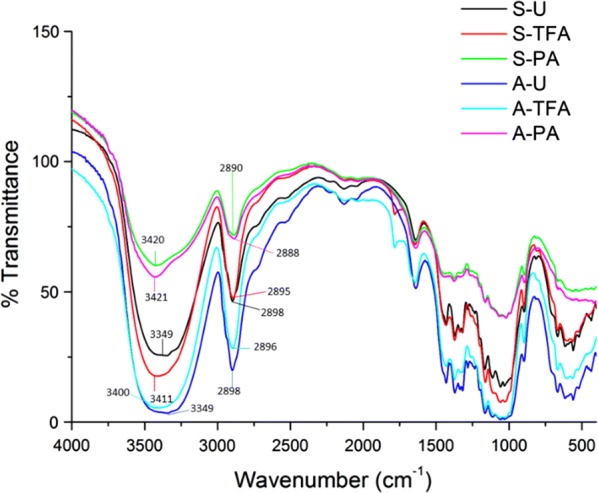
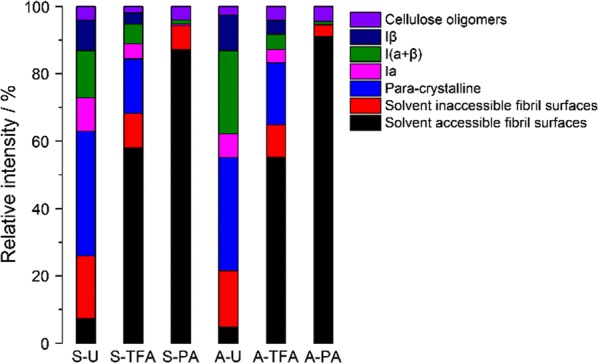
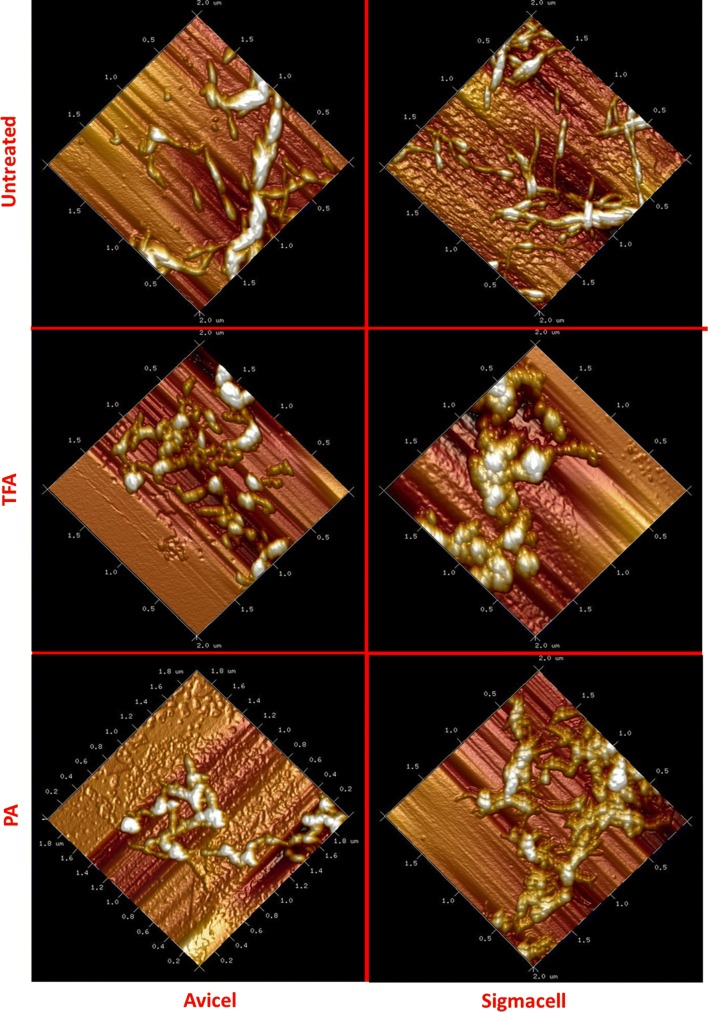
In this study, two swelling agents, TFA and PA, are compared and found to be highly efficient for cellulose decrystallization at low temperatures within 1 h. After treatment, the microfibril structure of swollen celluloses was observed to develop distinct microscopic morphology and subsequent enzymatic hydrolysis resulted over 90% cellulose conversion within 24 h. The crystalline cellulose change was determined by reduction of loss of X-ray diffractability, and loss of resistance to enzymatic hydrolysis. NMR results suggest that both TFA and PA efficiently converted most of the crystalline cellulose regions to amorphous regions through cellulose chain relocation that inhibits recrystallization. It was found that the swelling mechanism is different between TFA and PA. To the best of our knowledge, it is the first time to compare and quantify the cellulose regions transformation by swelling agents.
This study shows the low-temperature swelling of different celluloses in TFA and PA reduces recalcitrance of crystalline cellulose to enzymatic hydrolysis. TFA and PA are both ideal candidate swelling agents for a closed system for ease of solvent recovery by either simple distillation or filtration. This study provides potentially useful agents in large-scale deconstruction of biomass.
高效的木质纤维素转化系统的发明对于生物基化学品和生物燃料的经济可行生产至关重要。一个限制步骤是采用高度选择性的工艺来快速使紧密的纤维素结构脱结晶以实现高效水解。我们评估了三氟乙酸(TFA)和亚磷酸(PA)诱导的结晶纤维素溶胀对增强酶解作用的影响。
在本研究中,对两种溶胀剂TFA和PA进行了比较,发现它们在1小时内的低温下对纤维素脱结晶非常有效。处理后,观察到溶胀纤维素的微纤丝结构呈现出明显不同的微观形态,随后的酶水解在24小时内实现了超过90%的纤维素转化。通过X射线衍射能力损失的降低以及对酶水解抗性的丧失来确定结晶纤维素的变化。核磁共振结果表明,TFA和PA都通过抑制重结晶的纤维素链重排有效地将大部分结晶纤维素区域转化为无定形区域。发现TFA和PA的溶胀机制不同。据我们所知,这是首次比较和量化溶胀剂引起的纤维素区域转化。
本研究表明,不同纤维素在TFA和PA中的低温溶胀降低了结晶纤维素对酶水解的抗性。TFA和PA都是封闭系统中理想的候选溶胀剂,便于通过简单蒸馏或过滤回收溶剂。本研究为生物质的大规模解构提供了潜在有用的试剂。