Department of Primary and Community Care, Radboud University Medical Center, P.O. Box 9101, route 68, 6500, HB, Nijmegen, The Netherlands.
Biometris, Wageningen University, Wageningen, The Netherlands.
BMC Med Res Methodol. 2018 Jul 16;18(1):80. doi: 10.1186/s12874-018-0539-1.
The lack of suitable and reliable scales to measure self-reported health and health behaviour among people with intellectual disabilities (ID) is an important methodological challenge in health research. This study, which was undertaken together with co-researchers with ID, explores possibilities for self-reported health scales by adjusting, testing, and reflecting on three self-reported health scales.
In an inclusive process, the researchers and co-researchers with ID adjusted the SBQ (sedentary behaviour), SQUASH (physical activity), and SRH (self-reported health) scales, after which a test-retest study among adults with ID was performed. Test outcomes were analysed on suitability and test-retest reliability, and discussed with the co-researchers with ID to reflect on outcomes and to make further recommendations.
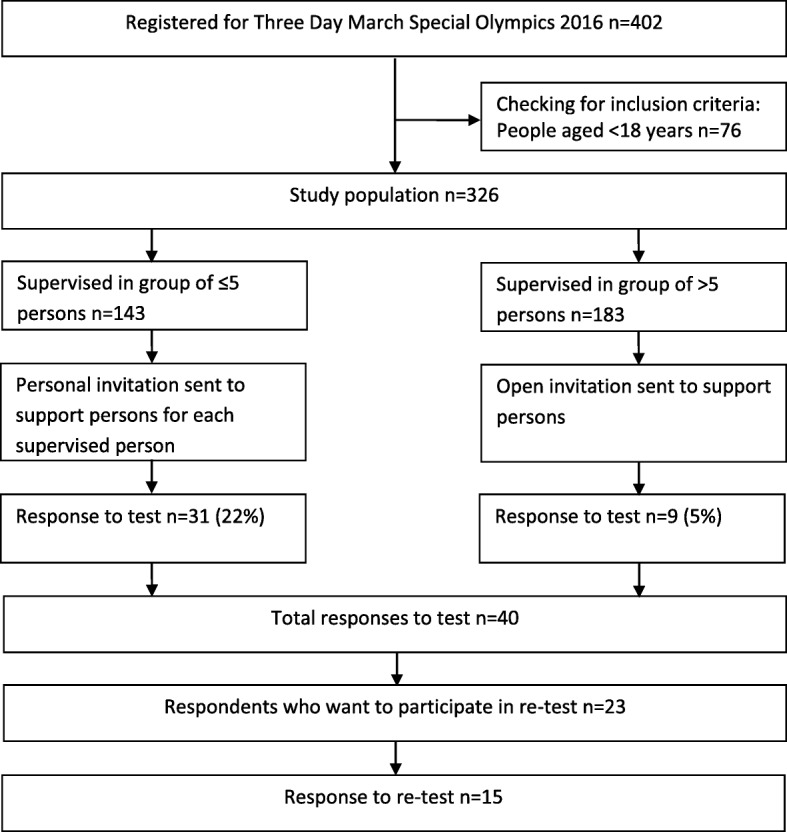
Main adjustments made to the scales included: use easy words, short sentences, and easy answer formats. Suitability (N = 40) and test-retest reliability (N = 15) was higher for the adjusted SQUASH (SQUASH-ID), in which less precise time-based judgements are sought, than in the adjusted SBQ (SBQ-ID). Suitability and test-retest reliability were fair to moderate for the SRH-ID and CHS-ID. The main outcome from the reflection was the recommendation to use SQUASH-ID answer options, in which less precise time-based judgements were sought, in the SBQ-ID as well.
This study served as a pilot of an inclusive process in which people with ID collaborated in adjusting, testing, and reflecting on self-reported health scales. Although the adjusted self-reported measurements may be reliable and suitable to the target group, the adjustments needed may impair measurement precision. This study's results contribute to informed decision making on the adaptation and use of self-reported health scales for people with ID.
缺乏合适且可靠的量表来衡量智障人士(ID)的自我报告健康和健康行为,这是健康研究中的一个重要方法学挑战。本研究与智障共同研究者合作,通过调整、测试和反思三个自我报告健康量表,探讨了自我报告健康量表的可能性。
在一个包容性的过程中,研究人员和智障共同研究者调整了 SBQ(久坐行为)、SQUASH(身体活动)和 SRH(自我报告健康)量表,之后对智障成年人进行了重测研究。测试结果进行了适宜性和重测信度分析,并与智障共同研究者进行了讨论,以反思结果并提出进一步的建议。
对量表进行的主要调整包括:使用简单的词语、简短的句子和简单的答案格式。调整后的 SQUASH(SQUASH-ID)的适宜性(N=40)和重测信度(N=15)高于调整后的 SBQ(SBQ-ID),后者需要更不精确的基于时间的判断。SRH-ID 和 CHS-ID 的适宜性和重测信度为中等至良好。反思的主要结果是建议在 SBQ-ID 中也使用 SQUASH-ID 答案选项,其中寻求更不精确的基于时间的判断。
本研究是一个包容性过程的试点,智障人士共同参与了自我报告健康量表的调整、测试和反思。虽然调整后的自我报告测量可能对目标群体可靠且适宜,但所需的调整可能会降低测量精度。本研究的结果有助于在为智障人士改编和使用自我报告健康量表时做出明智的决策。