Department of Mechanical and Aerospace Engineering, University of Florida, PO Box 116250, Gainesville, FL, 32611, USA.
Fluids Barriers CNS. 2018 Jul 16;15(1):20. doi: 10.1186/s12987-018-0105-6.
In animal models, dissolved compounds in the subarachnoid space and parenchyma have been found to preferentially transport through the cortex perivascular spaces (PVS) but the transport phenomena involved are unclear.
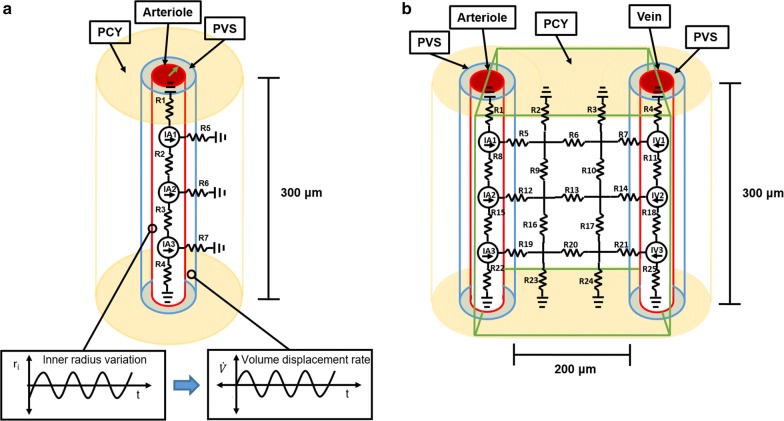
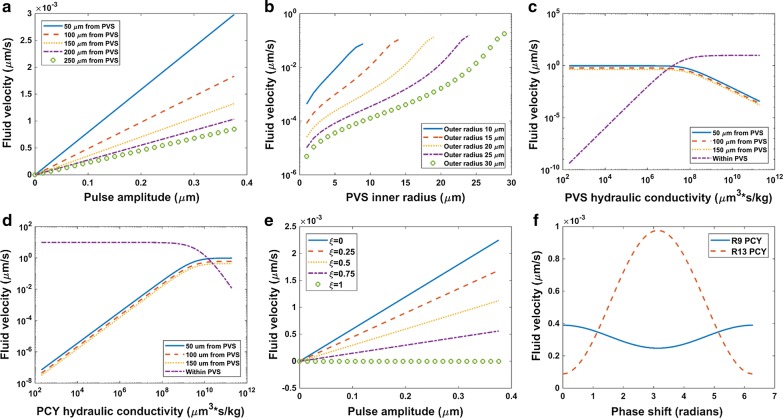
In this study two hydraulic network models were used to predict fluid motion produced by blood vessel pulsations and estimate the contribution made to solute transport in PVS and parenchyma. The effect of varying pulse amplitude and timing, PVS dimensions, and tissue hydraulic conductivity on fluid motion was investigated.
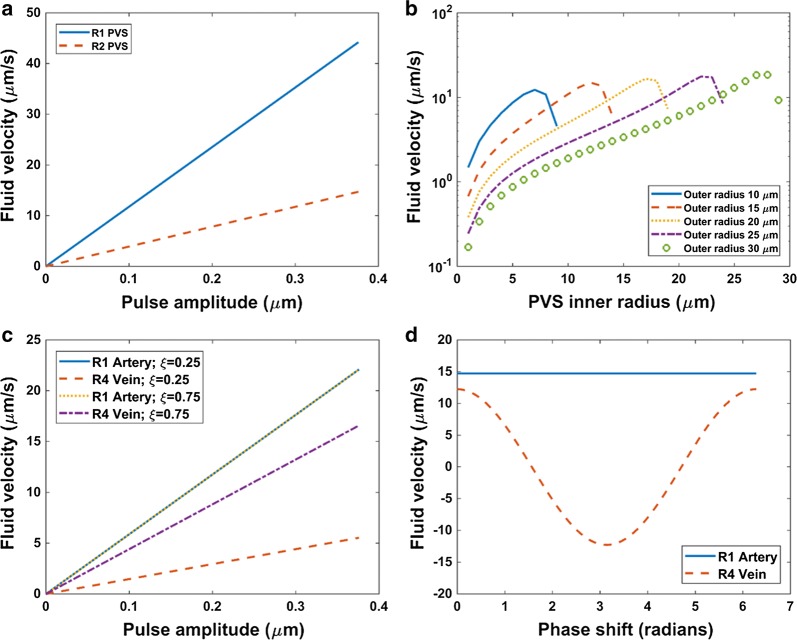
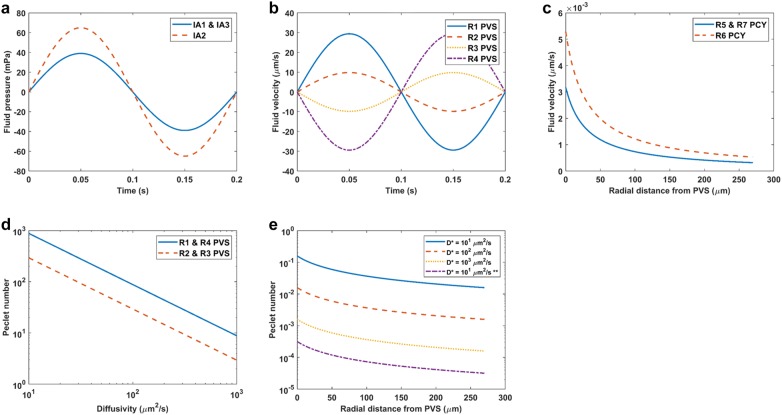
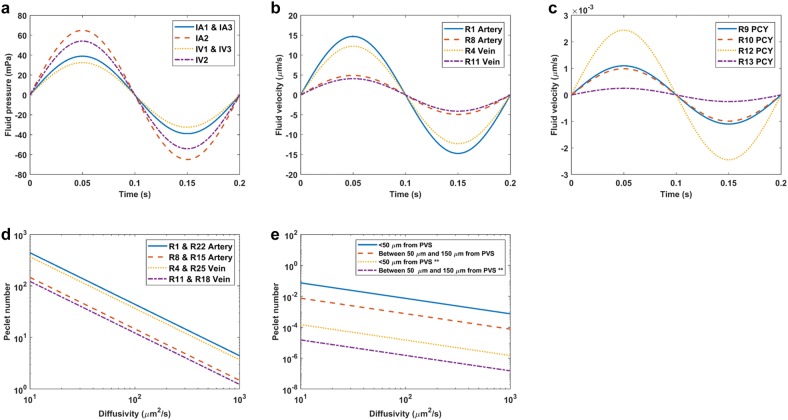
Periodic vessel pulses resulted in oscillatory fluid motion in PVS and parenchyma but no net flow over time. For baseline parameters, PVS and parenchyma peak fluid velocity was on the order of 10 μm/s and 1 nm/s, with corresponding Peclet numbers below 10 and 10 respectively. Peak fluid velocity in the PVS and parenchyma tended to increase with increasing pulse amplitude and vessel size, and exhibited asymptotic relationships with hydraulic conductivity.
Solute transport in parenchyma was predicted to be diffusion dominated, with a negligible contribution from convection. In the PVS, dispersion due to oscillating flow likely plays a significant role in PVS rapid transport observed in previous in vivo experiments. This dispersive effect could be more significant than convective solute transport from net flow that may exist in PVS and should be studied further.
在动物模型中,发现蛛网膜下腔和实质中的溶解化合物优先通过皮质血管周围空间(PVS)运输,但涉及的运输现象尚不清楚。
在这项研究中,使用了两个液压网络模型来预测血管搏动产生的流体运动,并估计 PVS 和实质中溶质运输的贡献。研究了脉幅和定时、PVS 尺寸和组织液压传导率的变化对流体运动的影响。
周期性的血管脉冲导致 PVS 和实质中的振荡流体运动,但随时间没有净流动。对于基线参数,PVS 和实质中的峰值流体速度约为 10μm/s 和 1nm/s,相应的 Peclet 数分别低于 10 和 10。PVS 和实质中的峰值流体速度随脉幅和血管尺寸的增加而增加,并与液压传导率呈渐近关系。
预测实质中的溶质运输以扩散为主,对流贡献可忽略不计。在 PVS 中,由于振荡流动引起的弥散作用可能在先前的体内实验中观察到的 PVS 快速运输中起重要作用。这种弥散效应可能比 PVS 中可能存在的净流动引起的对流溶质运输更为显著,应进一步研究。