Biofluid Mechanics Laboratory, Department of Mechanical Engineering, University of Louisville, Louisville, KY, 40292, USA.
Fluids Barriers CNS. 2018 Jun 15;15(1):17. doi: 10.1186/s12987-018-0103-8.
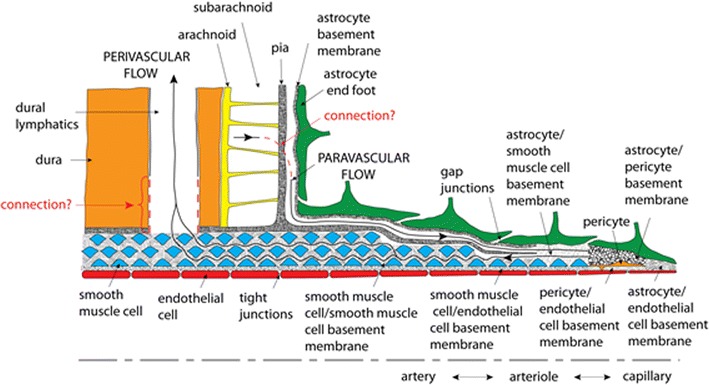
Transport of solutes has been observed in the spaces surrounding cerebral arteries and veins. Indeed, transport has been found in opposite directions in two different spaces around arteries. These findings have motivated hypotheses of bulk flow within these spaces. The glymphatic circulation hypothesis involves flow of cerebrospinal fluid from the cortical subarachnoid space to the parenchyma along the paraarterial (extramural, Virchow-Robin) space around arteries, and return flow to the cerebrospinal fluid (CSF) space via paravenous channels. The second hypothesis involves flow of interstitial fluid from the parenchyma to lymphatic vessels along basement membranes between arterial smooth muscle cells.
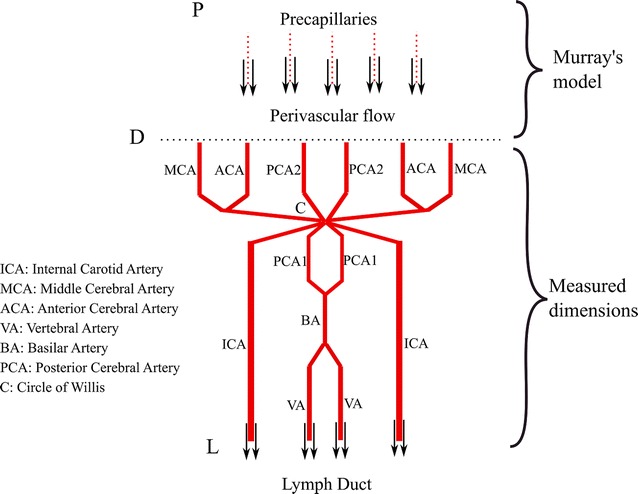
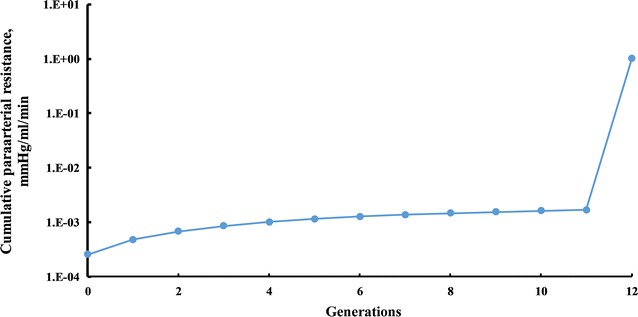
This article evaluates the plausibility of steady, pressure-driven flow in these channels with one-dimensional branching models.
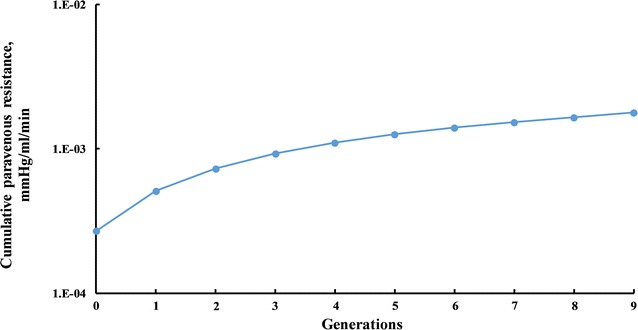
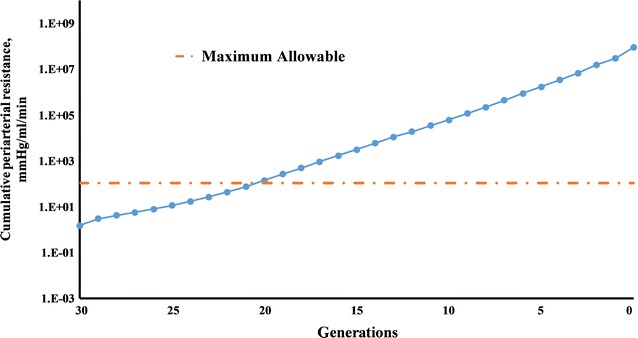
According to the models, the hydraulic resistance of arterial basement membranes is too large to accommodate estimated interstitial perfusion of the brain, unless the flow empties to lymphatic ducts after only several generations (still within the parenchyma). The estimated pressure drops required to drive paraarterial and paravenous flows of the same magnitude are not large, but paravenous flow back to the CSF space means that the total pressure difference driving both flows is limited to local pressure differences among the different CSF compartments, which are estimated to be small.
Periarterial flow and glymphatic circulation driven by steady pressure are both found to be implausible, given current estimates of anatomical and fluid dynamic parameters.
在脑动脉和静脉周围的空间中已经观察到溶质的转运。事实上,在动脉周围的两个不同空间中已经发现了相反方向的转运。这些发现激发了这些空间内的整体流动假说。神经淋巴假说涉及脑脊髓液从皮质下蛛网膜空间沿着动脉周围的旁血管(外膜,Virchow-Robin)空间向实质流动,以及通过旁静脉通道向脑脊髓液(CSF)空间的回流。第二个假说是指间质液从实质沿着动脉平滑肌细胞之间的基底膜向淋巴管流动。
本文通过一维分支模型评估了这些通道中稳定的压力驱动流动的可能性。
根据模型,动脉基底膜的水力阻力太大,无法容纳大脑估计的间质灌注,除非在仅经过几代(仍在实质内)后,流量排空到淋巴管。驱动同等大小的旁血管和旁静脉流动所需的估计压力降并不大,但旁静脉回流到 CSF 空间意味着驱动这两种流动的总压差仅限于不同 CSF 隔室之间的局部压差,这些压差估计很小。
考虑到当前对解剖学和流体动力学参数的估计,稳态压力驱动的动脉周围流动和神经淋巴循环都被认为是不合理的。