Dept. of Physics & Astronomy, University of North Carolina at Chapel Hill, Chapel Hill, NC, United States of America.
PLoS One. 2018 Jul 17;13(7):e0200345. doi: 10.1371/journal.pone.0200345. eCollection 2018.
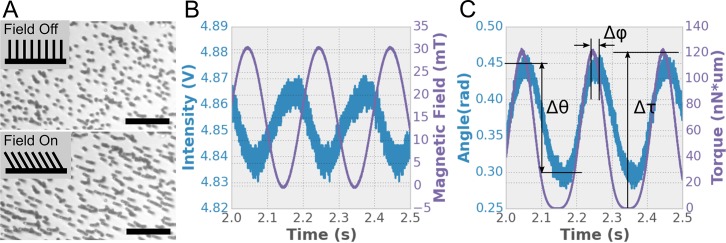
Here we describe development of a microfluidic viscometer based on arrays of magnetically actuated micro-posts. Quantitative viscosities over a range of three orders of magnitude were determined for samples of less than 20 μL. This represents the first demonstration of quantitative viscometry using driven flexible micropost arrays. Critical to the success of our system is a comprehensive analytical model that includes the mechanical and magnetic properties of the actuating posts, the optical readout, and fluid-structure interactions. We found that alterations of the actuator beat shape as parameterized by the dimensionless "sperm number" must be taken into account to determine the fluid properties from the measured actuator dynamics. Beyond our particular system, the model described here can provide dynamics predictions for a broad class of flexible microactuator designs. We also show how the model can guide the design of new arrays that expand the accessible range of measurements.
在这里,我们描述了一种基于磁驱动微柱阵列的微流控粘度计的开发。对于小于 20 μL 的样品,我们确定了定量粘度在三个数量级范围内的变化。这代表了使用驱动的柔性微柱阵列进行定量粘度测量的首次演示。我们系统成功的关键是一个全面的分析模型,该模型包括致动柱的机械和磁性能、光学读数和流固相互作用。我们发现,必须考虑由无量纲“精子数”参数化的致动器拍打形状的改变,才能从测量的致动器动力学中确定流体特性。除了我们的特定系统之外,这里描述的模型可以为广泛的柔性微致动器设计提供动力学预测。我们还展示了如何使用该模型指导新阵列的设计,从而扩展可测量的范围。