Norwegian Institute for Water Research, Oslo, Norway.
Limnological Research Station Iffeldorf, Technical University of Munich, Munich, Germany.
PLoS One. 2018 Jul 19;13(7):e0200774. doi: 10.1371/journal.pone.0200774. eCollection 2018.
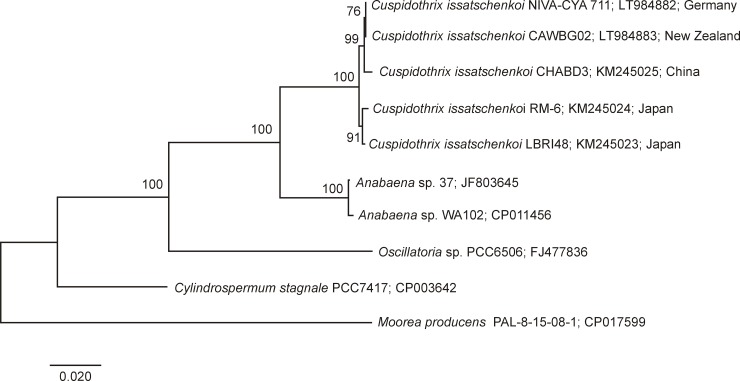
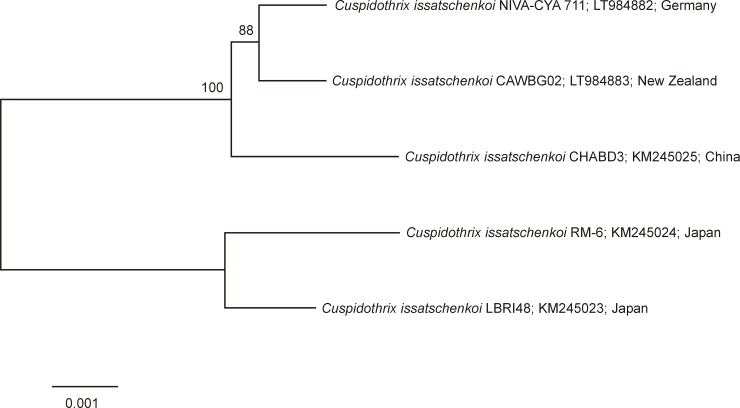
Anatoxin-a and homoanatoxin-a are neurotoxic cyanotoxins produced by benthic and planktonic cyanobacteria worldwide. These toxins are produced by the cyanobacterial genera Dolichospermum, Cuspidothrix, Phormidium, Oscillatoria, Tychonema and Cylindrospermum. In the present study the ana gene clusters (anaA-anaG; c. 21.1 kilobases) of two anatoxin producing Cuspidothrix issatschenkoi strains from Germany: (NIVA-CYA 711) and New Zealand (CAWBG02) were sequenced and compared with the ana gene clusters of two C. issatschenkoi strains from Japan (RM-6 and LBRI48) and one from China (CHABD3). All five ana gene clusters are characterized by the same gene order for anaA-anaG. Similarities were highest (99.56-99.57%) between German (NIVA-CYA 711), New Zealand (CAWBG02) and Chinese (CHABD3) strains. Similarities were lower (91.40-91.67%) when compared to the Japanese strains (RM-6 and LBRI48). Collectively, 2,037 variable sites (328 single nucleotide polymorphisms and 9 insertions/deletions, comprising 1,709 nucleotides) were found in the ana gene clusters of the German, New Zealand and Japanese strains compared to the Chinese strain (CHABD3). The ana gene clusters of the German (NIVA-CYA 711), New Zealand (CAWBG02) and Japanese (RM-6 and LBRI48) strains were characterized by 83, 84, 255 and 231 SNP's compared to the Chinese strain (CHABD3), respectively. The anaE and anaF genes showed the highest variability in all five strains and are recommended as the best genetic markers for further phylogenetic studies of the ana gene cluster from C. issatschenkoi.
石莼毒素-a 和同石莼毒素-a 是由世界范围内底栖和浮游蓝藻产生的神经毒素。这些毒素由蓝藻属的束丝藻、束毛藻、平裂藻、颤藻、席藻和柱孢藻产生。在本研究中,对来自德国的两种产石莼毒素的束丝藻菌株(NIVA-CYA 711 和 CAWBG02)和来自日本的两种菌株(RM-6 和 LBRI48)以及来自中国的一种菌株(CHABD3)的 ana 基因簇(anaA-anaG;约 21.1kb)进行了测序和比较。所有五个 ana 基因簇都具有相同的 anaA-anaG 基因排列顺序。德国(NIVA-CYA 711)、新西兰(CAWBG02)和中国(CHABD3)菌株之间的相似性最高(99.56-99.57%)。与日本菌株(RM-6 和 LBRI48)相比,相似性较低(91.40-91.67%)。总的来说,与中国菌株(CHABD3)相比,德国、新西兰和日本菌株的 ana 基因簇中发现了 2037 个变异位点(328 个单核苷酸多态性和 9 个插入/缺失,包含 1709 个核苷酸)。与中国菌株(CHABD3)相比,德国(NIVA-CYA 711)、新西兰(CAWBG02)和日本(RM-6 和 LBRI48)菌株的 ana 基因簇分别具有 83、84、255 和 231 个 SNP。在所有五个菌株中,anaE 和 anaF 基因的变异性最高,建议将其作为束丝藻 ana 基因簇进一步系统发育研究的最佳遗传标记。