School of Information Science and Engineering, Central South University, Changsha 410083, China.
School of Informatics, Hunan University of Chinese Medicine, Changsha 410208, China.
Sensors (Basel). 2018 Jul 19;18(7):2349. doi: 10.3390/s18072349.
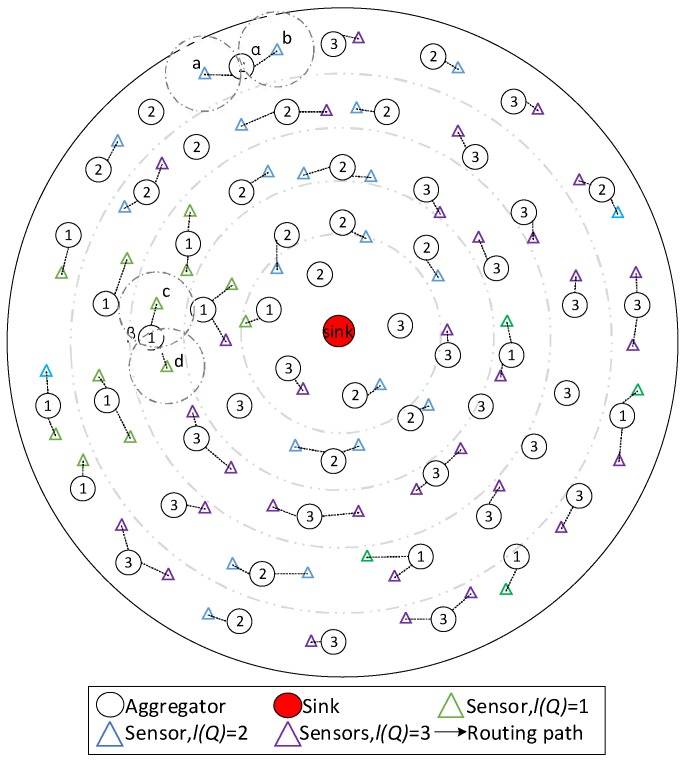
Data aggregation is a widely adopted method to effectively reduce the data transmission volume and improve the lifetime of wireless sensor networks (WSNs). In the data aggregation networks, some parameters directly determine the delay of aggregation. In industrial applications, the data generated by different sensors have different requirements for delay or other QoS performance. In the previous study, a common strategy is that all kinds of data is aggregated into one frame when the condition is satisfied with a QoS requirement, which causes excessive energy consumption and severely impairs the lifetime of network. A Differentiated Data Aggregation Routing (DDAR) scheme is proposed to reduce energy consumption and guarantee that the delay could be controlled within the corresponding QoS requirement constraint. The primary contributions of the DDAR scheme are the following: (a) The DDAR scheme makes data with different QoS requirement route to the sink along the different paths. The parameters of the aggregators in each path, such as aggregation deadline (Tt) and the aggregation threshold (Nt), are configured according to the QoS requirements. Accordingly, energy consumption can be reduced without degrading the performance of data transmission. (b) Based on DDAR scheme, an improved DDAR scheme is proposed to further improve performance through fully utilize the residual energy in the nodes which are far from the sink. The frequency of aggregation of these nodes increases by reducing the value of Tt and Nt so as to further improve the energy efficiency and reduce delay. Simulation results demonstrate that compared with the previous scheme, this scheme reduces the delay by 25.01%, improves the lifetime by 55.45%, and increases energy efficiency by 83.99%. The improved DDAR scheme improves the energy efficiency by 33.97% and service guarantee rate by 10.11%.
数据聚合是一种广泛采用的方法,可以有效地减少无线传感器网络(WSN)的数据传输量并提高其寿命。在数据聚合网络中,一些参数直接决定了聚合的延迟。在工业应用中,不同传感器生成的数据对延迟或其他服务质量(QoS)性能有不同的要求。在之前的研究中,一种常见的策略是,只要满足 QoS 要求,就将各种数据聚合到一个帧中,这会导致过度的能量消耗,并严重损害网络的寿命。提出了一种差异化数据聚合路由(DDAR)方案,以降低能量消耗并保证延迟可以控制在相应的 QoS 要求约束内。DDAR 方案的主要贡献如下:(a)DDAR 方案使具有不同 QoS 要求的数据沿着不同的路径路由到汇聚点。每条路径上的聚合器的参数,如聚合截止时间(Tt)和聚合阈值(Nt),都是根据 QoS 要求进行配置的。因此,在不降低数据传输性能的情况下,可以降低能量消耗。(b)基于 DDAR 方案,提出了一种改进的 DDAR 方案,通过充分利用远离汇聚点的节点中的剩余能量来进一步提高性能。通过降低 Tt 和 Nt 的值,这些节点的聚合频率增加,从而进一步提高能量效率并降低延迟。仿真结果表明,与之前的方案相比,该方案将延迟降低了 25.01%,将寿命提高了 55.45%,并将能量效率提高了 83.99%。改进的 DDAR 方案将能量效率提高了 33.97%,服务保证率提高了 10.11%。