Charité - Universitätsmedizin Berlin, corporate member of Freie Universität Berlin, Humboldt-Universität zu Berlin, and Berlin Institute of Health, Institute of Physiology, Sleep Research & Clinical Chronobiology, Berlin, Germany.
Intellux GmbH, Berlin, Germany.
Sci Rep. 2018 Jul 20;8(1):11012. doi: 10.1038/s41598-018-29380-z.
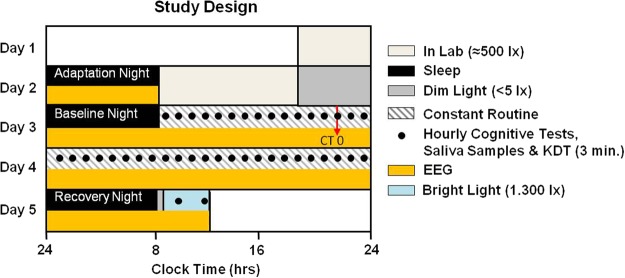
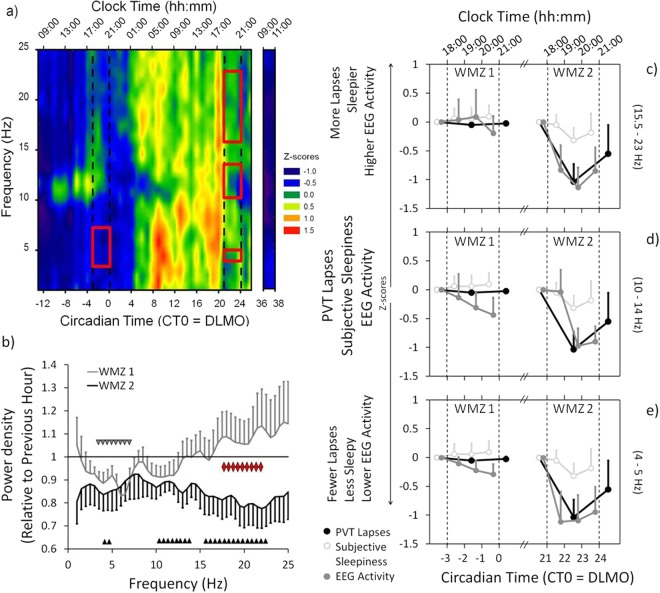
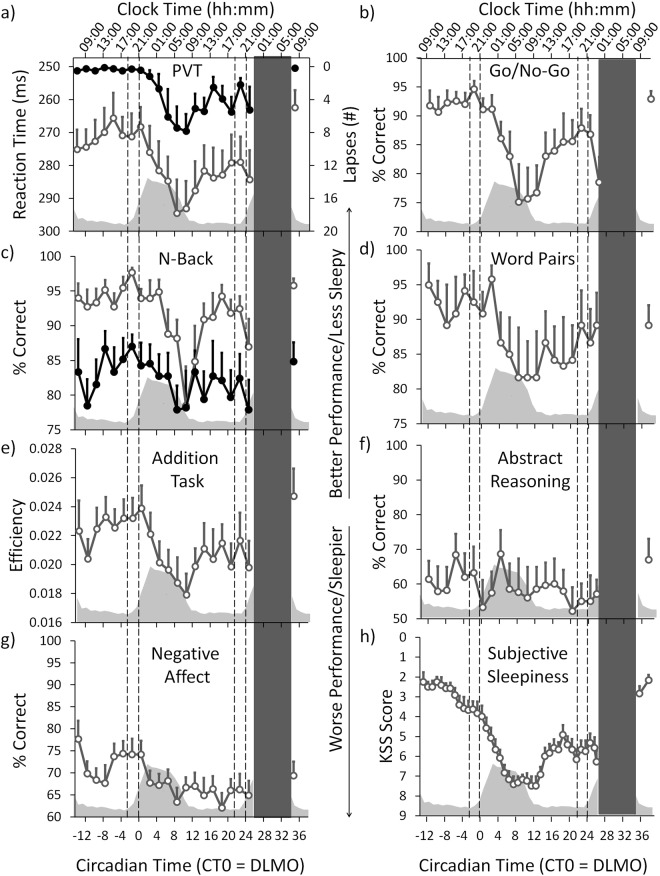
Under entrained conditions, the accumulation of homeostatic sleep pressure in the evening is opposed by a strong circadian arousal signal prior to the dim light melatonin onset, called the Wake Maintenance Zone (WMZ). This study aimed at investigating the impact of the WMZ on different cognitive performance tests, as well as on subjective and objective sleepiness. Twelve young male participants completed a constant routine protocol with 40 h of extended wakefulness that included two WMZs. Cognitive tests and saliva samples were assessed hourly, while the electroencephalogram (EEG) was recorded continuously. Participants improved in cognitive response inhibition during WMZ1 (13.5 h awake) and sustained attention during WMZ2 (37.5 h awake), but not in higher executive function tests. There were significant EEG power density reductions in the delta/theta frequency range during WMZ1 and in delta/theta, alpha, and sigma/beta ranges during WMZ2, with a greater change in the sigma/beta range during WMZ2 compared to WMZ1. EEG power reductions coincided during WMZ1 with stable subjective sleepiness and sustained attention. During WMZ2, EEG power reductions were more pronounced and coincided with improved sustained attention. Our results suggest the circadian arousal signal in the evening differently modulates cognitive functions and EEG power depending on the duration of prior wakefulness.
在夹带条件下,稳态睡眠压力的积累在傍晚会受到强烈的昼夜觉醒信号的阻碍,该信号称为清醒维持区 (WMZ)。本研究旨在调查 WMZ 对不同认知性能测试以及主观和客观嗜睡的影响。12 名年轻男性参与者完成了一项包含两个 WMZ 的 40 小时延长清醒的恒常作息方案。每小时评估认知测试和唾液样本,同时连续记录脑电图 (EEG)。参与者在 WMZ1(清醒 13.5 小时)时改善了认知反应抑制,在 WMZ2(清醒 37.5 小时)时改善了持续注意力,但在更高的执行功能测试中没有改善。在 WMZ1 期间,在 delta/theta 频率范围内观察到 EEG 功率密度显著降低,在 WMZ2 期间,在 delta/theta、alpha 和 sigma/beta 范围内观察到 EEG 功率密度降低,与 WMZ1 相比,在 WMZ2 期间,sigma/beta 范围内的变化更大。在 WMZ1 期间,EEG 功率降低与稳定的主观嗜睡和持续注意力相吻合。在 WMZ2 期间,EEG 功率降低更为明显,与改善的持续注意力相吻合。我们的研究结果表明,傍晚的昼夜觉醒信号根据先前清醒时间的长短,对认知功能和 EEG 功率有不同的调节作用。