Department of Imaging Chemistry and Biology, School of Biomedical Engineering and Imaging Sciences, Kings' College London, London, UK.
Department of Preclinical Imaging and Radiopharmacy, Werner Siemens Imaging Center, Eberhard Karls University, Tuebingen, Germany.
Mol Imaging Biol. 2018 Oct;20(5):696-704. doi: 10.1007/s11307-018-1254-3.
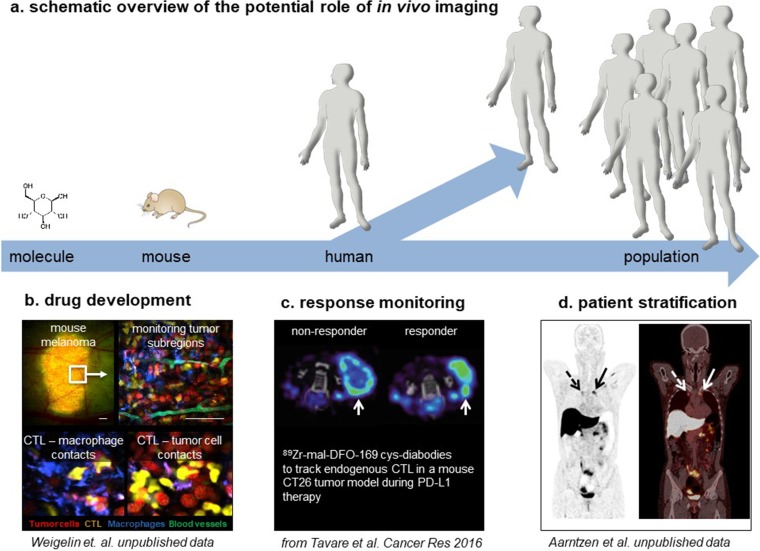
This review aims to emphasize the potential of in vivo imaging to optimize current and upcoming anti-cancer immunotherapies: spanning from preclinical to clinical applications. Immunotherapies are an emerging class of treatments for a variety of diseases. The agents include molecular and cellular therapeutics, which aim to treat the disease through re-education of the host immune system, often via complex mechanisms of action. In vivo imaging has the potential to contribute in several different ways: (1) as a drug development tool to improve our understanding of their complex mechanisms of action, (2) as a tool to predict efficacy, for example, to stratify patients into probable responders and likely non-responders, and (3) as a non-invasive treatment response biomarker to guide efficient immunotherapy use and to recognize early signs of potential loss of efficacy or resistance in patients. Areas where in vivo imaging is already successfully implemented in onco-immunology research will be discussed and domains where its use offers great potential will be highlighted. The focus of this article is on anti-cancer immunotherapy as it currently is the most advanced immunotherapy area. However, the described concepts can also be paralleled in other immune-mediated disorders and for conditions requiring immunotherapeutic intervention. Importantly, we introduce a new study group within the European Society of Molecular Imaging with the goal to facilitate and enhance immunotherapy development through the use of in vivo imaging.
从临床前到临床应用。免疫疗法是一类新兴的治疗多种疾病的方法。这些药物包括分子和细胞治疗药物,其旨在通过重新教育宿主免疫系统来治疗疾病,通常通过复杂的作用机制。体内成像具有多种潜在用途:(1) 作为一种药物开发工具,以提高我们对其复杂作用机制的理解;(2) 作为一种预测疗效的工具,例如,将患者分层为可能的应答者和可能的无应答者;(3) 作为一种非侵入性的治疗反应生物标志物,以指导免疫疗法的有效使用,并识别患者潜在疗效丧失或耐药的早期迹象。本文将讨论体内成像在肿瘤免疫学研究中已成功实施的领域,并强调其在具有巨大应用潜力的领域的应用。本文的重点是癌症免疫疗法,因为它是目前最先进的免疫疗法领域。然而,所描述的概念也可以在其他免疫介导的疾病和需要免疫治疗干预的情况下进行类比。重要的是,我们在欧洲分子成像学会内引入了一个新的研究小组,旨在通过使用体内成像来促进和增强免疫疗法的发展。