King's College London, Institute of Psychiatry, Psychology and Neuroscience, Department of Psychological Medicine, Section of Perinatal Psychiatry & Stress, Psychiatry and Immunology, The Maurice Wohl Clinical Neuroscience Institute, Cutcombe Road, London, SE5 9RX, UK.
King's College London, Institute of Psychiatry, Psychology and Neuroscience, Department of Psychological Medicine, Section of Perinatal Psychiatry & Stress, Psychiatry and Immunology, The Maurice Wohl Clinical Neuroscience Institute, Cutcombe Road, London, SE5 9RX, UK; King's College London, Institute of Psychiatry, Psychology and Neuroscience, Department of Psychological Medicine, Section of Psychosis Studies, London, SE5 9AF, UK.
Psychoneuroendocrinology. 2018 Dec;98:211-221. doi: 10.1016/j.psyneuen.2018.06.017. Epub 2018 Jul 19.
Antenatal depression is associated with a broad range of suboptimal outcomes in offspring, although the underlying mechanisms are not yet understood. Animal studies propose inflammation and glucocorticoids as mediators of the developmental programming effect of prenatal stress on offspring stress responses, but studies in humans are not yet at this stage. Indeed, to date no single study has examined the effects of a rigorously defined, clinically significant Major Depressive Disorder (MDD) in pregnancy on maternal antenatal inflammatory biomarkers and hypothalamic-pituitary (HPA) axis, as well as on offspring HPA axis, behavior and developmental outcomes in the first postnatal year.
A prospective longitudinal design was used in 106 women (49 cases vs. 57 healthy controls) to study the effect of MDD in pregnancy and associated antenatal biology (inflammatory and cortisol biomarkers), on offspring stress response (cortisol response to immunization, at 8 weeks and 12 months), early neurobehavior (Neonatal Behavioral Assessment Scale, NBAS, at day 6), and cognitive, language and motor development (Bayley Scales of Infant and Toddler Development at 12 months).
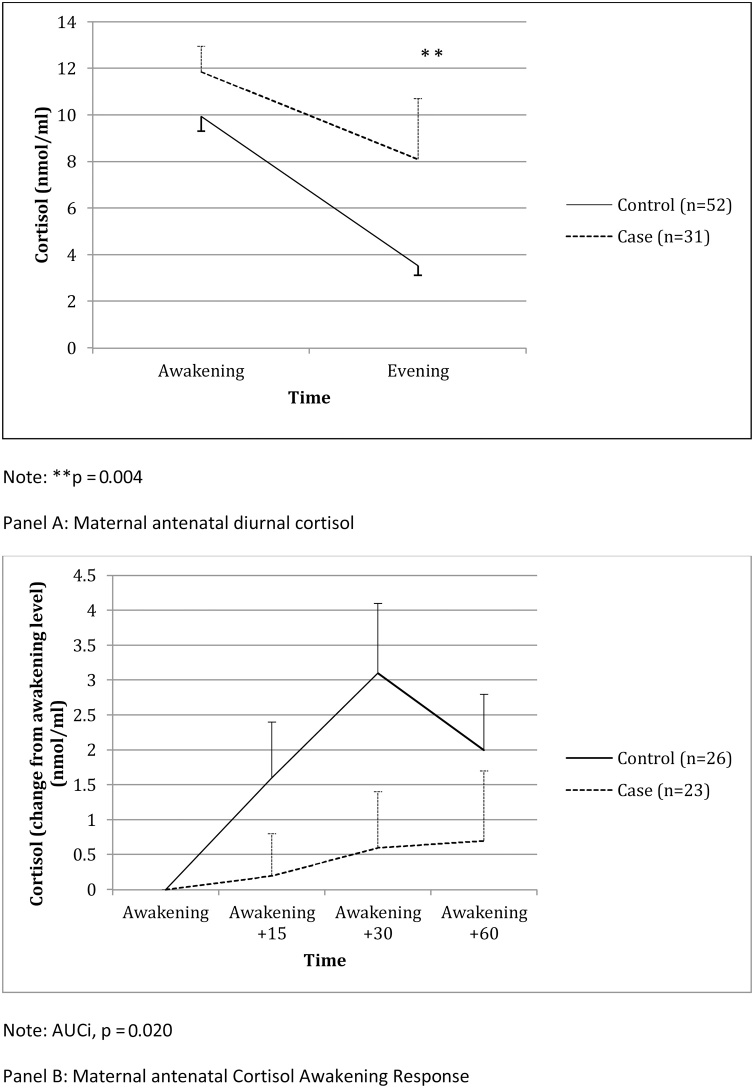
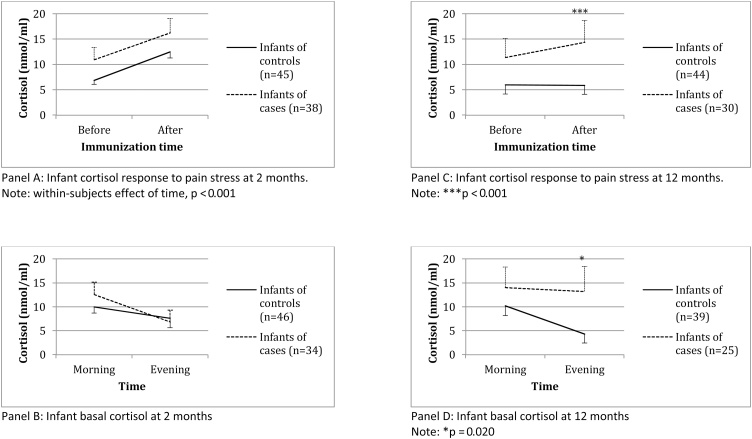
Compared with healthy controls, women with MDD in pregnancy had raised interleukin (IL) IL-6 (effect size (δ) = 0.53, p = 0.031), IL-10 (δ = 0.53, p = 0.043), tumor necrosis factor alpha (δ = 0.90, p = 0.003) and vascular endothelial growth factor (δ = 0.56, p = 0.008), together with raised diurnal cortisol secretion (δ = 0.89, p = 0.006), raised evening cortisol (δ = 0.64, p = 0.004), and blunted cortisol awakening response (δ = 0.70, p = 0.020), and an 8-day shorter length of gestation (δ = 0.70, p = 0.005). Furthermore, they had neonates with suboptimal neurobehavioral function in four out of five NBAS clusters measured (range of δ = 0.45-1.22 and p = 0.049-<0.001) and increased cortisol response to stress at one year of age (δ = 0.87, p < 0.001). Lastly, maternal inflammatory biomarkers and cortisol levels were correlated with infant stress response, suggesting a mechanistic link.
This study confirms and extends the notion that depression in pregnancy is associated with altered offspring behavior and biological stress response, and demonstrates that changes in maternal antenatal stress-related biology are associated with these infant outcomes.
产前抑郁症与后代一系列不理想的结果相关,尽管其潜在机制尚不清楚。动物研究提出炎症和糖皮质激素作为产前应激对后代应激反应的发育编程效应的介质,但人类研究尚未达到这一阶段。事实上,迄今为止,尚无一项研究检查过严格定义的、临床上显著的妊娠期重度抑郁症(MDD)对产妇产前炎症生物标志物和下丘脑-垂体(HPA)轴以及后代 HPA 轴、行为和第一年产后发育结果的影响。
采用前瞻性纵向设计,对 106 名女性(49 例病例与 57 名健康对照组)进行研究,以研究妊娠期间 MDD 及相关产前生物学(炎症和皮质醇生物标志物)对后代应激反应(8 周和 12 个月时免疫接种后的皮质醇反应)、早期神经行为(新生儿行为评估量表,NBAS,第 6 天)和认知、语言和运动发育(12 个月时贝利婴幼儿发育量表)的影响。
与健康对照组相比,患有妊娠 MDD 的女性白细胞介素(IL)IL-6(效应量(δ)=0.53,p=0.031)、IL-10(δ=0.53,p=0.043)、肿瘤坏死因子-α(δ=0.90,p=0.003)和血管内皮生长因子(δ=0.56,p=0.008)水平升高,同时伴有日间皮质醇分泌增加(δ=0.89,p=0.006)、夜间皮质醇升高(δ=0.64,p=0.004)和皮质醇觉醒反应减弱(δ=0.70,p=0.020),以及妊娠周期缩短 8 天(δ=0.70,p=0.005)。此外,她们的新生儿在 NBAS 中五个测量的神经行为功能中有四个功能欠佳(范围的δ=0.45-1.22,p=0.049-<0.001),并且在一岁时对压力的皮质醇反应增加(δ=0.87,p<0.001)。最后,产妇炎症生物标志物和皮质醇水平与婴儿应激反应相关,表明存在一种机制联系。
这项研究证实并扩展了这样一种观念,即怀孕期间的抑郁症与后代行为和生物应激反应的改变有关,并表明母体产前应激相关生物学的变化与这些婴儿结局有关。