• 文献检索
  • 文档翻译
  • 深度研究
  • 学术资讯
  • Suppr Zotero 插件Zotero 插件
  • 邀请有礼
  • 套餐&价格
  • 历史记录
应用&插件
Suppr Zotero 插件Zotero 插件浏览器插件Mac 客户端Windows 客户端微信小程序
定价
高级版会员购买积分包购买API积分包
服务
文献检索文档翻译深度研究API 文档MCP 服务
关于我们
关于 Suppr公司介绍联系我们用户协议隐私条款
关注我们

Suppr 超能文献

核心技术专利:CN118964589B侵权必究
粤ICP备2023148730 号-1Suppr @ 2026

文献检索

告别复杂PubMed语法,用中文像聊天一样搜索,搜遍4000万医学文献。AI智能推荐,让科研检索更轻松。

立即免费搜索

文件翻译

保留排版,准确专业,支持PDF/Word/PPT等文件格式,支持 12+语言互译。

免费翻译文档

深度研究

AI帮你快速写综述,25分钟生成高质量综述,智能提取关键信息,辅助科研写作。

立即免费体验

机器学习在乳腺癌放射组学中的应用:一项包含 922 名患者和 529 项 DCE-MRI 特征的研究。

A machine learning approach to radiogenomics of breast cancer: a study of 922 subjects and 529 DCE-MRI features.

机构信息

Department of Radiology, Duke University School of Medicine, Durham, NC, 22705, USA.

Department of Electrical and Computer Engineering, Duke University, Durham, NC, 22705, USA.

出版信息

Br J Cancer. 2018 Aug;119(4):508-516. doi: 10.1038/s41416-018-0185-8. Epub 2018 Jul 23.

DOI:10.1038/s41416-018-0185-8
PMID:30033447
原文链接:https://pmc.ncbi.nlm.nih.gov/articles/PMC6134102/
Abstract

BACKGROUND

Recent studies showed preliminary data on associations of MRI-based imaging phenotypes of breast tumours with breast cancer molecular, genomic, and related characteristics. In this study, we present a comprehensive analysis of this relationship.

METHODS

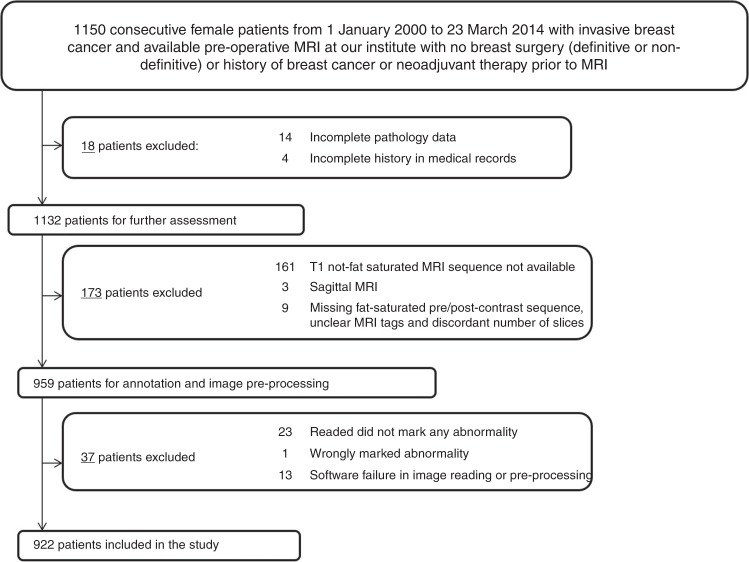
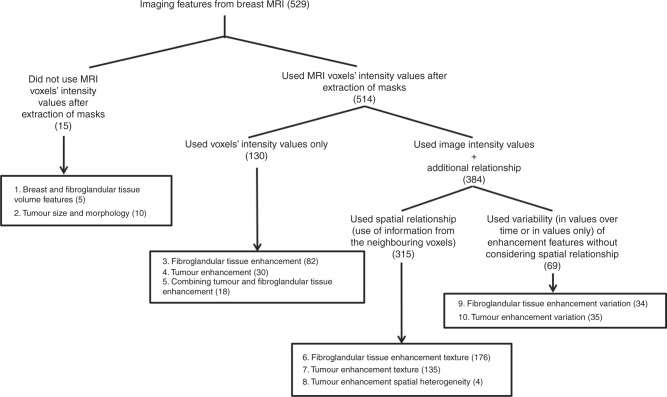
We analysed a set of 922 patients with invasive breast cancer and pre-operative MRI. The MRIs were analysed by a computer algorithm to extract 529 features of the tumour and the surrounding tissue. Machine-learning-based models based on the imaging features were trained using a portion of the data (461 patients) to predict the following molecular, genomic, and proliferation characteristics: tumour surrogate molecular subtype, oestrogen receptor, progesterone receptor and human epidermal growth factor status, as well as a tumour proliferation marker (Ki-67). Trained models were evaluated on the set of the remaining 461 patients.

RESULTS

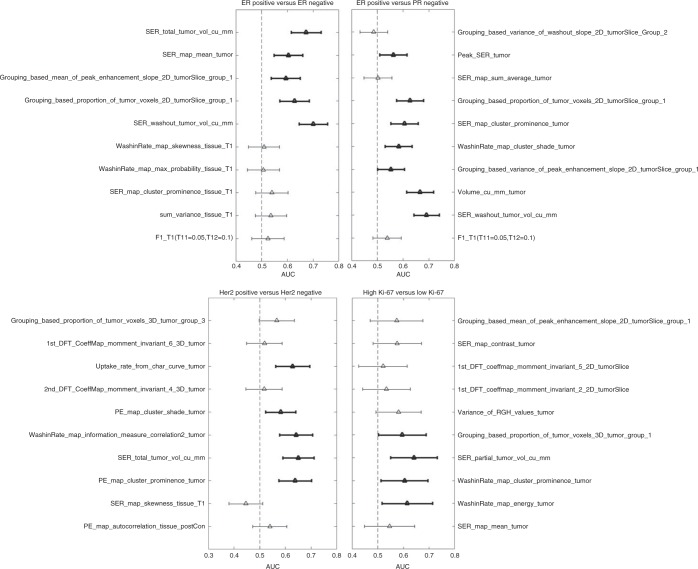
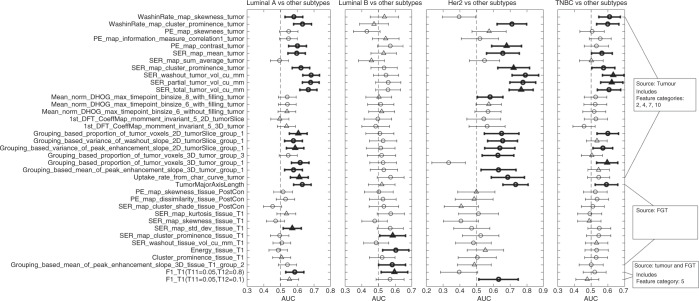
Multivariate models were predictive of Luminal A subtype with AUC = 0.697 (95% CI: 0.647-0.746, p < .0001), triple negative breast cancer with AUC = 0.654 (95% CI: 0.589-0.727, p < .0001), ER status with AUC = 0.649 (95% CI: 0.591-0.705, p < .001), and PR status with AUC = 0.622 (95% CI: 0.569-0.674, p < .0001). Associations between individual features and subtypes we also found.

CONCLUSIONS

There is a moderate association between tumour molecular biomarkers and algorithmically assessed imaging features.

摘要

背景

最近的研究显示了基于 MRI 的乳腺癌成像表型与乳腺癌分子、基因组和相关特征之间关联的初步数据。在这项研究中,我们对这种关系进行了全面分析。

方法

我们分析了一组 922 名患有浸润性乳腺癌和术前 MRI 的患者。通过计算机算法对 MRI 进行分析,以提取肿瘤和周围组织的 529 个特征。使用部分数据(461 名患者)基于成像特征训练基于机器学习的模型,以预测以下分子、基因组和增殖特征:肿瘤替代分子亚型、雌激素受体、孕激素受体和人表皮生长因子状态,以及肿瘤增殖标志物(Ki-67)。在其余的 461 名患者中评估训练模型。

结果

多变量模型可预测 Luminal A 亚型,AUC=0.697(95%CI:0.647-0.746,p<0.0001),三阴性乳腺癌,AUC=0.654(95%CI:0.589-0.727,p<0.0001),ER 状态,AUC=0.649(95%CI:0.591-0.705,p<0.001)和 PR 状态,AUC=0.622(95%CI:0.569-0.674,p<0.0001)。我们还发现了个体特征与亚型之间的关联。

结论

肿瘤分子生物标志物与算法评估的成像特征之间存在中度关联。

https://cdn.ncbi.nlm.nih.gov/pmc/blobs/8e65/6134102/1bc669a87463/41416_2018_185_Fig4_HTML.jpg
https://cdn.ncbi.nlm.nih.gov/pmc/blobs/8e65/6134102/547f43bfe0f8/41416_2018_185_Fig1_HTML.jpg
https://cdn.ncbi.nlm.nih.gov/pmc/blobs/8e65/6134102/91c779d735ff/41416_2018_185_Fig2_HTML.jpg
https://cdn.ncbi.nlm.nih.gov/pmc/blobs/8e65/6134102/0deef94e454b/41416_2018_185_Fig3_HTML.jpg
https://cdn.ncbi.nlm.nih.gov/pmc/blobs/8e65/6134102/1bc669a87463/41416_2018_185_Fig4_HTML.jpg
https://cdn.ncbi.nlm.nih.gov/pmc/blobs/8e65/6134102/547f43bfe0f8/41416_2018_185_Fig1_HTML.jpg
https://cdn.ncbi.nlm.nih.gov/pmc/blobs/8e65/6134102/91c779d735ff/41416_2018_185_Fig2_HTML.jpg
https://cdn.ncbi.nlm.nih.gov/pmc/blobs/8e65/6134102/0deef94e454b/41416_2018_185_Fig3_HTML.jpg
https://cdn.ncbi.nlm.nih.gov/pmc/blobs/8e65/6134102/1bc669a87463/41416_2018_185_Fig4_HTML.jpg

相似文献

1
A machine learning approach to radiogenomics of breast cancer: a study of 922 subjects and 529 DCE-MRI features.机器学习在乳腺癌放射组学中的应用:一项包含 922 名患者和 529 项 DCE-MRI 特征的研究。
Br J Cancer. 2018 Aug;119(4):508-516. doi: 10.1038/s41416-018-0185-8. Epub 2018 Jul 23.
2
Computational approach to radiogenomics of breast cancer: Luminal A and luminal B molecular subtypes are associated with imaging features on routine breast MRI extracted using computer vision algorithms.基于计算方法的乳腺癌放射组学研究:使用计算机视觉算法提取的常规乳腺 MRI 成像特征与腔 A 型和腔 B 型分子亚型相关。
J Magn Reson Imaging. 2015 Oct;42(4):902-7. doi: 10.1002/jmri.24879. Epub 2015 Mar 17.
3
Breast MRI background parenchymal enhancement as an imaging bridge to molecular cancer sub-type.乳腺 MRI 背景实质增强作为连接分子肿瘤亚型的影像学桥梁。
Eur J Radiol. 2019 Apr;113:148-152. doi: 10.1016/j.ejrad.2019.02.018. Epub 2019 Feb 15.
4
Quantification of breast tumor heterogeneity for ER status, HER2 status, and TN molecular subtype evaluation on DCE-MRI.在动态对比增强磁共振成像(DCE-MRI)上对雌激素受体(ER)状态、人表皮生长因子受体2(HER2)状态和TN分子亚型评估进行乳腺肿瘤异质性的量化。
Magn Reson Imaging. 2016 Jul;34(6):809-819. doi: 10.1016/j.mri.2016.03.001. Epub 2016 Mar 8.
5
Is there a correlation between 3T multiparametric MRI and molecular subtypes of breast cancer?3T 多参数 MRI 与乳腺癌分子亚型之间是否存在相关性?
Eur J Radiol. 2018 Nov;108:120-127. doi: 10.1016/j.ejrad.2018.09.024. Epub 2018 Sep 24.
6
MRI texture analysis in differentiating luminal A and luminal B breast cancer molecular subtypes - a feasibility study.磁共振成像纹理分析在鉴别管腔A型和管腔B型乳腺癌分子亚型中的应用——一项可行性研究
BMC Med Imaging. 2017 Dec 29;17(1):69. doi: 10.1186/s12880-017-0239-z.
7
Quantitative MRI morphology of invasive breast cancer: correlation with immunohistochemical biomarkers and subtypes.浸润性乳腺癌的定量MRI形态学:与免疫组化生物标志物及亚型的相关性
Acta Radiol. 2015 Mar;56(3):269-75. doi: 10.1177/0284185114524197. Epub 2014 Feb 20.
8
Investigation of breast cancer molecular subtype in a multi-ethnic population using MRI.应用 MRI 对多民族人群的乳腺癌分子亚型进行研究。
PLoS One. 2024 Aug 29;19(8):e0309131. doi: 10.1371/journal.pone.0309131. eCollection 2024.
9
Diagnostic Value of ER, PR, FR and HER-2-Targeted Molecular Probes for Magnetic Resonance Imaging in Patients with Breast Cancer.雌激素受体、孕激素受体、卵泡抑素和人表皮生长因子受体2靶向分子探针在乳腺癌患者磁共振成像中的诊断价值
Cell Physiol Biochem. 2018;49(1):271-281. doi: 10.1159/000492877. Epub 2018 Aug 23.
10
Computer-aided evaluation of the correlation between MRI morphology and immunohistochemical biomarkers or molecular subtypes in breast cancer.计算机辅助评估乳腺癌中 MRI 形态学与免疫组织化学标志物或分子亚型之间的相关性。
Sci Rep. 2017 Oct 23;7(1):13818. doi: 10.1038/s41598-017-14274-3.

引用本文的文献

1
From large language models to multimodal AI: a scoping review on the potential of generative AI in medicine.从大语言模型到多模态人工智能:关于生成式人工智能在医学领域潜力的范围综述
Biomed Eng Lett. 2025 Aug 22;15(5):845-863. doi: 10.1007/s13534-025-00497-1. eCollection 2025 Sep.
2
3D Frequency-Domain Full Waveform Inversion for Whole-Breast Imaging With a Multi-Row Ring Array.用于全乳腺成像的多排环形阵列三维频域全波形反演
IEEE Open J Ultrason Ferroelectr Freq Control. 2025;5:77-81. doi: 10.1109/ojuffc.2025.3570253. Epub 2025 May 14.
3
SCGAN: Sparse CounterGAN for Counterfactual Explanations in Breast Cancer Prediction.

本文引用的文献

1
Effects of MRI scanner parameters on breast cancer radiomics.MRI扫描仪参数对乳腺癌影像组学的影响。
Expert Syst Appl. 2017 Nov 30;87:384-391. doi: 10.1016/j.eswa.2017.06.029. Epub 2017 Jun 20.
2
Identifying relations between imaging phenotypes and molecular subtypes of breast cancer: Model discovery and external validation.鉴定乳腺癌影像学表型与分子亚型之间的关系:模型发现与外部验证。
J Magn Reson Imaging. 2017 Oct;46(4):1017-1027. doi: 10.1002/jmri.25661. Epub 2017 Feb 8.
3
Radiomic analysis reveals DCE-MRI features for prediction of molecular subtypes of breast cancer.
SCGAN:用于乳腺癌预测中反事实解释的稀疏对抗生成网络
IEEE Trans Autom Sci Eng. 2024 Jul;21(3):2264-2275. doi: 10.1109/tase.2023.3333788. Epub 2023 Nov 23.
4
Exploring personalized neoadjuvant therapy selection strategies in breast cancer: an explainable multi-modal response model.探索乳腺癌个性化新辅助治疗选择策略:一种可解释的多模态反应模型。
EClinicalMedicine. 2025 Jul 17;86:103356. doi: 10.1016/j.eclinm.2025.103356. eCollection 2025 Aug.
5
Neutrophils drive vascular occlusion, tumour necrosis and metastasis.中性粒细胞会导致血管阻塞、肿瘤坏死和转移。
Nature. 2025 Jul 16. doi: 10.1038/s41586-025-09278-3.
6
Medical slice transformer for improved diagnosis and explainability on 3D medical images with DINOv2.用于借助DINOv2改进3D医学图像诊断及可解释性的医学切片变换器
Sci Rep. 2025 Jul 4;15(1):23979. doi: 10.1038/s41598-025-09041-8.
7
Simulating dynamic tumor contrast enhancement in breast MRI using conditional generative adversarial networks.使用条件生成对抗网络模拟乳腺MRI中的动态肿瘤对比增强。
J Med Imaging (Bellingham). 2025 Nov;12(Suppl 2):S22014. doi: 10.1117/1.JMI.12.S2.S22014. Epub 2025 Jun 28.
8
Machine learning-based classification model to differentiate subtypes of invasive breast cancer using MRI.基于机器学习的分类模型,用于利用磁共振成像鉴别浸润性乳腺癌的亚型
Front Oncol. 2025 Jun 3;15:1588787. doi: 10.3389/fonc.2025.1588787. eCollection 2025.
9
Investigating the Prognostic Role of Telomerase-Related Cellular Senescence Gene Signatures in Breast Cancer Using Machine Learning.利用机器学习研究端粒酶相关细胞衰老基因特征在乳腺癌中的预后作用。
Biomedicines. 2025 Mar 30;13(4):826. doi: 10.3390/biomedicines13040826.
10
Comparative analysis of nnU-Net and Auto3Dseg for fat and fibroglandular tissue segmentation in MRI.nnU-Net与Auto3Dseg在MRI中对脂肪和纤维腺组织分割的比较分析
J Med Imaging (Bellingham). 2025 Mar;12(2):024005. doi: 10.1117/1.JMI.12.2.024005. Epub 2025 Apr 16.
放射组学分析揭示了用于预测乳腺癌分子亚型的动态对比增强磁共振成像(DCE-MRI)特征。
PLoS One. 2017 Feb 6;12(2):e0171683. doi: 10.1371/journal.pone.0171683. eCollection 2017.
4
Quantitative MRI radiomics in the prediction of molecular classifications of breast cancer subtypes in the TCGA/TCIA data set.在TCGA/TCIA数据集中,定量MRI影像组学对乳腺癌亚型分子分类的预测
NPJ Breast Cancer. 2016;2:16012-. doi: 10.1038/npjbcancer.2016.12. Epub 2016 May 11.
5
MR Imaging Radiomics Signatures for Predicting the Risk of Breast Cancer Recurrence as Given by Research Versions of MammaPrint, Oncotype DX, and PAM50 Gene Assays.用于预测MammaPrint、Oncotype DX和PAM50基因检测研究版本所给出的乳腺癌复发风险的磁共振成像放射组学特征
Radiology. 2016 Nov;281(2):382-391. doi: 10.1148/radiol.2016152110. Epub 2016 May 5.
6
A Radio-genomics Approach for Identifying High Risk Estrogen Receptor-positive Breast Cancers on DCE-MRI: Preliminary Results in Predicting OncotypeDX Risk Scores.一种用于在动态对比增强磁共振成像(DCE-MRI)上识别高危雌激素受体阳性乳腺癌的放射基因组学方法:预测OncotypeDX风险评分的初步结果
Sci Rep. 2016 Feb 18;6:21394. doi: 10.1038/srep21394.
7
Prediction of clinical phenotypes in invasive breast carcinomas from the integration of radiomics and genomics data.通过整合放射组学和基因组学数据预测浸润性乳腺癌的临床表型
J Med Imaging (Bellingham). 2015 Oct;2(4):041007. doi: 10.1117/1.JMI.2.4.041007. Epub 2015 Sep 23.
8
Identifying Triple-Negative Breast Cancer Using Background Parenchymal Enhancement Heterogeneity on Dynamic Contrast-Enhanced MRI: A Pilot Radiomics Study.利用动态对比增强MRI上的背景实质强化异质性识别三阴性乳腺癌:一项初步的放射组学研究
PLoS One. 2015 Nov 24;10(11):e0143308. doi: 10.1371/journal.pone.0143308. eCollection 2015.
9
Radiogenomics: what it is and why it is important.放射基因组学:是什么以及为何重要。
J Am Coll Radiol. 2015 Aug;12(8):862-6. doi: 10.1016/j.jacr.2015.04.019.
10
Recurrence-free survival in breast cancer is associated with MRI tumor enhancement dynamics quantified using computer algorithms.乳腺癌的无复发生存与使用计算机算法量化的MRI肿瘤强化动力学相关。
Eur J Radiol. 2015 Nov;84(11):2117-22. doi: 10.1016/j.ejrad.2015.07.012. Epub 2015 Jul 18.