PostGraduate Program, Department of Nutrition, Federal University of Pernambuco, Pernambuco 50670-901, Brazil.
Academic Center of Vitoria de Santo Antão, Federal University of Pernambuco, Pernambuco 55608-680, Brazil.
Nutrients. 2018 Jul 20;10(7):932. doi: 10.3390/nu10070932.
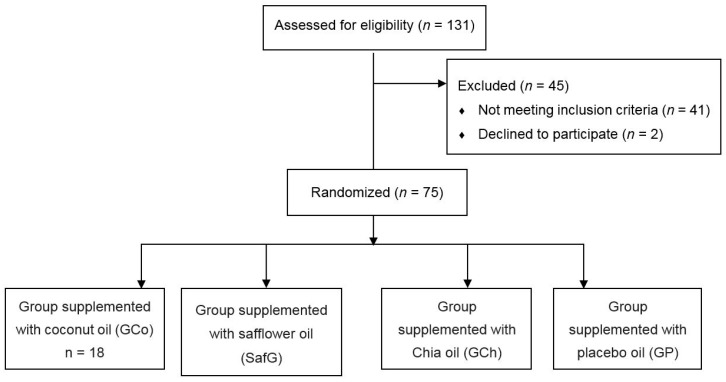
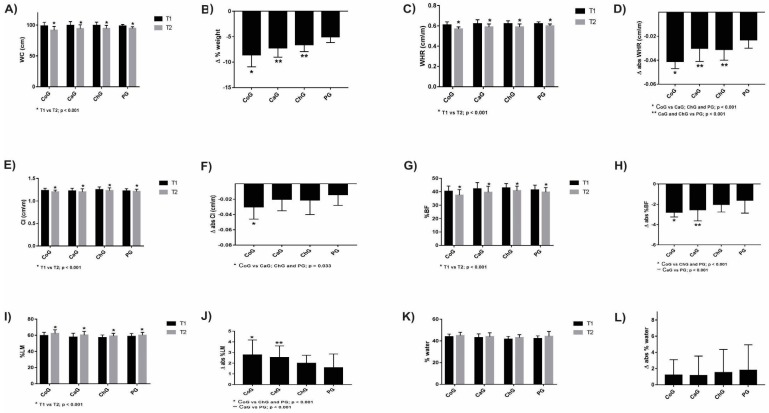
Fatty acid (FA) composition is a determinant of the physiological effects of dietary oils. This study investigated the effects of vegetable oil supplementation with different FA compositions on anthropometric and biochemical parameters in obese women on a hypocaloric diet with lifestyle modifications. Seventy-five women (body mass index, BMI, 30⁻39.9kg/m²) were randomized based on 8-week oil supplementation into four experimental groups: the coconut oil group (CoG, = 18), the safflower oil group (SafG, = 19), the chia oil group (ChG, = 19), and the soybean oil placebo group (PG, = 19). Pre- and post-supplementation weight, anthropometric parameters, and body fat (%BF), and lean mass percentages (%LM) were evaluated, along with biochemical parameters related to lipid and glycidemic profiles. In the anthropometric evaluation, the CoG showed greater weight loss (Δ% = -8.54 ± 2.38), and reduced BMI (absolute variation, Δabs = -2.86 ± 0.79), waist circumference (Δabs = -6.61 ± 0.85), waist-to-height ratio (Δabs = -0.041 ± 0.006), conicity index (Δabs = -0.03 ± 0.016), and %BF (Δabs = -2.78 ± 0.46), but increased %LM (Δabs = 2.61 ± 1.40) ( < 0.001). Moreover, the CoG showed a higher reduction in biochemical parameters of glycemia (Δabs = -24.71 ± 8.13) and glycated hemoglobin (Δabs = -0.86 ± 0.28) ( < 0.001). The ChG showed a higher reduction in cholesterol (Δabs = -45.36 ± 0.94), low-density lipoprotein cholesterol (LDLc; Δabs = -42.53 ± 22.65), and triglycerides (Δabs = -49.74 ± 26.3), but an increase in high-density lipoprotein cholesterol (HDLc; abs = 3.73 ± 1.24, = 0.007). Coconut oil had a more pronounced effect on abdominal adiposity and glycidic profile, whereas chia oil had a higher effect on improving the lipid profile. Indeed, supplementation with different fatty acid compositions resulted in specific responses.
脂肪酸(FA)组成是膳食油生理效应的决定因素。本研究旨在探讨不同 FA 组成的植物油补充对接受低热量饮食并进行生活方式改变的肥胖女性的人体测量和生化参数的影响。75 名女性(体重指数,BMI,30⁻39.9kg/m²)按 8 周油补充随机分为四个实验组:椰子油组(CoG,n=18)、红花油组(SafG,n=19)、奇亚籽油组(ChG,n=19)和大豆油安慰剂组(PG,n=19)。评估补充前后的体重、人体测量参数和体脂肪(%BF)、瘦体重百分比(%LM)以及与脂质和糖脂谱相关的生化参数。在人体测量评估中,CoG 显示出更大的体重减轻(Δ%=-8.54±2.38),BMI(绝对变化,Δabs=-2.86±0.79)、腰围(Δabs=-6.61±0.85)、腰高比(Δabs=-0.041±0.006)、肥胖指数(Δabs=-0.03±0.016)和%BF(Δabs=-2.78±0.46)下降,但%LM(Δabs=2.61±1.40)增加(<0.001)。此外,CoG 显示血糖(Δabs=-24.71±8.13)和糖化血红蛋白(Δabs=-0.86±0.28)的生化参数降低幅度更高(<0.001)。ChG 显示胆固醇(Δabs=-45.36±0.94)、低密度脂蛋白胆固醇(LDLc;Δabs=-42.53±22.65)和甘油三酯(Δabs=-49.74±26.3)降低幅度更高,但高密度脂蛋白胆固醇(HDLc;abs=3.73±1.24,=0.007)升高。椰子油对腹部肥胖和糖脂谱的影响更为明显,而奇亚籽油对改善血脂谱的影响更高。事实上,补充不同的脂肪酸组成会产生特定的反应。