Faid Fathia, Nikolic Marina, Milesevic Jelena, Zekovic Milica, Kadvan Agnes, Gurinovic Mirjana, Glibetic Marija
a Faculty of Biology , University of Belgrade , Belgrade , Serbia.
b Center of Research Excellence in Nutrition and Metabolism, Institute for Medical Research (IMR) , University of Belgrade , Belgrade , Serbia.
Libyan J Med. 2018 Dec;13(1):1502028. doi: 10.1080/19932820.2018.1502028.
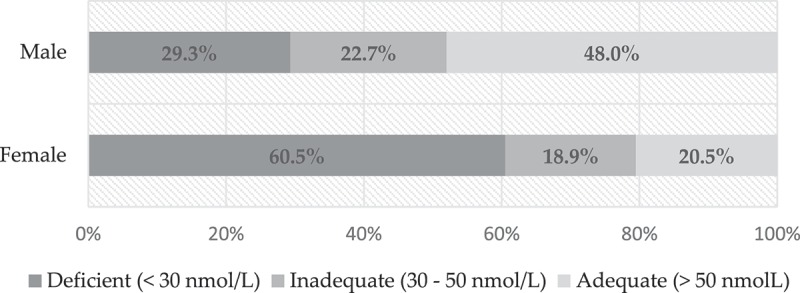
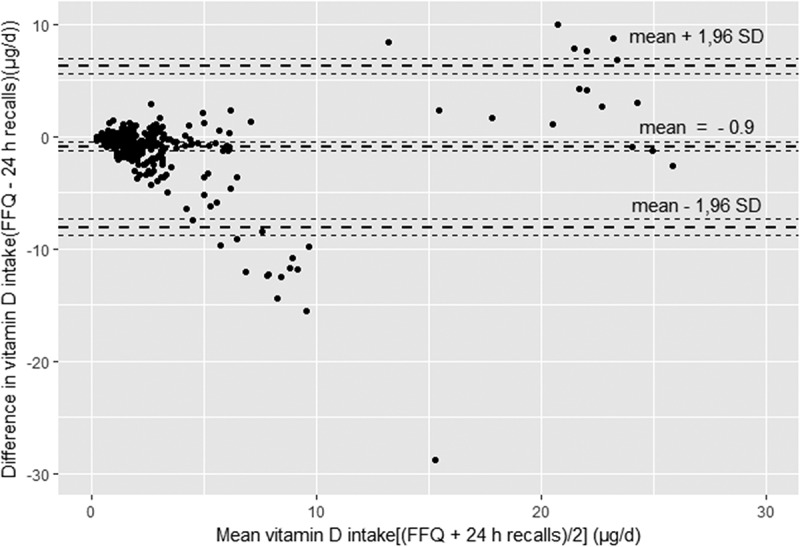
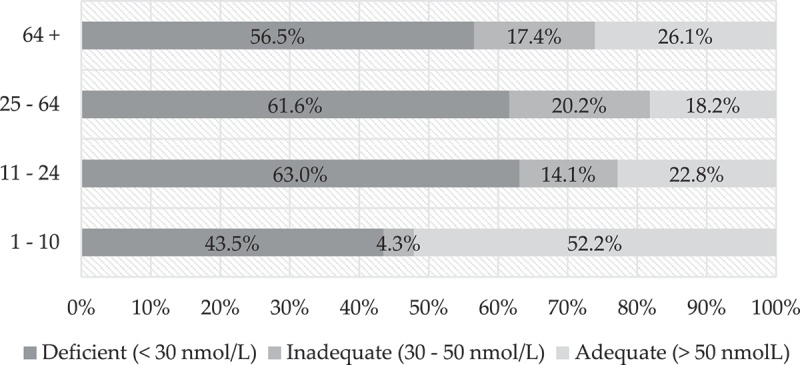
Vitamin D deficiency (VDD) has pandemic proportions worldwide. Numerous studies report on high prevalence of VDD in sunny regions like Near East and North Africa (NENA). Previous studies indicated that Libyan population was at risk of VDD. To contribute to the body of evidence, measurement of vitamin D status on children, adults, in Misurata region was conducted, and confirmed with validated dietary intake study. Serum 25(OH)D was analysed using electrochemiluminescence protein binding assay. Existing Food Frequency Questionnaires (FFQ) were adapted to Libyan Women Food Frequency Questionnaire (LW-FFQ). Repeated 24 h dietary recalls and LW-FFQ were employed in vitamin D intake evaluation. LW-FFQ was validated using 24 h dietary recall and vitamin D status as referent methods. The questionnaires included anthropometry and lifestyle information. Vitamin D status assessment revealed inadequate levels (25(OH)D < 50 nmol/l) in almost 80% of participants. Women (25-64 y) were identified as the most vulnerable group with vitamin D inadequacy present in 82% (61.6% had 25(OH)D < 25 nmol/l, and 20.2% had 25-50 nmol/l 25(OH)D). Average Vitamin D intake within the study sample (n = 316) was 3.9 ± 7.9 µg/d, with 92% participants below both Institute of Medicine (IOM) (10 µg/d) and European Food Safety Authority (15 µg/d) recommendations. Measured vitamin D status, in 13% of this group, correlated significantly (p = 0.015) with intake estimates. Based on self-report, consumption of vitamin D supplements does not exist among study participants. Additional lifestyle factors influencing vitamin D status were analysed. Only 2% of study participants spend approximately 11 min on the sun daily, 60.4% were obese, 23.1% were overweight and 71.2% reported low physical activity. These findings confirm previous reports on high prevalence of VDD in women across NENA, and in Libya. The situation calls for multi-sectoral actions and public health initiatives to address dietary and lifestyle habits.
维生素D缺乏症(VDD)在全球范围内呈流行态势。众多研究报告了近东和北非(NENA)等阳光充足地区维生素D缺乏症的高患病率。先前的研究表明,利比亚人群存在维生素D缺乏风险。为补充证据,对米苏拉塔地区的儿童和成人进行了维生素D状况测量,并通过经过验证的饮食摄入量研究加以证实。使用电化学发光蛋白结合分析法分析血清25(OH)D。现有的食物频率问卷(FFQ)被改编为利比亚妇女食物频率问卷(LW - FFQ)。采用重复的24小时饮食回忆法和LW - FFQ评估维生素D摄入量。以24小时饮食回忆法和维生素D状况作为参照方法对LW - FFQ进行验证。问卷包括人体测量学和生活方式信息。维生素D状况评估显示,近80%的参与者维生素D水平不足(25(OH)D < 50 nmol/l)。女性(25 - 64岁)被确定为最脆弱群体,82%的女性维生素D不足(61.6%的女性25(OH)D < 25 nmol/l,20.2%的女性25(OH)D为25 - 50 nmol/l)。研究样本(n = 316)中的维生素D平均摄入量为3.9 ± 7.9 μg/d,92%的参与者低于医学研究所(IOM)(10 μg/d)和欧洲食品安全局(15 μg/d)的建议值。在该群体中,13%的人测量的维生素D状况与摄入量估计值显著相关(p = 0.015)。根据自我报告,研究参与者中无人服用维生素D补充剂。分析了影响维生素D状况的其他生活方式因素。只有2%的研究参与者每天晒太阳约11分钟,60.4%的人肥胖,23.1%的人超重,71.2%的人报告身体活动水平低。这些发现证实了先前关于NENA地区及利比亚女性维生素D缺乏症高患病率的报告。这种情况需要多部门行动和公共卫生倡议来解决饮食和生活方式习惯问题。