Department of Dietetics, Faculty of Human Nutrition and Consumer Sciences, Warsaw University of Life Sciences (SGGW-WULS), 159c Nowoursynowska Str., 02-787 Warsaw, Poland.
Department of Nutrition and Dietetics, University Hospital Centre Zagreb, 12 Kišpatićeva Str., 10-000 Zagreb, Croatia.
Nutrients. 2018 Sep 10;10(9):1278. doi: 10.3390/nu10091278.
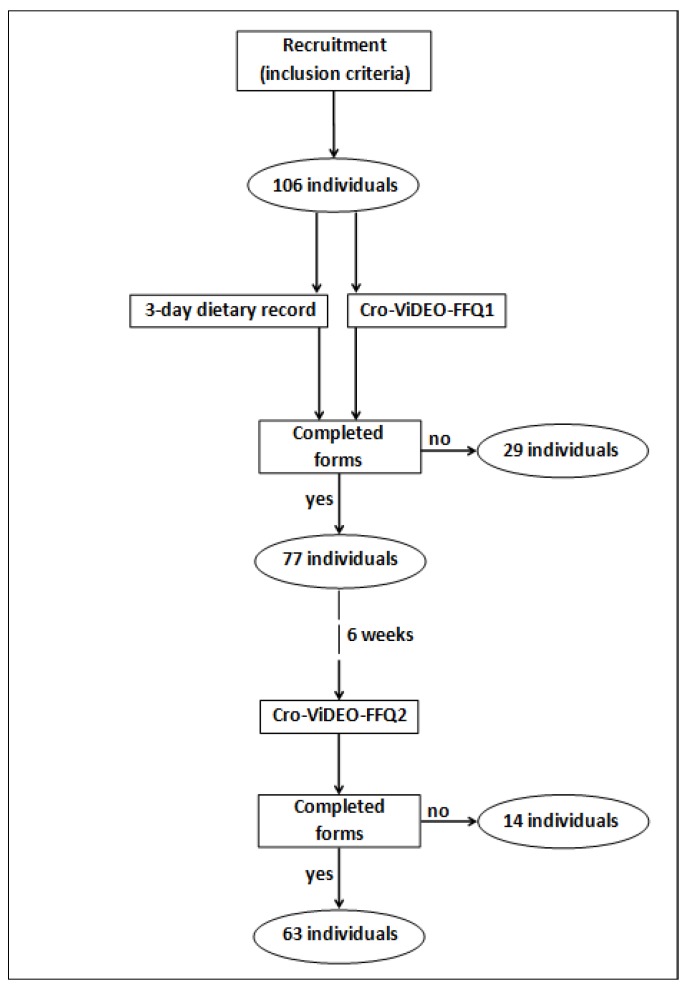
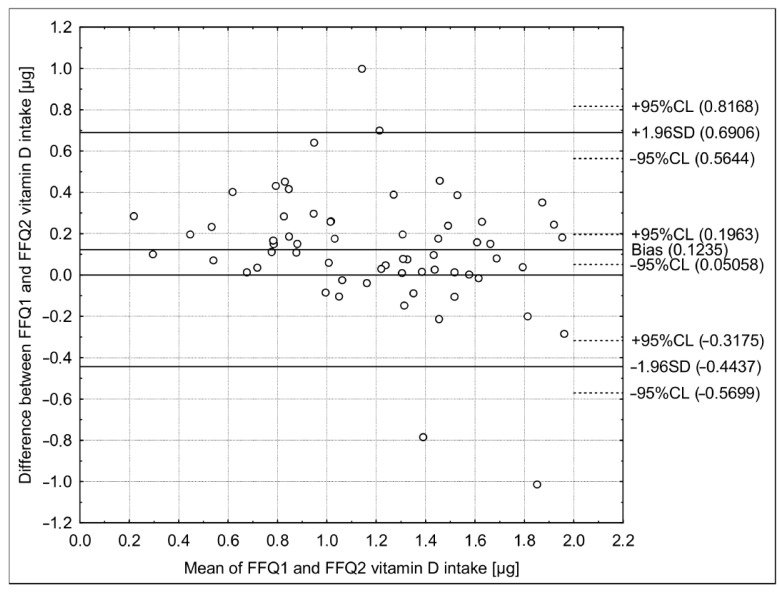
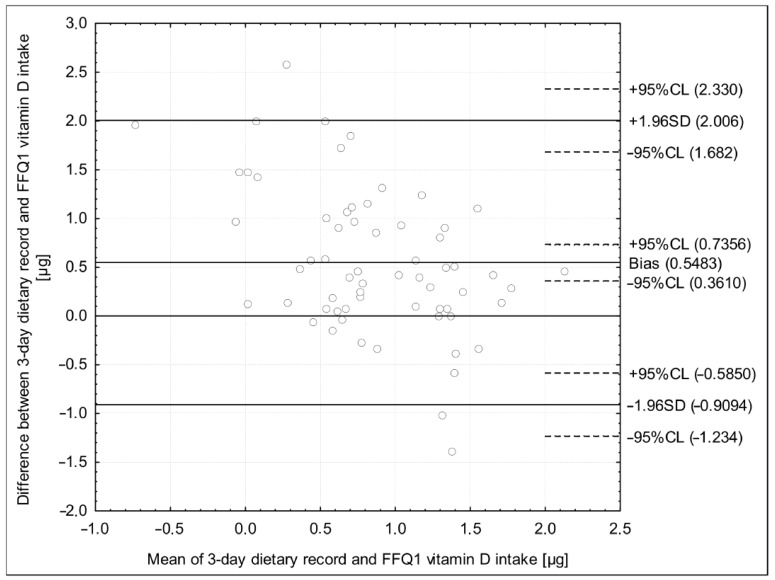
Although the role of vitamin D is well known, the possibility of assessing its intake may be constricted in countries with no vitamin D data in food composition tables, as in the case of Croatia. The aim of the presented study was to adjust the VIDEO-FFQ (Vitamin D Estimation Only-Food Frequency Questionnaire), previously validated in Poland, to the Croatian population and to assess the validity and reproducibility of the adjusted Cro-VIDEO-FFQ (Croatian-VIDEO-FFQ). The study involved a group of Croatian women aged 20⁻30 and the Polish questionnaire was adjusted for a population due to similarities of the nutritional habits between countries. 106 individuals were recruited and 63 completed all the stages of the study. Participants conducted a 3-day dietary record and filled out the Cro-VIDEO-FFQ1 (first stage), as well as the same questionnaire (Cro-VIDEO-FFQ2) 6 weeks after (second stage). The following vitamin D intakes were observed in the studied group: 1.9 µg (0.2⁻8.0 µg) for 3-day dietary record, 3.3 µg (1.1⁻10.6 µg) for Cro-VIDEO-FFQ1, 3.6 µg (1.4⁻7.8 µg) for Cro-VIDEO-FFQ2. The Bland-Altman indexes in assessment of validity and reproducibility were 4.8% and 6.3%, respectively, with mean differences of 0.55 µg and 0.12 µg, as well as limits of agreement -0.91⁻2.01 µg and -0.44⁻0.69 µg. The kappa coefficient indicated a fair agreement for validity (0.21) and substantial for reproducibility (0.62), while correlations were significant ( = 0.0027, = 0.37 for validity; < 0.0001, = 0.80 for reproducibility). It was observed that VIDEO-FFQ may be adjusted as a simple tool to assess vitamin D intake in a population with no vitamin D data in food composition tables, while Cro-VIDEO-FFQ may be a valid tool for nutritional assessment in Croatia.
虽然维生素 D 的作用众所周知,但在像克罗地亚这样的国家,由于食品成分表中没有维生素 D 数据,评估其摄入量的可能性可能会受到限制。本研究的目的是调整先前在波兰验证过的 VIDEO-FFQ(仅评估维生素 D 的食物频率问卷),使其适用于克罗地亚人群,并评估调整后的 Cro-VIDEO-FFQ(克罗地亚-VIDEO-FFQ)的有效性和可重复性。该研究涉及一组年龄在 20-30 岁的克罗地亚女性,由于两国的营养习惯相似,因此对波兰问卷进行了调整,以适应当地人群。共招募了 106 名参与者,其中 63 名完成了所有研究阶段。参与者进行了为期 3 天的饮食记录,并填写了 Cro-VIDEO-FFQ1(第一阶段),以及 6 周后相同的问卷(Cro-VIDEO-FFQ2)(第二阶段)。在所研究的人群中观察到以下维生素 D 摄入量:3 天饮食记录为 1.9 µg(0.2-8.0 µg),Cro-VIDEO-FFQ1 为 3.3 µg(1.1-10.6 µg),Cro-VIDEO-FFQ2 为 3.6 µg(1.4-7.8 µg)。评估有效性和可重复性的 Bland-Altman 指数分别为 4.8%和 6.3%,平均差异分别为 0.55 µg 和 0.12 µg,以及协议界限-0.91-2.01 µg 和-0.44-0.69 µg。kappa 系数表明有效性的一致性为一般(0.21),可重复性的一致性为强(0.62),而相关性具有统计学意义(=0.0027,=0.37 用于有效性;<0.0001,=0.80 用于可重复性)。结果表明,VIDEO-FFQ 可以作为一种简单的工具来评估没有维生素 D 数据的人群的维生素 D 摄入量,而 Cro-VIDEO-FFQ 可能是评估克罗地亚人群营养状况的有效工具。