College of Health and Behavioural Sciences, Bangor University, Bangor, Gwynedd, UNITED KINGDOM.
Department of Nutrition and Health Care Management, Appalachian State University, Boone, NC.
Med Sci Sports Exerc. 2018 Dec;50(12):2555-2564. doi: 10.1249/MSS.0000000000001721.
To determine the relationship between vitamin D status and exercise performance in a large, prospective cohort study of young men and women across seasons (study 1). Then, in a randomized, placebo-controlled trial, to investigate the effects on exercise performance of achieving vitamin D sufficiency (serum 25(OH)D ≥ 50 nmol·L) by a unique comparison of safe, simulated-sunlight and oral vitamin D3 supplementation in wintertime (study 2).
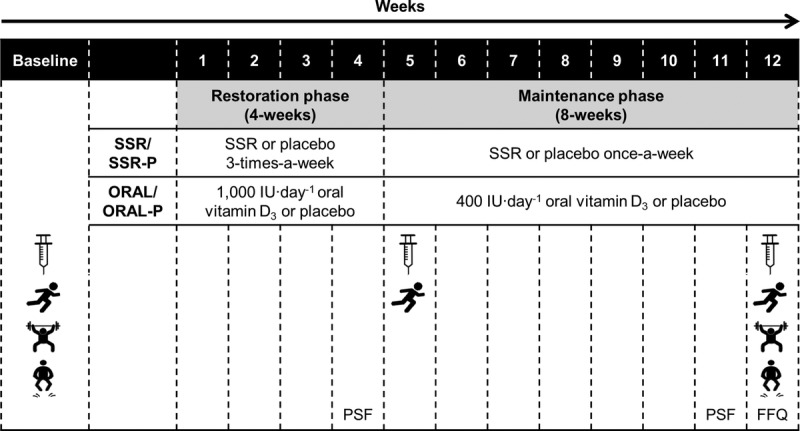
In study 1, we determined 25(OH)D relationship with exercise performance in 967 military recruits. In study 2, 137 men received either placebo, simulated sunlight (1.3× standard erythemal dose in T-shirt and shorts, three times per week for 4 wk and then once per week for 8 wk) or oral vitamin D3 (1000 IU·d for 4 wk and then 400 IU·d for 8 wk). We measured serum 25(OH)D by high-pressure liquid chromatography tandem mass spectrometry and endurance, strength and power by 1.5-mile run, maximum dynamic lift and vertical jump, respectively.
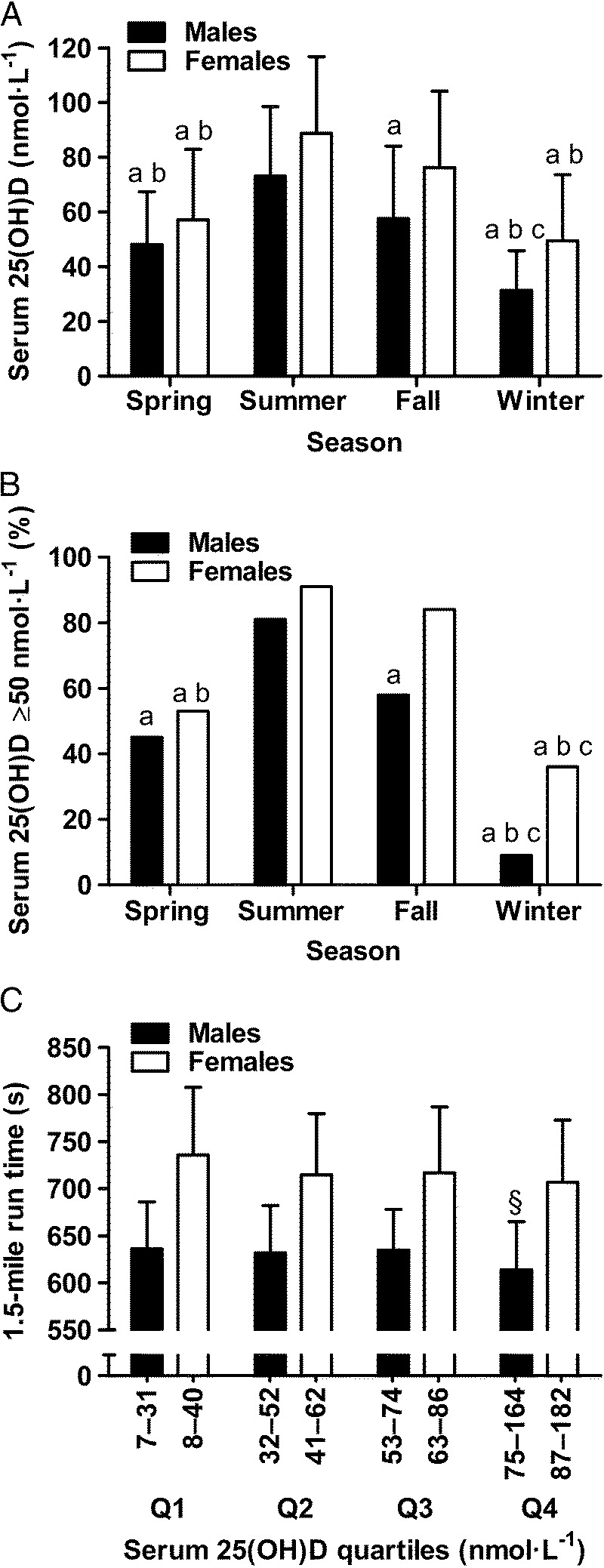
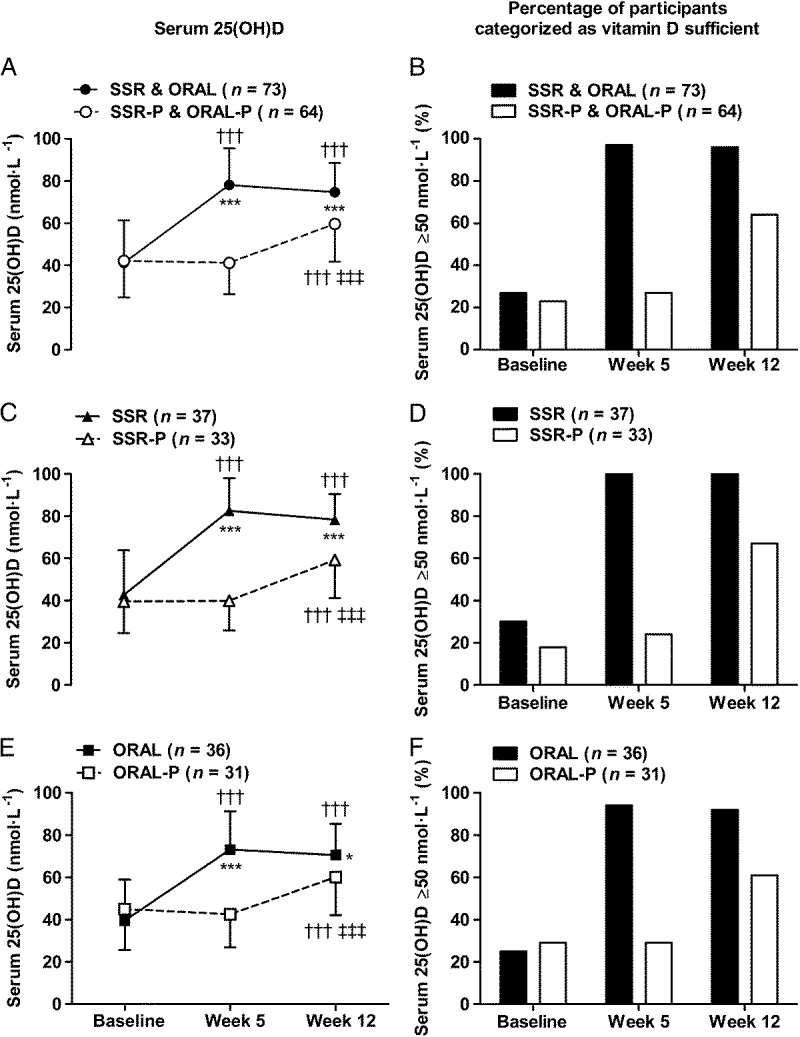
In study 1, only 9% of men and 36% of women were vitamin D sufficient during wintertime. After controlling for body composition, smoking, and season, 25(OH)D was positively associated with endurance performance (P ≤ 0.01, ΔR = 0.03-0.06, small f effect sizes): 1.5-mile run time was ~half a second faster for every 1 nmol·L increase in 25(OH)D. No significant effects on strength or power emerged (P > 0.05). In study 2, safe simulated sunlight and oral vitamin D3 supplementation were similarly effective in achieving vitamin D sufficiency in almost all (97%); however, this did not improve exercise performance (P > 0.05).
Vitamin D status was associated with endurance performance but not strength or power in a prospective cohort study. Achieving vitamin D sufficiency via safe, simulated summer sunlight, or oral vitamin D3 supplementation did not improve exercise performance in a randomized-controlled trial.
在一项跨越季节的大型青年男女前瞻性队列研究中,确定维生素 D 状态与运动表现之间的关系(研究 1)。然后,在一项随机、安慰剂对照试验中,通过比较安全的模拟阳光和口服维生素 D3 补充剂在冬季达到维生素 D 充足(血清 25(OH)D≥50nmol·L)对运动表现的影响(研究 2)。
在研究 1 中,我们确定了 967 名新兵中 25(OH)D 与运动表现的关系。在研究 2 中,137 名男性接受了安慰剂、模拟阳光(在 T 恤和短裤中接受 1.3×标准红斑剂量,每周 3 次,持续 4 周,然后每周 1 次,持续 8 周)或口服维生素 D3(4 周 1000IU·d,然后 8 周 400IU·d)。我们通过高压液相色谱串联质谱法测量血清 25(OH)D,通过 1.5 英里跑、最大动态提升和垂直跳跃分别测量耐力、力量和功率。
在研究 1 中,只有 9%的男性和 36%的女性在冬季维生素 D 充足。在控制身体成分、吸烟和季节后,25(OH)D 与耐力表现呈正相关(P≤0.01,ΔR=0.03-0.06,小 f 效应大小):25(OH)D 每增加 1nmol·L,1.5 英里跑时间快半秒。对力量或功率没有显著影响(P>0.05)。在研究 2 中,安全的模拟阳光和口服维生素 D3 补充剂在几乎所有(97%)方面同样有效实现维生素 D 充足,但这并没有改善运动表现(P>0.05)。
在一项前瞻性队列研究中,维生素 D 状态与耐力表现相关,但与力量或功率无关。通过安全的模拟夏季阳光或口服维生素 D3 补充剂达到维生素 D 充足状态,在随机对照试验中并没有改善运动表现。