Laboratório de Transmissores de Hematozoários, Instituto Oswaldo Cruz, Fiocruz, Rio de Janeiro, RJ, Brazil.
Laboratório de Imunologia Viral, Instituto Oswaldo Cruz, Fiocruz, Rio de Janeiro, RJ, Brazil.
PLoS One. 2018 Jul 26;13(7):e0200766. doi: 10.1371/journal.pone.0200766. eCollection 2018.
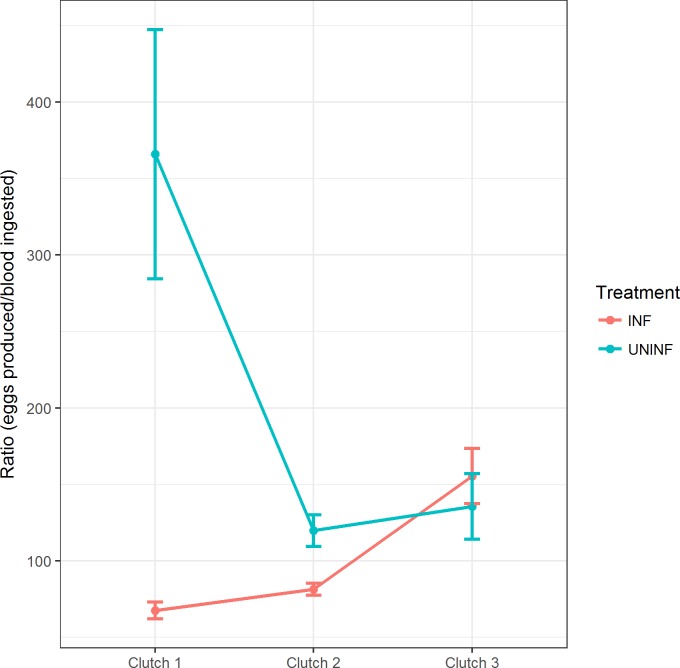
The impact of senescence and pathogen infection on Aedes aegypti life-history traits remains poorly understood. This laboratory study focused on the impact of Zika virus (ZIKV) infection and the age of first blood intake on blood meal and clutch sizes, and more importantly on the egg production ratio per μL of blood. Three groups of ZIKV-infected and uninfected Ae. aegypti females that received their first blood meal at 7 (young feeders), 14 (mature feeders) and 21 days old (old feeders) were monitored daily for survival and received a blood meal free of ZIKV once a week. The number of eggs laid per female were registered 3-4 days after blood feeding. Infection by ZIKV and age of feeding produced a strong negative impact on survival and oviposition success (e.g. likelihood of laying at least one egg per gonotrophic cycle). Interestingly, clutch size presented a dramatic reduction on uninfected mosquitoes, but raised from 36.5 in clutch1 to 55.1 eggs in clutch 3. Blood meal size remained stable in uninfected females, while a slight increase was observed for the infected counterparts. In uninfected Ae. aegypti, egg production was strongly affected by the age of feeding with younger females laying three times more eggs than when older. On the other hand, ZIKV-infected mosquitoes had a constant but low egg production. Overall, mosquito senescence and ZIKV infection had an impact on mosquito egg production by causing a sharp decrease in the number of eggs along the clutches for uninfected mosquitoes and a slight increase for infected mosquitoes. Despite some study limitations, our results contribute to a better understanding of the effects of mosquito aging and pathogen infection on the vectorial capacity of Ae. aegypti.
衰老和病原体感染对埃及伊蚊生活史特征的影响仍知之甚少。本实验室研究重点关注寨卡病毒(ZIKV)感染和首次吸血年龄对血餐和卵包大小的影响,更重要的是,关注每微升血液的产卵率。三组感染和未感染寨卡病毒的埃及伊蚊雌性,在 7 天(幼龄饲养者)、14 天(成熟饲养者)和 21 天(老龄饲养者)龄首次接受血餐,每天监测其生存情况,并每周接受一次不含寨卡病毒的血餐。在血餐 3-4 天后记录每只雌蚊产卵数。ZIKV 感染和摄食年龄对生存和产卵成功率(例如,每个生殖周期至少产卵一次的可能性)产生了强烈的负面影响。有趣的是,未感染的蚊子中,卵包大小显著减小,但从第 1 卵包的 36.5 个卵增加到第 3 卵包的 55.1 个卵。未感染雌性的血餐大小保持稳定,而感染雌性的血餐大小略有增加。在未感染的埃及伊蚊中,摄食年龄对产卵有强烈影响,年轻的雌性产卵量是年长雌性的三倍。另一方面,感染 ZIKV 的蚊子产卵量保持稳定,但较低。总体而言,蚊子衰老和 ZIKV 感染对蚊子产卵产生了影响,未感染蚊子的卵包数量急剧减少,而感染蚊子的卵包数量略有增加。尽管存在一些研究限制,但我们的结果有助于更好地理解蚊子衰老和病原体感染对埃及伊蚊媒介能力的影响。