Department of Community Medicine, University of Ruhuna, Ruhuna, Sri Lanka.
Department of Psychiatry & Neuropsychology, School for Mental Health and Neuroscience, Maastricht University, Maastricht, The Netherlands.
J Trauma Stress. 2018 Aug;31(4):487-498. doi: 10.1002/jts.22311. Epub 2018 Jul 30.
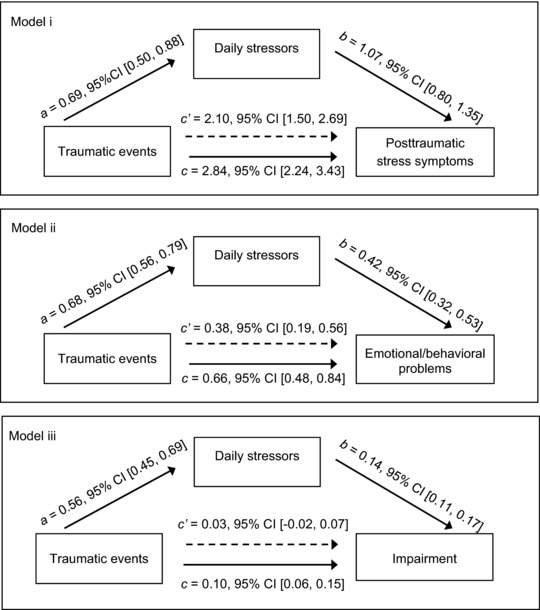
Prior trauma, current stress, and poor social support contribute to youth mental health problems. As daily stressors often increase in the aftermath of traumatic events, trauma could plausibly impact psychopathology not only directly but also indirectly via ongoing stress. In this study, we examined the relative roles of trauma and daily stressors in mental health outcomes in 753 Sri Lankan adolescents residing in areas impacted by the 2004 tsunami. In 2008, participants completed measures of trauma exposure, daily stressors, social support, posttraumatic stress symptoms (PTSS), emotional and behavioral problems (EBP), and functional impairment; a subsample (n = 89) repeated these assessments 16 months later. Regression models revealed positive associations between cumulative trauma and all three mental health measures. Significant variance in these associations could be explained indirectly, via daily stressors. For PTSS, the indirect effect accounted for 26.1% of the total effect of trauma, unstandardized coefficient ab = 0. 739, 95% CI [0.459, 1.122]. For EBP this percentage was 42.4%, ab = 0.287, 95% CI [0.189, 0. 404], and for functional impairment 70.0%, ab = 0.072, 95% CI [0.049, 0.121]. Indirect effects on impairment were strongest when perceived social support was low. Although we also present evidence that pathways between stressors and psychopathology may have been bidirectional, findings support the notion that adolescents' daily stressors are important transmitters of the impact of traumatic events and highlight the need for interventions focused not only on trauma processing but also on reducing current stress and improving social support.
先前的创伤、当前的压力和不良的社会支持都会导致青少年的心理健康问题。由于创伤后日常压力源通常会增加,因此创伤不仅可能直接影响精神病理学,还可能通过持续的压力间接影响精神病理学。在这项研究中,我们研究了创伤和日常压力源在 753 名居住在受 2004 年海啸影响地区的斯里兰卡青少年心理健康结果中的相对作用。2008 年,参与者完成了创伤暴露、日常压力源、社会支持、创伤后应激症状 (PTSS)、情绪和行为问题 (EBP) 和功能障碍的测量;一个子样本(n = 89)在 16 个月后重复了这些评估。回归模型显示,累积创伤与所有三种心理健康指标之间存在正相关。通过日常压力源,这些关联的显著差异可以间接解释。对于 PTSD,间接效应占创伤总效应的 26.1%,未标准化系数 ab = 0.739,95%置信区间 [0.459, 1.122]。对于 EBP,这一百分比为 42.4%,ab = 0.287,95%置信区间 [0.189, 0.404],对于功能障碍为 70.0%,ab = 0.072,95%置信区间 [0.049, 0.121]。当感知社会支持较低时,对障碍的间接影响最强。尽管我们也提供了证据表明压力源和精神病理学之间的途径可能是双向的,但研究结果支持这样一种观点,即青少年的日常压力源是创伤事件影响的重要传递者,并强调需要关注不仅是创伤处理,还要减少当前压力和提高社会支持的干预措施。