Barrera Giuseppina, Pizzimenti Stefania, Daga Martina, Dianzani Chiara, Arcaro Alessia, Cetrangolo Giovanni Paolo, Giordano Giulio, Cucci Marie Angele, Graf Maria, Gentile Fabrizio
Dipartimento di Scienze Cliniche e Biologiche, Università di Torino, 10124 Turin, Italy.
Dipartimento di Scienze e Tecnologia del Farmaco, Università di Torino, 10124 Turin, Italy.
Antioxidants (Basel). 2018 Jul 30;7(8):102. doi: 10.3390/antiox7080102.
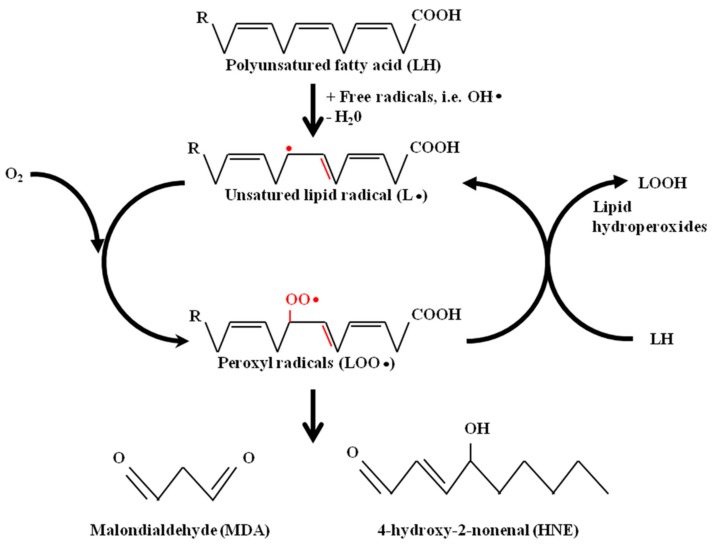
Among the various mechanisms involved in aging, it was proposed long ago that a prominent role is played by oxidative stress. A major way by which the latter can provoke structural damage to biological macromolecules, such as DNA, lipids, and proteins, is by fueling the peroxidation of membrane lipids, leading to the production of several reactive aldehydes. Lipid peroxidation-derived aldehydes can not only modify biological macromolecules, by forming covalent electrophilic addition products with them, but also act as second messengers of oxidative stress, having relatively extended lifespans. Their effects might be further enhanced with aging, as their concentrations in cells and biological fluids increase with age. Since the involvement and the role of lipid peroxidation-derived aldehydes, particularly of 4-hydroxynonenal (HNE), in neurodegenerations, inflammation, and cancer, has been discussed in several excellent recent reviews, in the present one we focus on the involvement of reactive aldehydes in other age-related disorders: osteopenia, sarcopenia, immunosenescence and myelodysplastic syndromes. In these aging-related disorders, characterized by increases of oxidative stress, both HNE and malondialdehyde (MDA) play important pathogenic roles. These aldehydes, and HNE in particular, can form adducts with circulating or cellular proteins of critical functional importance, such as the proteins involved in apoptosis in muscle cells, thus leading to their functional decay and acceleration of their molecular turnover and functionality. We suggest that a major fraction of the toxic effects observed in age-related disorders could depend on the formation of aldehyde-protein adducts. New redox proteomic approaches, pinpointing the modifications of distinct cell proteins by the aldehydes generated in the course of oxidative stress, should be extended to these age-associated disorders, to pave the way to targeted therapeutic strategies, aiming to alleviate the burden of morbidity and mortality associated with these disturbances.
在衰老涉及的各种机制中,早在很久以前就有人提出氧化应激起着重要作用。氧化应激引发对生物大分子(如DNA、脂质和蛋白质)结构损伤的主要方式是促使膜脂过氧化,从而产生多种反应性醛类。脂质过氧化衍生的醛类不仅可以通过与生物大分子形成共价亲电加成产物来修饰它们,还可以作为氧化应激的第二信使,具有相对较长的寿命。随着年龄的增长,它们的浓度在细胞和生物体液中升高,其影响可能会进一步增强。由于脂质过氧化衍生醛类,特别是4-羟基壬烯醛(HNE)在神经退行性疾病、炎症和癌症中的参与情况及作用,在最近几篇优秀综述中已有讨论,因此在本综述中,我们将重点关注反应性醛类在其他与年龄相关的疾病中的作用:骨质减少、肌肉减少症、免疫衰老和骨髓增生异常综合征。在这些以氧化应激增加为特征的与衰老相关的疾病中,HNE和丙二醛(MDA)都起着重要的致病作用。这些醛类,尤其是HNE,可以与具有关键功能重要性的循环或细胞蛋白质形成加合物,如参与肌肉细胞凋亡的蛋白质,从而导致其功能衰退,并加速其分子更新和功能丧失。我们认为,在与年龄相关的疾病中观察到的大部分毒性作用可能取决于醛-蛋白质加合物的形成。新的氧化还原蛋白质组学方法,可精确确定氧化应激过程中产生的醛类对不同细胞蛋白质的修饰,应扩展到这些与年龄相关的疾病中,为靶向治疗策略铺平道路,旨在减轻与这些疾病相关的发病和死亡负担。