Department of General Internal Medicine, University of Pittsburgh Medical Center, Pittsburgh, Pennsylvania, United States of America.
Department of Engineering and Public Policy and Institute for Politics and Strategy, Carnegie Mellon University, Pittsburgh, Pennsylvania, United States of America.
PLoS One. 2018 Jul 31;13(7):e0201093. doi: 10.1371/journal.pone.0201093. eCollection 2018.
The PROMIS-Preference (PROPr) score is a recently developed summary score for the Patient-Reported Outcomes Measurement Information System (PROMIS). PROPr is a preference-based scoring system for seven PROMIS domains created using multiplicative multi-attribute utility theory. It serves as a generic, societal, preference-based summary scoring system of health-related quality of life. This manuscript evaluates construct validity of PROPr in two large samples from the US general population.
We utilized 2 online panel surveys, the PROPr Estimation Survey and the Profiles-Health Utilities Index (HUI) Survey. Both included the PROPr measure, patient demographic information, self-reported chronic conditions, and other preference-based summary scores: the EuroQol-5D (EQ-5D-5L) and HUI in the PROPr Estimation Survey and the HUI in the Profiles-HUI Survey. The HUI was scored as both the Mark 2 and the Mark 3. Known-groups validity was evaluated using age- and gender-stratified mean scores and health condition impact estimates. Condition impact estimates were created using ordinary least squares regression in which a summary score was regressed on age, gender, and a single health condition. The coefficient for the health condition is the estimated effect on the preference score of having a condition vs. not having it. Convergent validity was evaluated using Pearson correlations between PROPr and other summary scores.
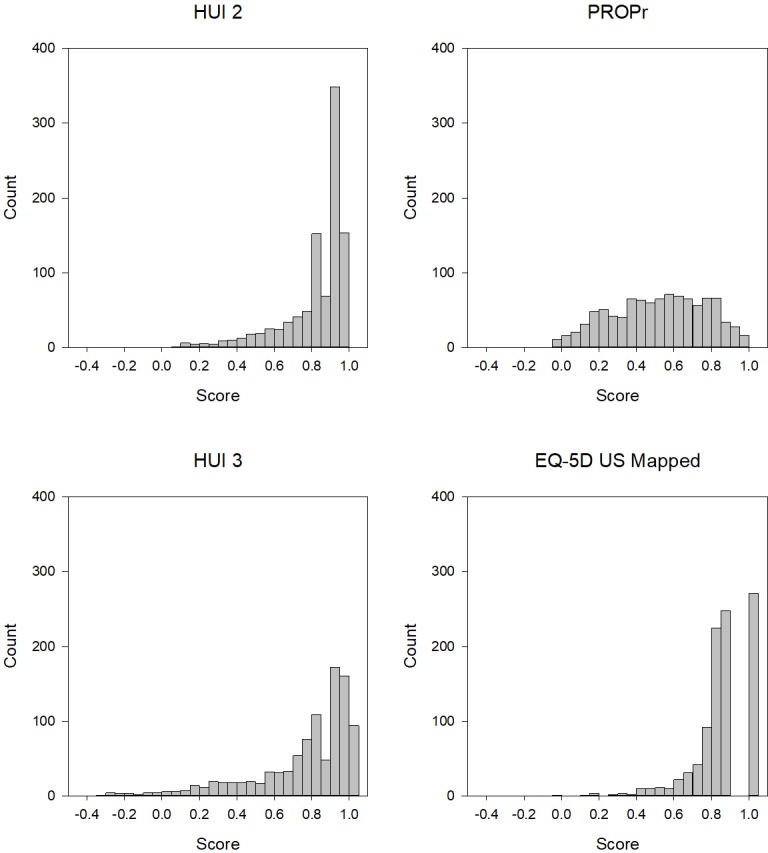
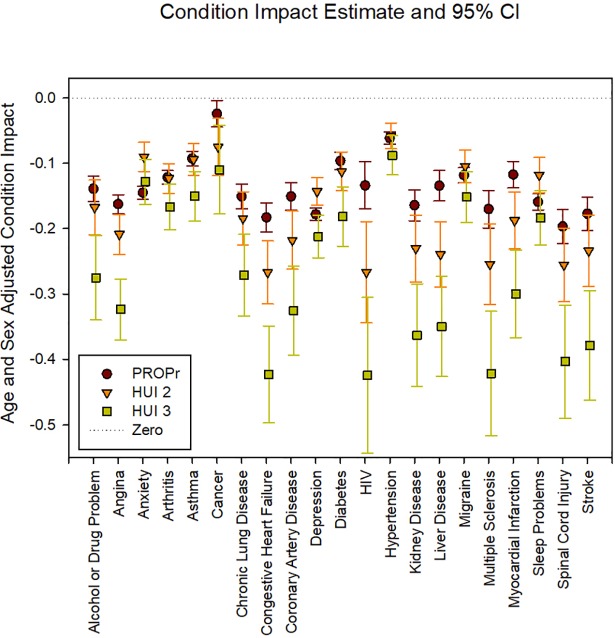
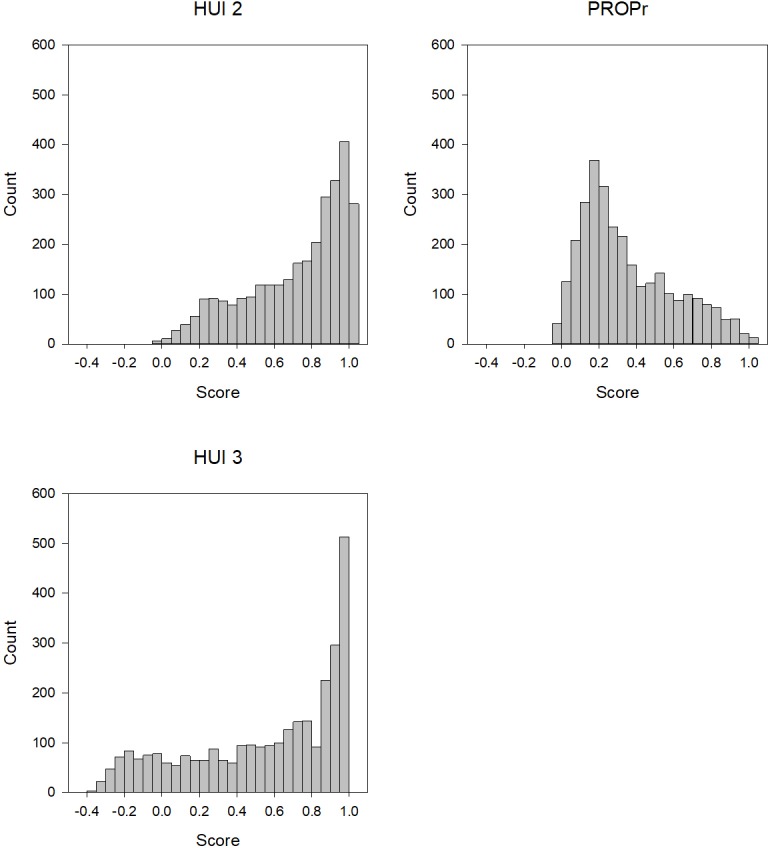
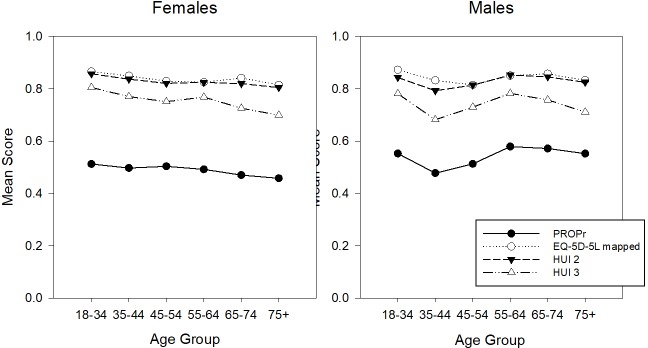
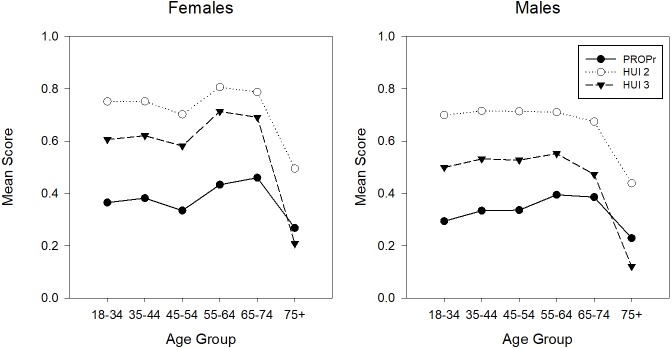
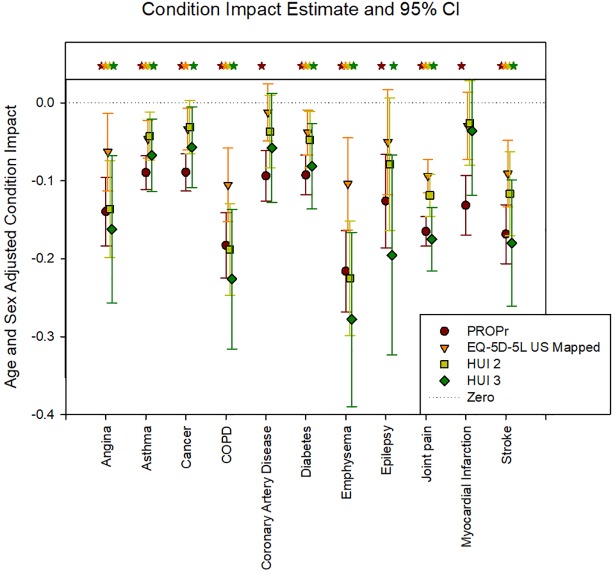
The sample consisted of 983 respondents from the PROPr Estimation Survey and 3,000 from the Profiles-HUI survey. Age- and gender-stratified mean PROPr scores were lower than EQ-5D and HUI scores, with fewer subjects having scores corresponding to perfect health on the PROPr. In the PROPr Estimation survey, all 11 condition impact estimates were statistically significant using PROPr, 8 were statistically significant by the EQ-5D, 7 were statistically significant by HUI Mark 2, and 9 were statistically significant by HUI Mark 3. In the Profiles-HUI survey, all 21 condition impact estimates were statistically significant using summary scores from all three scoring systems. In these samples, the correlations between PROPr and the other summary measures ranged from 0.67 to 0.70.
These results provide evidence of construct validity for PROPr using samples from the US general population.
PROMIS-偏好(PROPr)评分是一种新开发的患者报告结果测量信息系统(PROMIS)综合评分。PROPr 是一种基于乘法多属性效用理论的七个 PROMIS 领域的偏好评分系统。它是一种通用的、基于社会的、基于偏好的健康相关生活质量综合评分系统。本文利用来自美国普通人群的两个大型样本评估了 PROPr 的结构效度。
我们利用了 2 个在线面板调查,即 PROPr 估计调查和概况-健康效用指数(HUI)调查。这两个调查都包含了 PROPr 量表、患者人口统计学信息、自我报告的慢性疾病和其他偏好综合评分:欧洲五维健康量表(EQ-5D-5L)和 HUI 在 PROPr 估计调查中,HUI 在概况-HUI 调查中。HUI 分别被评为 Mark 2 和 Mark 3。采用年龄和性别分层均值评分和健康状况影响估计值来评估已知组别的有效性。通过普通最小二乘回归,将综合评分与年龄、性别和单一健康状况进行回归,从而创建状况影响估计值。健康状况的系数是存在健康状况与不存在健康状况对偏好评分的估计影响。采用 PROPr 与其他综合评分之间的 Pearson 相关来评估聚合效度。
样本包括来自 PROPr 估计调查的 983 名受访者和来自概况-HUI 调查的 3000 名受访者。年龄和性别分层的 PROPr 评分低于 EQ-5D 和 HUI 评分,较少的受试者的 PROPr 评分对应于完全健康。在 PROPr 估计调查中,所有 11 个状况影响估计值使用 PROPr 均具有统计学意义,8 个使用 EQ-5D 具有统计学意义,7 个使用 HUI Mark 2 具有统计学意义,9 个使用 HUI Mark 3 具有统计学意义。在概况-HUI 调查中,使用来自所有三个评分系统的综合评分,所有 21 个状况影响估计值均具有统计学意义。在这些样本中,PROPr 与其他综合测量指标之间的相关性范围为 0.67 至 0.70。
这些结果提供了使用来自美国普通人群的样本对 PROPr 的结构有效性的证据。